Department of Molecular Evolution, Cell and Molecular Biology, Science for Life Laboratory, Biomedical Centre, Uppsala University, Uppsala, Sweden.
PLoS Genet. 2013 Apr;9(4):e1003381. doi: 10.1371/journal.pgen.1003381. Epub 2013 Apr 4.
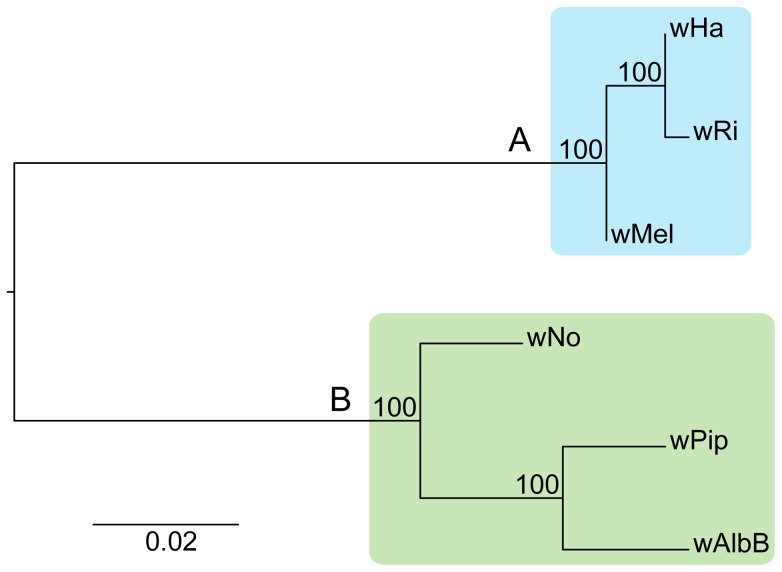
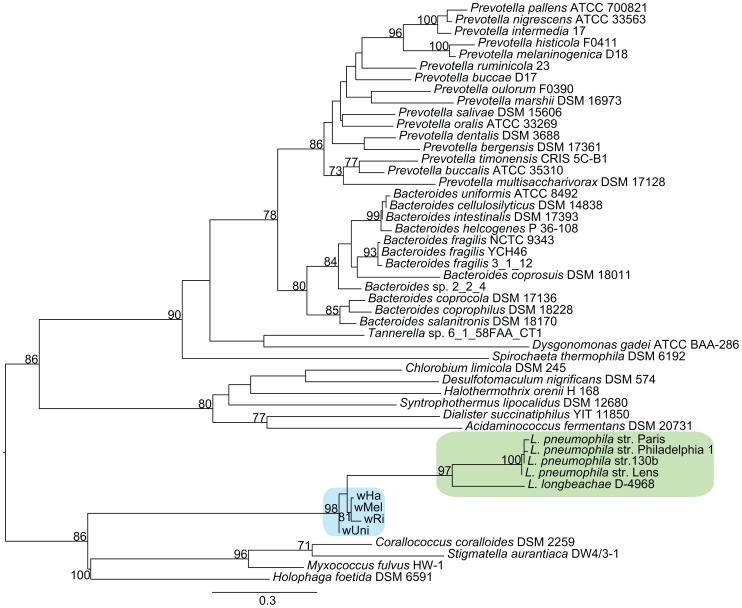
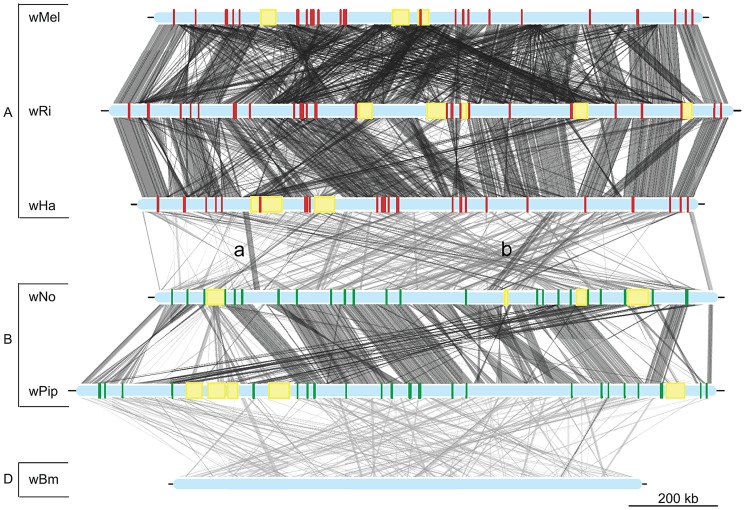
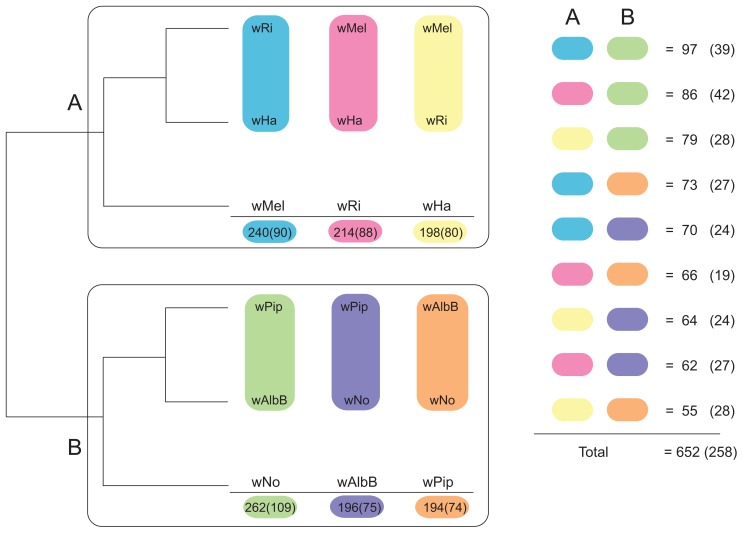
The importance of host-specialization to speciation processes in obligate host-associated bacteria is well known, as is also the ability of recombination to generate cohesion in bacterial populations. However, whether divergent strains of highly recombining intracellular bacteria, such as Wolbachia, can maintain their genetic distinctness when infecting the same host is not known. We first developed a protocol for the genome sequencing of uncultivable endosymbionts. Using this method, we have sequenced the complete genomes of the Wolbachia strains wHa and wNo, which occur as natural double infections in Drosophila simulans populations on the Seychelles and in New Caledonia. Taxonomically, wHa belong to supergroup A and wNo to supergroup B. A comparative genomics study including additional strains supported the supergroup classification scheme and revealed 24 and 33 group-specific genes, putatively involved in host-adaptation processes. Recombination frequencies were high for strains of the same supergroup despite different host-preference patterns, leading to genomic cohesion. The inferred recombination fragments for strains of different supergroups were of short sizes, and the genomes of the co-infecting Wolbachia strains wHa and wNo were not more similar to each other and did not share more genes than other A- and B-group strains that infect different hosts. We conclude that Wolbachia strains of supergroup A and B represent genetically distinct clades, and that strains of different supergroups can co-exist in the same arthropod host without converging into the same species. This suggests that the supergroups are irreversibly separated and that barriers other than host-specialization are able to maintain distinct clades in recombining endosymbiont populations. Acquiring a good knowledge of the barriers to genetic exchange in Wolbachia will advance our understanding of how endosymbiont communities are constructed from vertically and horizontally transmitted genes.
专性寄生菌的宿主特化对物种形成过程非常重要,重组产生细菌群体内聚的能力也是如此。然而,当感染同一宿主时,高度重组的内共生细菌(如沃尔巴克氏体)的分歧菌株是否能够保持其遗传独特性尚不清楚。我们首先开发了一种用于不可培养共生体基因组测序的方案。使用该方法,我们对存在于塞舌尔和新喀里多尼亚的果蝇 simulans 种群中的自然双重感染的沃尔巴克氏体菌株 wHa 和 wNo 的完整基因组进行了测序。从分类学上看,wHa 属于 A 超组,wNo 属于 B 超组。包括额外菌株的比较基因组学研究支持了超组分类方案,并揭示了 24 个和 33 个群体特异性基因,推测这些基因参与了宿主适应过程。尽管宿主偏好模式不同,但同一超组的菌株之间的重组频率很高,导致基因组内聚。不同超组菌株的推断重组片段长度较短,并且共同感染的沃尔巴克氏体菌株 wHa 和 wNo 的基因组彼此之间并不比感染不同宿主的其他 A 组和 B 组菌株更相似,也没有共享更多基因。我们得出结论,A 超组和 B 超组的沃尔巴克氏体菌株代表遗传上不同的分支,不同超组的菌株可以在同一节肢动物宿主中共存,而不会趋同成为同一物种。这表明超组是不可逆转分离的,除了宿主特化之外,其他障碍能够维持重组共生体种群中的不同分支。充分了解沃尔巴克氏体中遗传交换的障碍将有助于我们理解共生体群落如何由垂直和水平传播的基因构建。