Grupo Obesidómica, Laboratorio de Endocrinología Molecular y Celular, Instituto de Investigación Sanitaria de Santiago de Compostela (IDIS), Complexo Hospitalario Universitario de Santiago (CHUS/SERGAS), Santiago de Compostela, Spain.
PLoS One. 2013 Apr 11;8(4):e60563. doi: 10.1371/journal.pone.0060563. Print 2013.
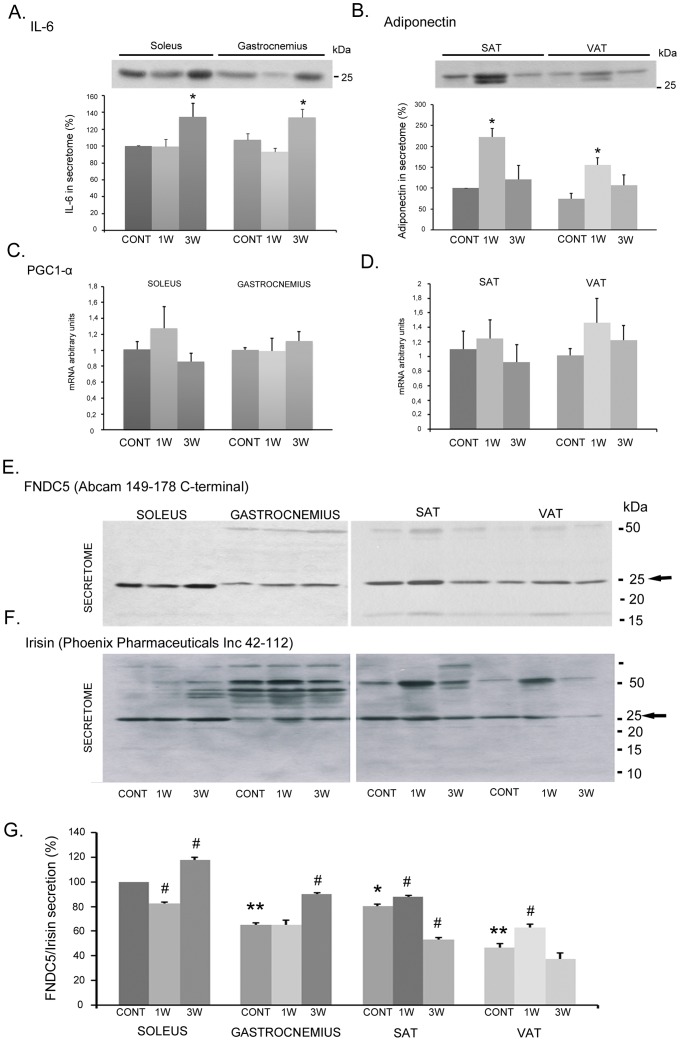
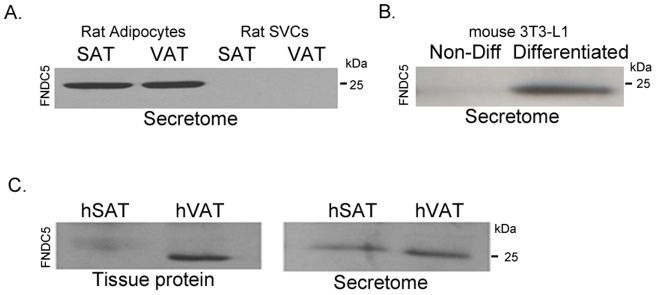
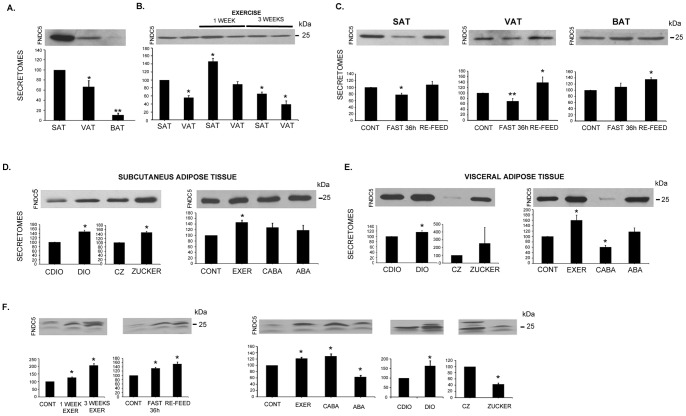
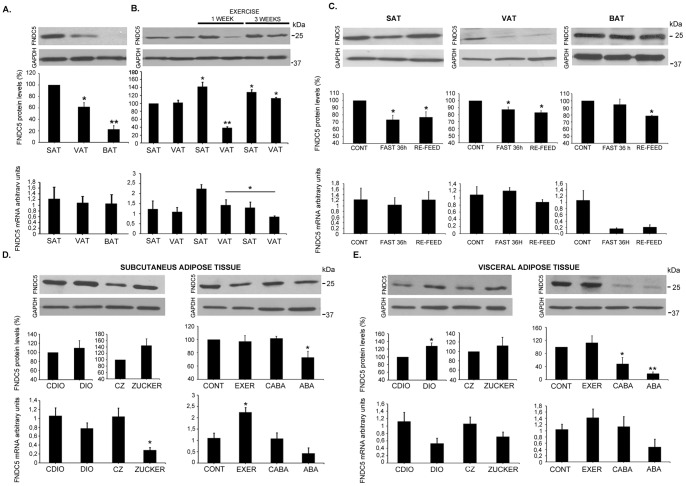
Exercise provides clear beneficial effects for the prevention of numerous diseases. However, many of the molecular events responsible for the curative and protective role of exercise remain elusive. The recent discovery of FNDC5/irisin protein that is liberated by muscle tissue in response to exercise might be an important finding with regard to this unsolved mechanism. The most striking aspect of this myokine is its alleged capacity to drive brown-fat development of white fat and thermogenesis. However, the nature and secretion form of this new protein is controversial. The present study reveals that rat skeletal muscle secretes a 25 kDa form of FNDC5, while the 12 kDa/irisin theoretical peptide was not detected. More importantly, this study is the first to reveal that white adipose tissue (WAT) also secretes FNDC5; hence, it may also behave as an adipokine. Our data using rat adipose tissue explants secretomes proves that visceral adipose tissue (VAT), and especially subcutaneous adipose tissue (SAT), express and secrete FNDC5. We also show that short-term periods of endurance exercise training induced FNDC5 secretion by SAT and VAT. Moreover, we observed that WAT significantly reduced FNDC5 secretion in fasting animals. Interestingly, WAT of obese animals over-secreted this hormone, which might suggest a type of resistance. Because 72% of circulating FNDC5/irisin was previously attributed to muscle secretion, our findings suggest a muscle-adipose tissue crosstalk through a regulatory feedback mechanism.
运动对预防许多疾病都有明显的益处。然而,许多负责运动的治疗和保护作用的分子事件仍然难以捉摸。最近发现的 FNDC5/鸢尾素蛋白,是肌肉组织对运动的反应而释放的,这可能是解决这个未解决机制的一个重要发现。这种肌肉因子最引人注目的方面是它据称能够驱动白色脂肪的棕色脂肪发育和产热。然而,这种新蛋白的性质和分泌形式仍存在争议。本研究表明,大鼠骨骼肌分泌 25 kDa 形式的 FNDC5,而未检测到 12 kDa/鸢尾素理论肽。更重要的是,本研究首次揭示了白色脂肪组织(WAT)也分泌 FNDC5;因此,它也可能作为一种脂肪因子。我们使用大鼠脂肪组织分泌组的数据证明,内脏脂肪组织(VAT),特别是皮下脂肪组织(SAT)表达和分泌 FNDC5。我们还表明,短期耐力运动训练诱导 SAT 和 VAT 分泌 FNDC5。此外,我们观察到禁食动物的 WAT 显著减少了 FNDC5 的分泌。有趣的是,肥胖动物的 WAT 过度分泌这种激素,这可能表明存在一种抵抗。因为以前有 72%的循环 FNDC5/鸢尾素归因于肌肉分泌,我们的发现表明通过调节反馈机制,肌肉-脂肪组织之间存在相互作用。