Department of Biological Science, National University of Singapore, Kent Ridge, Singapore, Republic of Singapore.
PLoS One. 2013 Apr 9;8(4):e61163. doi: 10.1371/journal.pone.0061163. Print 2013.
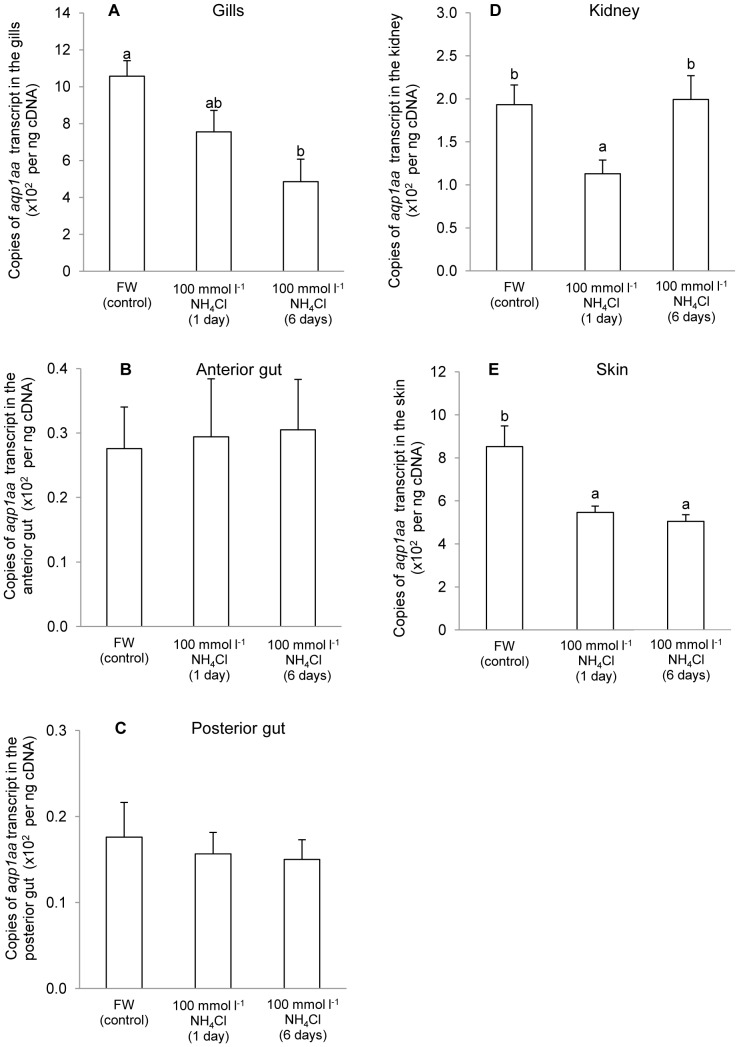
We obtained a full cDNA coding sequence of aquaporin 1aa (aqp1aa) from the gills of the freshwater climbing perch, Anabas testudineus, which had the highest expression in the gills and skin, suggesting an important role of Aqp1aa in these organs. Since seawater acclimation had no significant effects on the branchial and intestinal aqp1aa mRNA expression, and since the mRNA expression of aqp1aa in the gut was extremely low, it can be deduced that Aqp1aa, despite being a water channel, did not play a significant osmoregulatory role in A. testudineus. However, terrestrial exposure led to significant increases in the mRNA expression of aqp1aa in the gills and skin of A. testudineus. Since terrestrial exposure would lead to evaporative water loss, these results further support the proposition that Aqp1aa did not function predominantly for the permeation of water through the gills and skin. Rather, increased aqp1aa mRNA expression might be necessary to facilitate increased ammonia excretion during emersion, because A. testudineus is known to utilize amino acids as energy sources for locomotor activity with increased ammonia production on land. Furthermore, ammonia exposure resulted in significant decreases in mRNA expression of aqp1aa in the gills and skin of A. testudineus, presumably to reduce ammonia influx during ammonia loading. This corroborates previous reports on AQP1 being able to facilitate ammonia permeation. However, a molecular characterization of Aqp1aa from A. testudineus revealed that its intrinsic aquapore might not facilitate NH3 transport. Hence, ammonia probably permeated the central fifth pore of the Aqp1aa tetramer as suggested previously. Taken together, our results indicate that Aqp1aa might have a greater physiological role in ammonia excretion than in osmoregulation in A. testudineus.
我们从淡水攀鲈的鳃中获得了水通道蛋白 1aa(aqp1aa)的全长 cDNA 编码序列,该基因在鳃和皮肤中表达量最高,这表明 Aqp1aa 在这些器官中具有重要作用。由于海水驯化对鳃和肠道 aqp1aa mRNA 表达没有显著影响,而且肠道中 aqp1aa 的 mRNA 表达水平极低,可以推断出 Aqp1aa 尽管是一种水通道,但在攀鲈中并没有发挥重要的渗透压调节作用。然而,陆地暴露会导致攀鲈鳃和皮肤中 aqp1aa 的 mRNA 表达显著增加。由于陆地暴露会导致水分蒸发损失,这些结果进一步支持了 Aqp1aa 主要不是通过鳃和皮肤渗透水分的观点。相反,增加 aqp1aa mRNA 表达可能是为了促进在出水时增加氨的排泄,因为众所周知,攀鲈在陆地活动时会利用氨基酸作为能量来源,同时会增加氨的产生。此外,氨暴露会导致攀鲈鳃和皮肤中 aqp1aa 的 mRNA 表达显著下降,这可能是为了减少氨负荷时氨的内流。这与之前关于 AQP1 能够促进氨渗透的报道一致。然而,对攀鲈 Aqp1aa 的分子特征分析表明,其内在的水通道可能不利于 NH3 的转运。因此,氨可能像之前所建议的那样,通过 Aqp1aa 四聚体的中央第五个孔道渗透。综上所述,我们的结果表明,在攀鲈中,Aqp1aa 可能在氨排泄方面具有比渗透压调节更大的生理作用。