Tahlil Teuku, Woodman Richard J, Coveney John, Ward Paul R
Discipline of Public Health, School of Medicine, Flinders University, Adelaide, SA 5001, Australia.
BMC Public Health. 2013 Apr 19;13:367. doi: 10.1186/1471-2458-13-367.
School-based smoking prevention programs have been shown to increase knowledge of the negative effects of smoking and prevent tobacco smoking. The majority of evidence on effectiveness comes from Western countries. This study investigated the impact of school-based smoking prevention programs on adolescents' smoking knowledge, attitude, intentions and behaviors (KAIB) in Aceh, Indonesia.
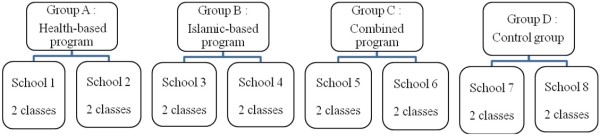
We conducted a 2 × 2 factorial randomized controlled trial among 7(th) and 8(th) grade students aged 11 to 14 years. Eight schools were randomly assigned to a control group or one of three school-based programs: health-based, Islamic-based, or a combined program. Students in the intervention groups received eight classroom sessions on smoking prevention education over two months. The KAIB impact of the program was measured by questionnaires administered one week before and one week after the intervention.
A total of 477 students participated (58% female, 51% eighth graders). Following the intervention, there was a significant main effect of the Health based intervention for health knowledge scores (β = 3.9 ± 0.6, p < 0.001). There were significant main effects of the Islamic-based intervention in both health knowledge (β = 3.8 ± 0.6, p < 0.001) and Islamic knowledge (β = 3.5 ± 0.5, p < 0.001); an improvement in smoking attitude (β = -7.1 ± 1.5, p < 0.001). The effects of Health and Islam were less than additive for the health and Islamic factors for health knowledge (β = -3.5 ± 0.9, p < 0.01 for interaction) and Islamic knowledge (β = -2.0 ± 0.8, p = 0.02 for interaction). There were no significant effects on the odds of intention to smoke or smoking behaviors.
Both Health and Islamic school-based smoking prevention programs provided positive effects on health and Islamic related knowledge respectively among adolescents in Indonesia. Tailoring program interventions with participants' religion background information may provide additional benefits to health only focused interventions.
Australia and New Zealand Clinical Trials Register, ACTRN12612001070820.
以学校为基础的吸烟预防项目已被证明能增加对吸烟负面影响的认识并预防吸烟。大多数关于有效性的证据来自西方国家。本研究调查了以学校为基础的吸烟预防项目对印度尼西亚亚齐青少年吸烟知识、态度、意图和行为(KAIB)的影响。
我们在11至14岁的七年级和八年级学生中进行了一项2×2析因随机对照试验。八所学校被随机分配到对照组或三个以学校为基础的项目之一:基于健康的项目、基于伊斯兰教的项目或综合项目。干预组的学生在两个月内接受了八节关于吸烟预防教育的课堂教学。该项目对KAIB的影响通过在干预前一周和干预后一周发放的问卷进行测量。
共有477名学生参与(58%为女性,51%为八年级学生)。干预后,基于健康的干预对健康知识得分有显著的主效应(β = 3.9 ± 0.6,p < 0.001)。基于伊斯兰教的干预在健康知识(β = 3.8 ± 0.6,p < 0.001)和伊斯兰教知识(β = 3.5 ± 0.5,p < 0.001)方面均有显著的主效应;吸烟态度有所改善(β = -7.1 ± 1.5,p < 0.001)。对于健康知识的健康和伊斯兰教因素(交互作用β = -3.5 ± 0.9,p < 0.01)以及伊斯兰教知识(交互作用β = -2.0 ± 0.8,p = 0.02),健康和伊斯兰教的影响小于相加效应。对吸烟意图或吸烟行为的几率没有显著影响。
基于健康和基于伊斯兰教的以学校为基础的吸烟预防项目分别对印度尼西亚青少年的健康和与伊斯兰教相关的知识产生了积极影响。根据参与者的宗教背景信息调整项目干预可能会为仅关注健康的干预带来额外益处。
澳大利亚和新西兰临床试验注册中心,ACTRN12612001070820。