Mohammadi Mahtab, Ghaleiha Ali, Rahnama Rozina
Rasht Health Center, Guilan University of Medical Sciences, Rasht, Iran.
Research Center for Behavioral Disorders and Substances Abuse, Hamadan University of Medical Sciences, Hamadan, Iran.
Int J Prev Med. 2019 Jun 12;10:111. doi: 10.4103/ijpvm.IJPVM_493_17. eCollection 2019.
Theory-based tobacco use prevention programs in schools were implemented to evaluate the effectiveness of this peer-led intervention on tobacco use-related knowledge, attitude, normative beliefs, and intention to tobacco use of school children aged 14-17 years old.
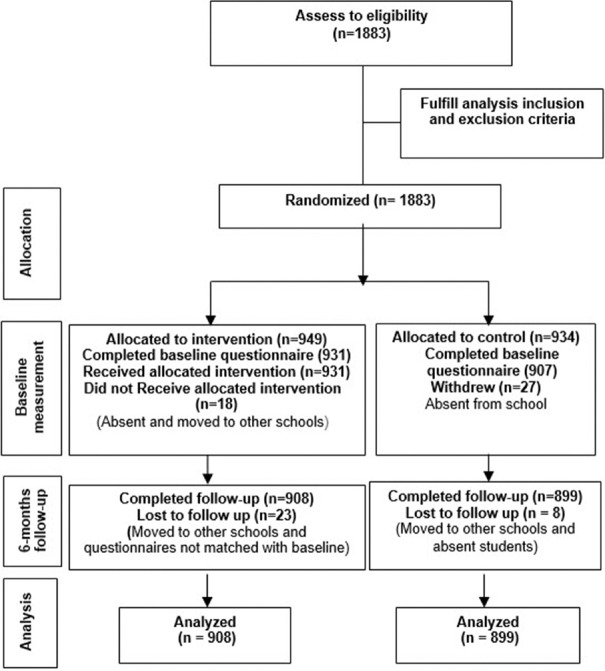
A school-based cluster randomized controlled intervention study was conducted among 1, 2, and 3 grade high school children in Sanandaj City, Iran. 4-h integrated tobacco use prevention program comprising of four structured modules was developed and delivered to the intervention group by trained peer educator. Outcome measures comprised changes in students' smoking-related knowledge, attitude, normative beliefs, and intention to tobacco use from baseline to 6-month follow-up through validated anonymous questionnaire.
The present study showed an intervention effect on tobacco use-related knowledge, normative beliefs, and intention to tobacco use but not attitude. The results indicated that there was significant decrease in intention to tobacco use ( ≤ 0.013) observed after 6-month postintervention. The intervention module was also effective in improving smoking knowledge ( ≤ 0.001), normative beliefs with regard to perceived prevalence of cigarette smoking and water-pipe use among adults and adolescents ( ≤ 0.001) in intervention group 6-month postintervention.
Participation in the peer-led education program to tobacco use prevention may have improvement in knowledge, normative beliefs, and intention to tobacco use. An implementation of the peer-led behavioral intervention components in the school setting may have a beneficial effect on public health by decreasing intention to tobacco use among nonsmoker adolescents.
在学校实施基于理论的烟草使用预防项目,以评估这种同伴主导的干预措施对14至17岁在校儿童烟草使用相关知识、态度、规范信念和烟草使用意图的有效性。
在伊朗萨南达杰市的高中一、二、三年级学生中开展了一项基于学校的整群随机对照干预研究。开发了一个由四个结构化模块组成的4小时综合烟草使用预防项目,并由经过培训的同伴教育者提供给干预组。通过经过验证的匿名问卷,测量从基线到6个月随访期间学生吸烟相关知识、态度、规范信念和烟草使用意图的变化。
本研究显示该干预措施对烟草使用相关知识、规范信念和烟草使用意图有效果,但对态度没有效果。结果表明,干预后6个月观察到烟草使用意图显著下降(≤0.013)。干预模块在干预后6个月也有效提高了干预组学生的吸烟知识(≤0.001)、关于成年人和青少年中吸烟和水烟使用感知流行率的规范信念(≤0.001)。
参与同伴主导的烟草使用预防教育项目可能会改善知识、规范信念和烟草使用意图。在学校环境中实施同伴主导的行为干预成分可能通过降低非吸烟青少年的烟草使用意图对公共卫生产生有益影响。