Environmental Studies Department, Center for Integrated Spatial Research, University of California Santa Cruz, Santa Cruz, California, United States of America.
PLoS One. 2013 Apr 17;8(4):e60590. doi: 10.1371/journal.pone.0060590. Print 2013.
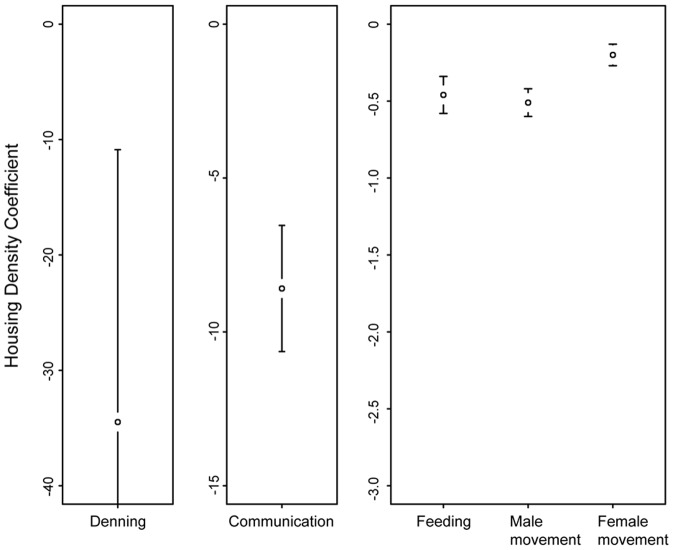
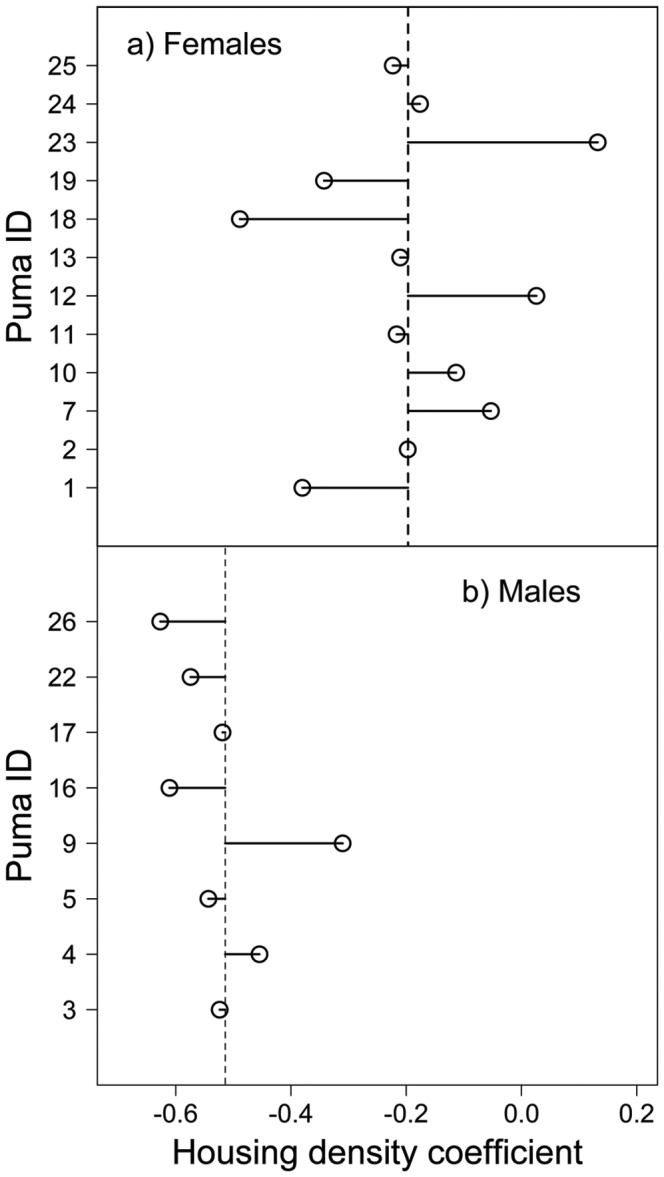
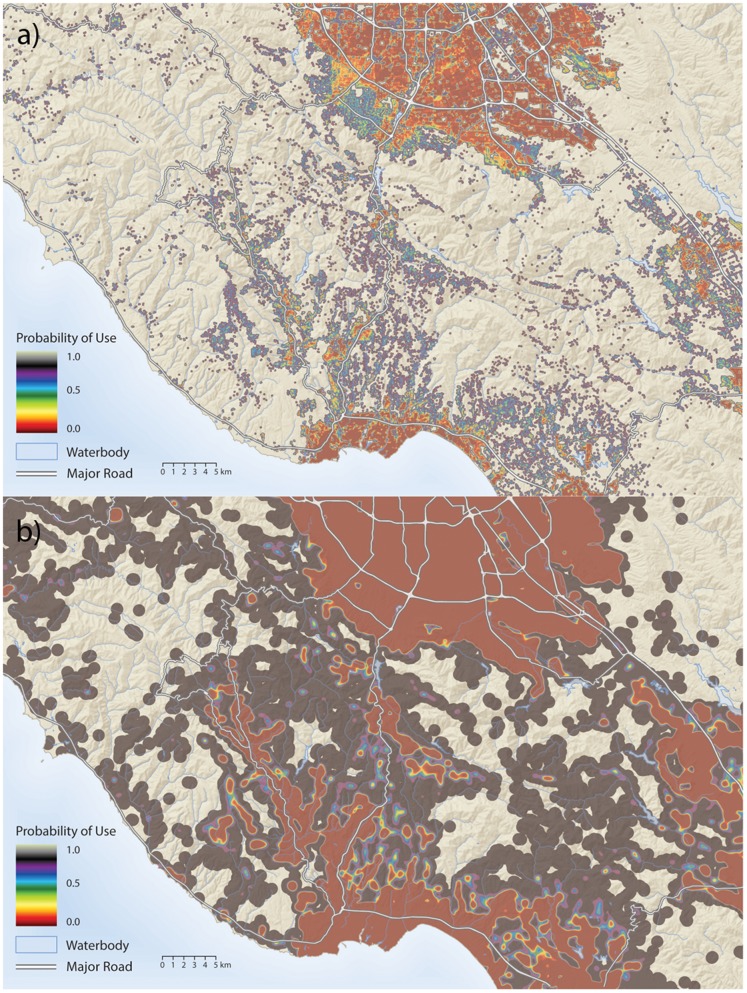
The spatial scale at which organisms respond to human activity can affect both ecological function and conservation planning. Yet little is known regarding the spatial scale at which distinct behaviors related to reproduction and survival are impacted by human interference. Here we provide a novel approach to estimating the spatial scale at which a top predator, the puma (Puma concolor), responds to human development when it is moving, feeding, communicating, and denning. We find that reproductive behaviors (communication and denning) require at least a 4× larger buffer from human development than non-reproductive behaviors (movement and feeding). In addition, pumas give a wider berth to types of human development that provide a more consistent source of human interference (neighborhoods) than they do to those in which human presence is more intermittent (arterial roads with speeds >35 mph). Neighborhoods were a deterrent to pumas regardless of behavior, while arterial roads only deterred pumas when they were communicating and denning. Female pumas were less deterred by human development than males, but they showed larger variation in their responses overall. Our behaviorally explicit approach to modeling animal response to human activity can be used as a novel tool to assess habitat quality, identify wildlife corridors, and mitigate human-wildlife conflict.
生物体对人类活动的响应的空间尺度可以影响生态功能和保护规划。然而,对于与繁殖和生存相关的不同行为受人类干扰影响的空间尺度,我们知之甚少。在这里,我们提供了一种新的方法来估计当美洲狮(Puma concolor)在移动、觅食、交流和巢穴时,对人类发展做出反应的空间尺度。我们发现,繁殖行为(交流和巢穴)需要至少比非繁殖行为(移动和觅食)大 4 倍的缓冲区来避免人类的干扰。此外,美洲狮对提供更一致的人类干扰源的人类发展类型(居民区)比它们对那些人类存在更间歇性的类型(速度超过 35 英里/小时的动脉道路)避让得更远。居民区对美洲狮来说是一种威慑,而动脉道路只有在它们交流和巢穴时才会阻止美洲狮。与雄性相比,雌性美洲狮受人类发展的影响较小,但它们的反应总体上变化更大。我们这种基于行为的方法可以用来评估动物对人类活动的反应,作为评估栖息地质量、识别野生动物走廊和缓解人类与野生动物冲突的新工具。