Department of Medicine, University of Alberta, Edmonton, Alberta, Canada.
PLoS One. 2013 Apr 17;8(4):e60595. doi: 10.1371/journal.pone.0060595. Print 2013.
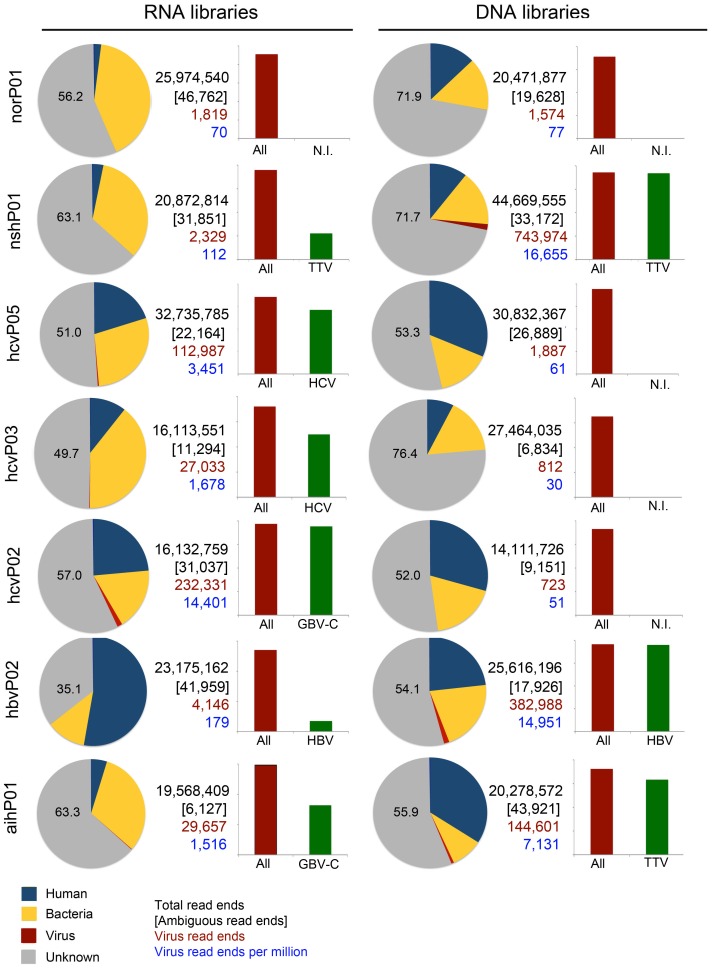
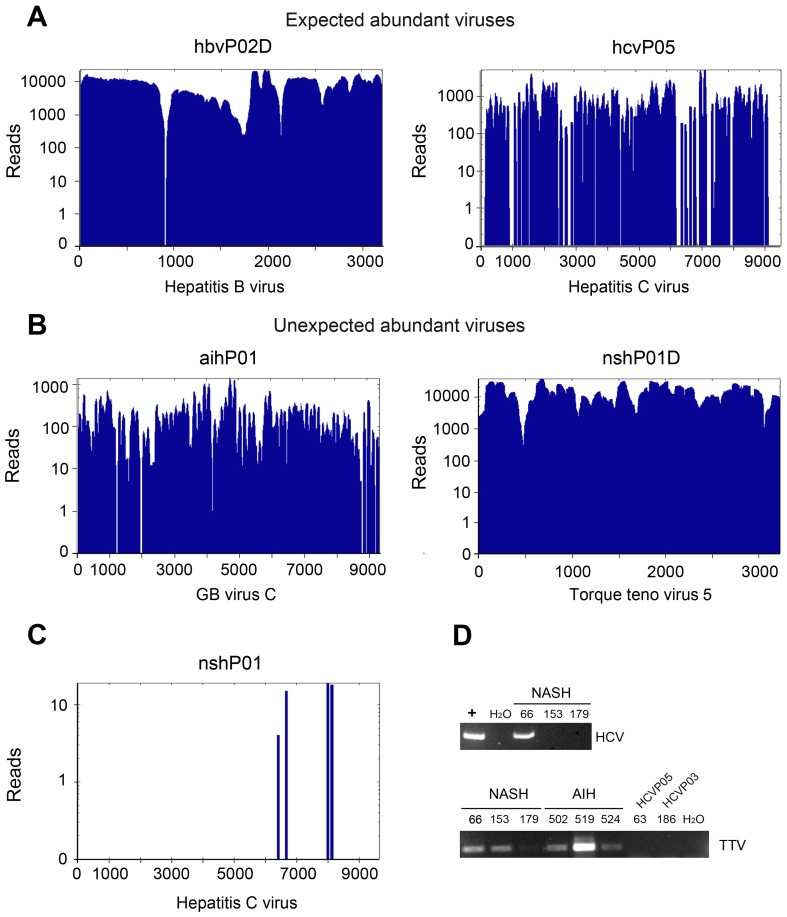
We conducted an unbiased metagenomics survey using plasma from patients with chronic hepatitis B, chronic hepatitis C, autoimmune hepatitis (AIH), non-alcoholic steatohepatitis (NASH), and patients without liver disease (control). RNA and DNA libraries were sequenced from plasma filtrates enriched in viral particles to catalog virus populations. Hepatitis viruses were readily detected at high coverage in patients with chronic viral hepatitis B and C, but only a limited number of sequences resembling other viruses were found. The exception was a library from a patient diagnosed with hepatitis C virus (HCV) infection that contained multiple sequences matching GB virus C (GBV-C). Abundant GBV-C reads were also found in plasma from patients with AIH, whereas Torque teno virus (TTV) was found at high frequency in samples from patients with AIH and NASH. After taxonomic classification of sequences by BLASTn, a substantial fraction in each library, ranging from 35% to 76%, remained unclassified. These unknown sequences were assembled into scaffolds along with virus, phage and endogenous retrovirus sequences and then analyzed by BLASTx against the non-redundant protein database. Nearly the full genome of a heretofore-unknown circovirus was assembled and many scaffolds that encoded proteins with similarity to plant, insect and mammalian viruses. The presence of this novel circovirus was confirmed by PCR. BLASTx also identified many polypeptides resembling nucleo-cytoplasmic large DNA viruses (NCLDV) proteins. We re-evaluated these alignments with a profile hidden Markov method, HHblits, and observed inconsistencies in the target proteins reported by the different algorithms. This suggests that sequence alignments are insufficient to identify NCLDV proteins, especially when these alignments are only to small portions of the target protein. Nevertheless, we have now established a reliable protocol for the identification of viruses in plasma that can also be adapted to other patient samples such as urine, bile, saliva and other body fluids.
我们使用来自慢性乙型肝炎、慢性丙型肝炎、自身免疫性肝炎(AIH)、非酒精性脂肪性肝炎(NASH)患者和无肝病患者(对照)的血浆进行了一项无偏倚的宏基因组调查。从富含病毒颗粒的血浆滤液中测序 RNA 和 DNA 文库,以编目病毒群。在慢性乙型肝炎和丙型肝炎患者中,很容易以高覆盖率检测到肝炎病毒,但只发现了数量有限的类似于其他病毒的序列。例外是来自诊断为丙型肝炎病毒(HCV)感染的患者的文库,其中包含多个与 GB 病毒 C(GBV-C)匹配的序列。在 AIH 患者的血浆中也发现了丰富的 GBV-C 读数,而在 AIH 和 NASH 患者的样本中发现了高频率的 Torque teno 病毒(TTV)。在通过 BLASTn 对序列进行分类后,每个文库中都有相当大的一部分(35%至 76%)仍然未分类。这些未知序列与病毒、噬菌体和内源性逆转录病毒序列一起组装成支架,然后通过 BLASTx 针对非冗余蛋白质数据库进行分析。迄今为止未知的环状病毒的全基因组被组装,并且许多支架编码与植物、昆虫和哺乳动物病毒具有相似性的蛋白质。通过 PCR 证实了这种新型环状病毒的存在。BLASTx 还鉴定了许多与核质大 DNA 病毒(NCLDV)蛋白相似的多肽。我们使用 profile hidden Markov 方法 HHblits 重新评估了这些比对,并观察到不同算法报告的靶蛋白之间存在不一致。这表明序列比对不足以识别 NCLDV 蛋白,尤其是当这些比对仅针对靶蛋白的一小部分时。尽管如此,我们现在已经建立了一种用于鉴定血浆中病毒的可靠方案,该方案也可以适应其他患者样本,如尿液、胆汁、唾液和其他体液。