Department of Primatology, Max Planck Institute for Evolutionary Anthropology, Leipzig, Germany.
PLoS One. 2013 Apr 17;8(4):e60773. doi: 10.1371/journal.pone.0060773. Print 2013.
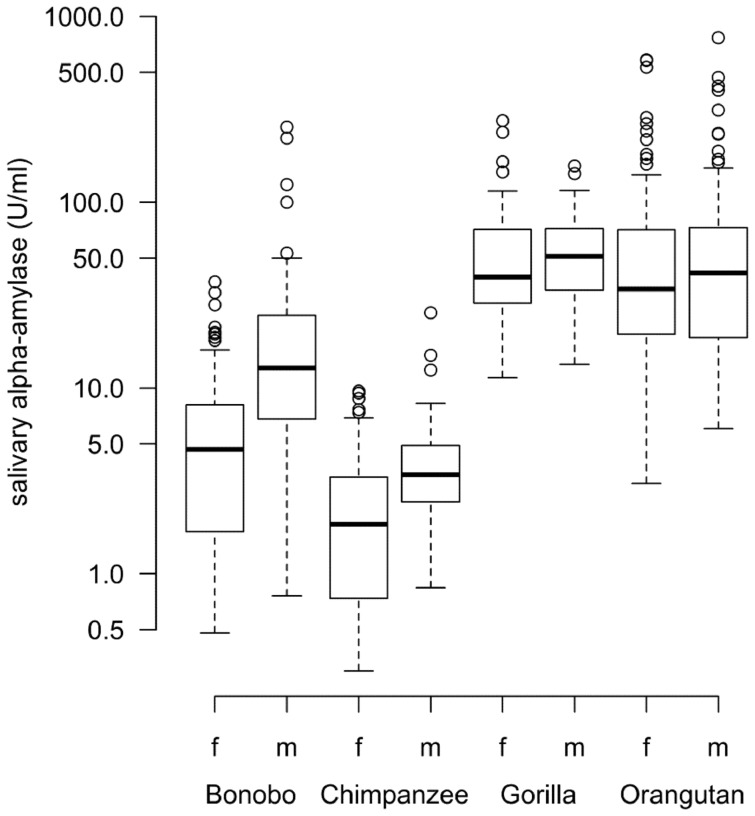
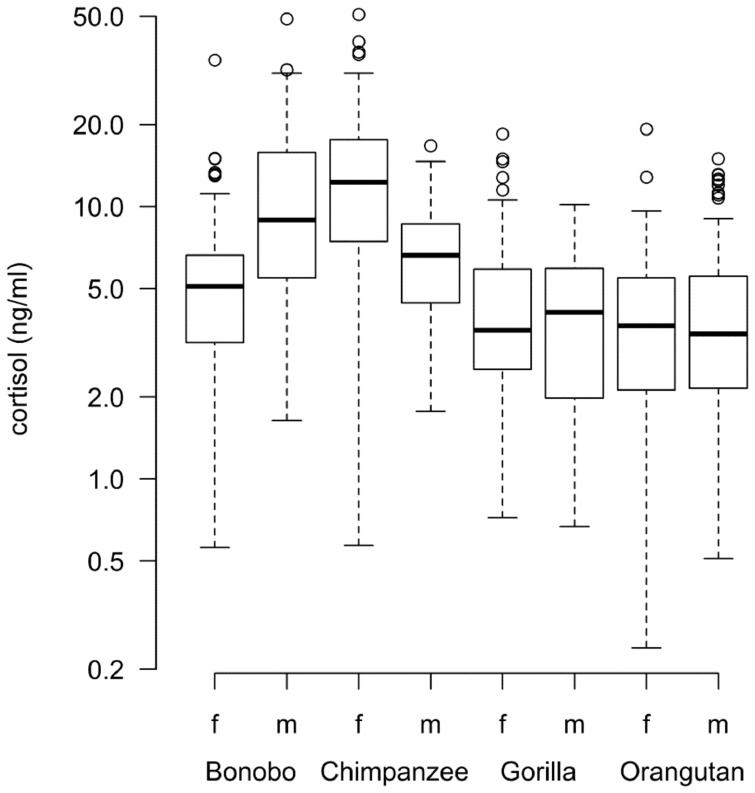
Salivary alpha amylase (sAA) is the most abundant enzyme in saliva. Studies in humans found variation in enzymatic activity of sAA across populations that could be linked to the copy number of loci for salivary amylase (AMY1), which was seen as an adaptive response to the intake of dietary starch. In addition to diet dependent variation, differences in sAA activity have been related to social stress. In a previous study, we found evidence for stress-induced variation in sAA activity in the bonobos, a hominoid primate that is closely related to humans. In this study, we explored patterns of variation in sAA activity in bonobos and three other hominoid primates, chimpanzee, gorilla, and orangutan to (a) examine if within-species differences in sAA activity found in bonobos are characteristic for hominoids and (b) assess the extent of variation in sAA activity between different species. The results revealed species-differences in sAA activity with gorillas and orangutans having higher basal sAA activity when compared to Pan. To assess the impact of stress, sAA values were related to cortisol levels measured in the same saliva samples. Gorillas and orangutans had low salivary cortisol concentrations and the highest cortisol concentration was found in samples from male bonobos, the group that also showed the highest sAA activity. Considering published information, the differences in sAA activity correspond with differences in AMY1 copy numbers and match with general features of natural diet. Studies on sAA activity have the potential to complement molecular studies and may contribute to research on feeding ecology and nutrition.
唾液α-淀粉酶(sAA)是唾液中含量最丰富的酶。人类研究发现,sAA 的酶活性在不同人群中有差异,这可能与唾液淀粉酶(AMY1)的基因座数量有关,这被视为对饮食中淀粉摄入的适应性反应。除了饮食相关的变化外,sAA 活性的差异还与社会压力有关。在之前的一项研究中,我们在倭黑猩猩中发现了 sAA 活性应激诱导变化的证据,倭黑猩猩是与人类关系密切的灵长类动物。在这项研究中,我们探索了 sAA 活性在倭黑猩猩和其他三种灵长类动物(黑猩猩、大猩猩和猩猩)中的变化模式,目的是(a)检验在倭黑猩猩中发现的 sAA 活性的种内差异是否是灵长类动物的特征,以及(b)评估不同物种之间 sAA 活性的变化程度。结果显示,sAA 活性存在物种差异,与 Pan 相比,大猩猩和猩猩的基础 sAA 活性更高。为了评估应激的影响,我们将 sAA 值与同一唾液样本中测量的皮质醇水平相关联。大猩猩和猩猩的唾液皮质醇浓度较低,而雄性倭黑猩猩的唾液皮质醇浓度最高,该群体的 sAA 活性也最高。考虑到已发表的信息,sAA 活性的差异与 AMY1 拷贝数的差异相对应,与自然饮食的一般特征相匹配。sAA 活性的研究有可能补充分子研究,并可能有助于对觅食生态和营养的研究。