Department of Physical Therapy and Rehabilitation Science, University of Kansas Medical Center, Kansas City, KS, USA.
Nat Sci Sleep. 2011 Jun 16;3:39-46. doi: 10.2147/NSS.S20063. Print 2011.
Healthy young individuals benefit from sleep to promote offline enhancement of a variety of explicitly learned discrete motor tasks. It remains unknown if sleep will promote learning of other types of explicit tasks. The purpose of this study is to verify the role of sleep in learning an explicitly instructed discrete motor task and to determine if participants who practice an explicitly instructed continuous tracking task demonstrate sleep-dependent offline learning of this task.
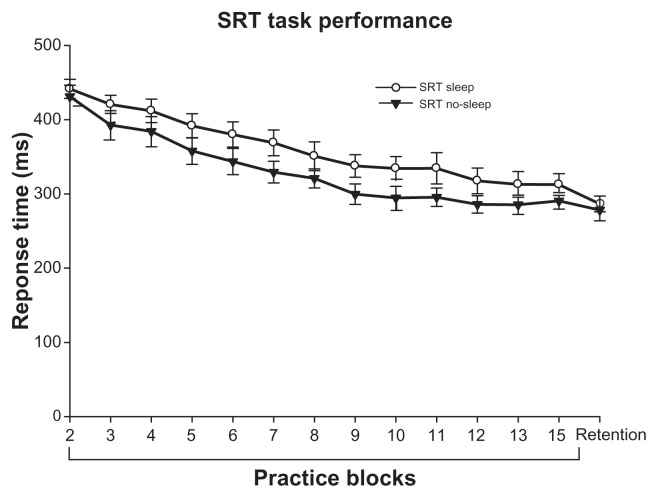
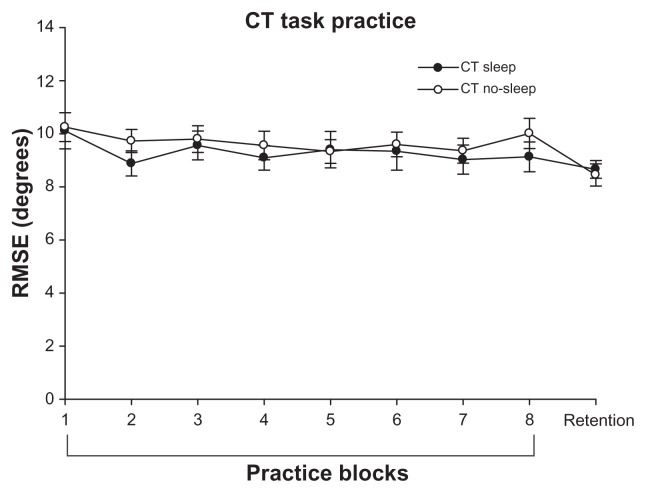
In experiment 1, 28 healthy young adults (mean age 25.6 ± 3.8 years) practiced a serial reaction time (SRT) task at either 8 am (SRT no-sleep group) or 8 pm (SRT sleep group) and underwent retention testing 12 ± 1 hours later. In experiment 2, 20 healthy young individuals (mean age 25.6 ± 3.3 years) practiced a continuous tracking task and were similarly divided into a no-sleep (continuous tracking no-sleep group) or sleep group (continuous tracking sleep group). Individuals in both experiments were provided with explicit instruction on the presence of a sequence in their respective task prior to practice.
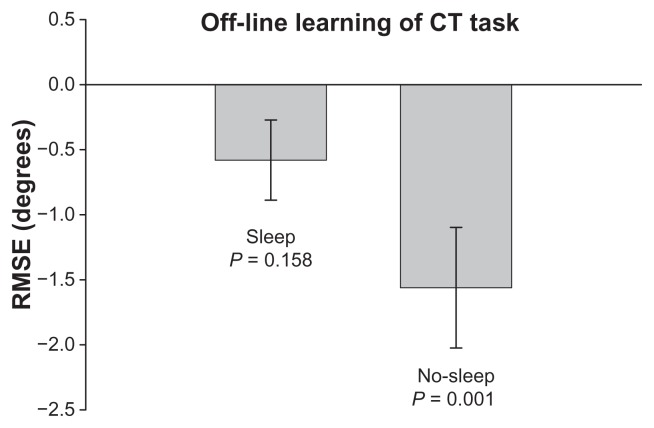
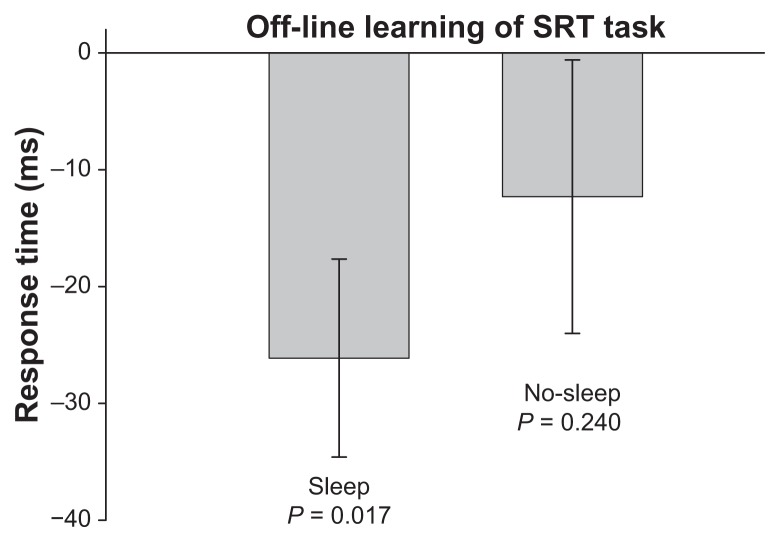
Individuals in the SRT sleep group demonstrated a significant offline reduction in reaction time whereas the SRT no-sleep group did not. Results for experiment 1 provide concurrent evidence that explicitly learned discrete tasks undergo sleep-dependent offline enhancement. Individuals in the continuous tracking sleep group failed to demonstrate a significant offline reduction in tracking error. However, the continuous tracking no-sleep group did demonstrate a significant offline improvement in performance. Results for experiment 2 indicate that sleep is not critical for offline enhancement of an explicit learned continuous task.
The findings that individuals who practiced an explicitly instructed discrete task experienced sleep-dependent offline learning while those individuals who practiced an explicitly instructed continuous task did not may be due to the difference in motor control or level of complexity between discrete and continuous tasks.
健康的年轻人从睡眠中受益,以促进各种明确学习的离散运动任务的离线增强。目前尚不清楚睡眠是否会促进其他类型的明确任务的学习。本研究的目的是验证睡眠在学习明确指导的离散运动任务中的作用,并确定练习明确指导的连续跟踪任务的参与者是否表现出该任务的睡眠依赖性离线学习。
在实验 1 中,28 名健康的年轻人(平均年龄 25.6±3.8 岁)分别在上午 8 点(SRT 无睡眠组)或晚上 8 点(SRT 睡眠组)练习序列反应时间(SRT)任务,并在 12±1 小时后进行保留测试。在实验 2 中,20 名健康的年轻人(平均年龄 25.6±3.3 岁)练习连续跟踪任务,并同样分为无睡眠(连续跟踪无睡眠组)或睡眠组(连续跟踪睡眠组)。在练习之前,两组实验中的个体都获得了关于其各自任务中存在序列的明确指导。
SRT 睡眠组的个体表现出明显的离线反应时间减少,而 SRT 无睡眠组则没有。实验 1 的结果提供了同时的证据,表明明确学习的离散任务经历了睡眠依赖性的离线增强。连续跟踪睡眠组的个体未能表现出跟踪错误的明显离线减少。然而,连续跟踪无睡眠组确实表现出了明显的离线性能提高。实验 2 的结果表明,睡眠对于明确学习的连续任务的离线增强不是关键的。
练习明确指导的离散任务的个体经历了睡眠依赖性的离线学习,而练习明确指导的连续任务的个体则没有,这可能是由于离散任务和连续任务之间的运动控制或复杂性水平的差异所致。