Yordanova Juliana, Kolev Vasil, Verleger Rolf
Department of Neurology, University of Lübeck Lübeck, Germany.
Front Hum Neurosci. 2009 Oct 30;3:40. doi: 10.3389/neuro.09.040.2009. eCollection 2009.
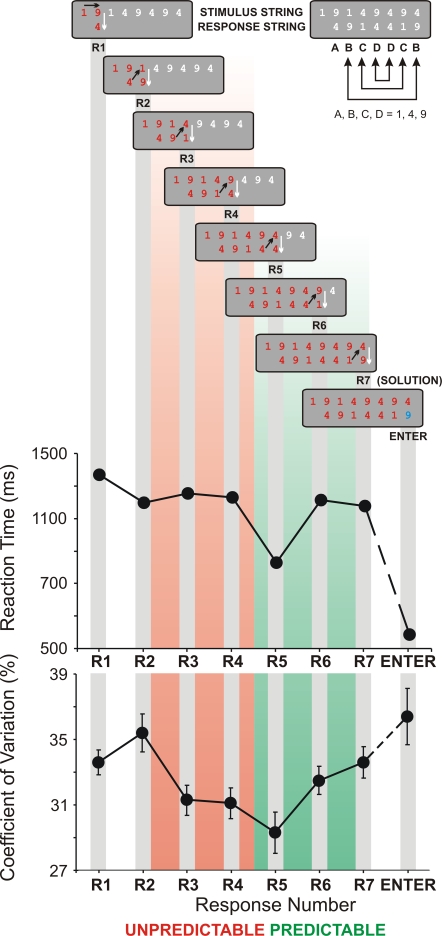
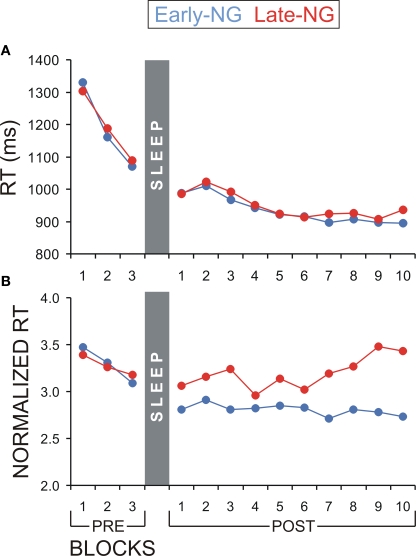
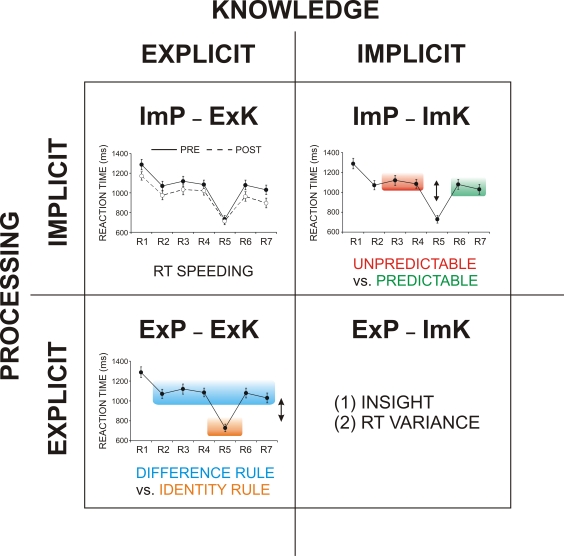
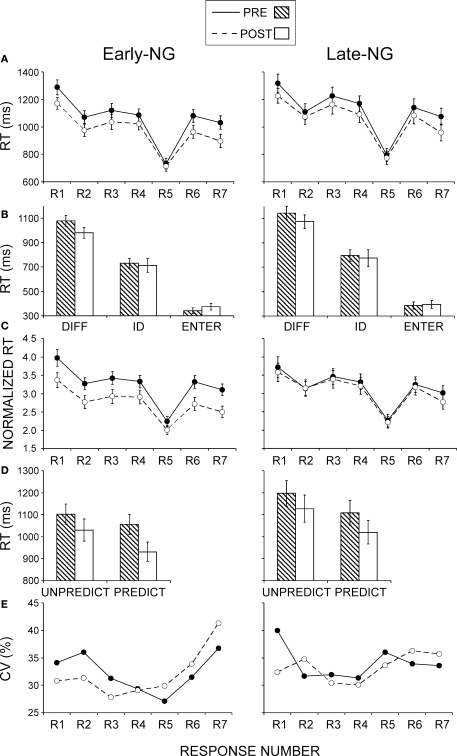
The present study assessed the effects of awareness at encoding on off-line learning during sleep. A new framework is suggested according to which two aspects of awareness are distinguished: awareness of task information, and awareness of task processing. The number reduction task (NRT) was employed because it has two levels of organization, an overt one based on explicit knowledge of task instructions, and a covert one based on hidden abstract regularities of task structure (implicit knowledge). Each level can be processed consciously (explicitly) or non-consciously (implicitly). Different performance parameters were defined to evaluate changes between two sessions for each of the four conditions of awareness arising from whether explicit or implicit task information was processed explicitly or implicitly. In two groups of subjects, the interval between the pre-sleep and post-sleep sessions was filled either with early-night sleep, rich in slow wave sleep (SWS), or late-night sleep, rich in rapid eye movement (REM) sleep. Results show that implicit processing of explicit information was improved in the post-sleep relative to the pre-sleep session only in the early-night group. Independently of sleep stage, changes between sessions occurred for explicit processing of implicit information only in those subjects who gained insight into the task regularity after sleep. It is concluded that SWS but not REM sleep specifically supports gains in computational skills for the processing of information that was accessible by consciousness before sleep.
本研究评估了编码时的意识对睡眠期间离线学习的影响。提出了一个新框架,据此区分意识的两个方面:任务信息意识和任务处理意识。采用数字缩减任务(NRT)是因为它有两个组织层次,一个基于对任务指令的明确知识的显性层次,另一个基于任务结构的隐藏抽象规律(隐性知识)的隐性层次。每个层次都可以有意识地(明确地)或无意识地(隐性地)处理。定义了不同的性能参数来评估由显性或隐性任务信息是被明确还是隐性处理而产生的四种意识条件下,两个阶段之间的变化。在两组受试者中,睡前和睡后阶段之间的间隔要么填充有富含慢波睡眠(SWS)的早睡,要么填充有富含快速眼动(REM)睡眠的晚睡。结果表明,只有在早睡组中,与睡前阶段相比,睡后显性信息的隐性处理得到了改善。与睡眠阶段无关,只有那些在睡眠后洞察到任务规律的受试者,隐性信息的显性处理在两个阶段之间才会发生变化。得出的结论是,慢波睡眠而非快速眼动睡眠特别有助于提高处理睡眠前意识可及信息的计算技能。