United Graduate School of Agricultural Sciences, Iwate University Morioka, Iwate, Japan.
Front Plant Sci. 2013 Apr 17;4:90. doi: 10.3389/fpls.2013.00090. eCollection 2013.
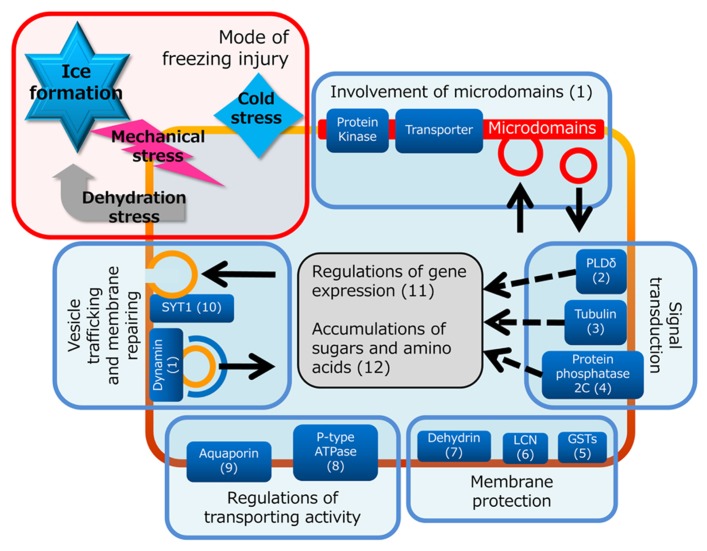
Plants are always exposed to various stresses. We have focused on freezing stress, which causes serious problems for agricultural management. When plants suffer freeze-induced damage, the plasma membrane is thought to be the primary site of injury because of its central role in regulation of various cellular processes. Cold tolerant species, however, adapt to such freezing conditions by modifying cellular components and functions (cold acclimation). One of the most important adaptation mechanisms to freezing is alteration of plasma membrane compositions and functions. Advanced proteomic technologies have succeeded in identification of many candidates that may play roles in adaptation of the plasma membrane to freezing stress. Proteomics results suggest that adaptations of plasma membrane functions to low temperature are associated with alterations of protein compositions during cold acclimation. Some of proteins identified by proteomic approaches have been verified their functional roles in freezing tolerance mechanisms further. Thus, accumulation of proteomic results in the plasma membrane is of importance for application to molecular breeding efforts to increase cold tolerance in crops.
植物经常会受到各种压力的影响。我们专注于冷冻胁迫,因为它会给农业管理带来严重的问题。当植物遭受冻害时,人们认为质膜是损伤的主要部位,因为它在调节各种细胞过程中起着核心作用。然而,耐寒物种通过改变细胞成分和功能(冷驯化)来适应这种冷冻条件。适应冷冻的最重要机制之一是改变质膜的组成和功能。先进的蛋白质组学技术已经成功地鉴定出许多可能在质膜适应冷冻胁迫中发挥作用的候选蛋白。蛋白质组学结果表明,质膜功能对低温的适应与冷驯化过程中蛋白质组成的改变有关。通过蛋白质组学方法鉴定的一些蛋白质已进一步验证了它们在抗冻机制中的功能作用。因此,质膜中蛋白质组学结果的积累对于应用于分子育种工作以提高作物的耐寒性非常重要。