Division of Sleep Medicine, Department of Neurology, Louisiana State University Health Sciences Center, Shreveport, LA, USA.
Nat Sci Sleep. 2013 Mar 9;5:37-42. doi: 10.2147/NSS.S42641. Print 2013.
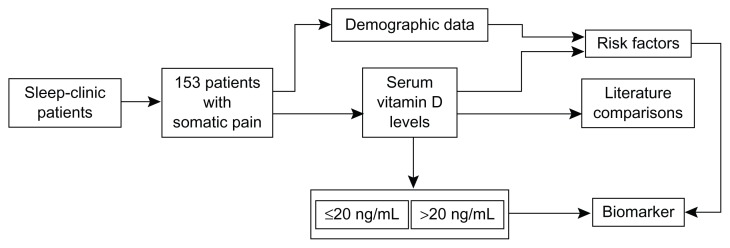
The purpose of this cross-sectional study was to test the hypothesis that serum vitamin D levels are abnormally low in sleep clinic patients admitting to chronic nonspecific musculoskeletal pain and to assess the associated risk factors. A secondary purpose was to identify a clinical biomarker for vitamin D deficiency.
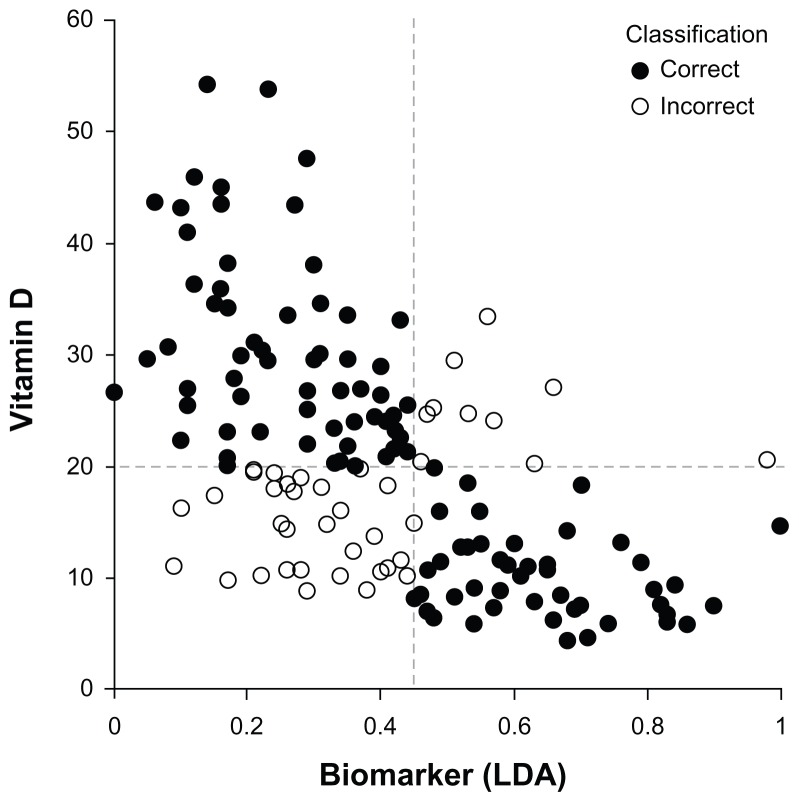
We enrolled 153 consecutive patients who admitted to the presence of chronic nonspecific musculoskeletal pain during a comprehensive sleep evaluation at a specialist sleep medicine clinic within an academic center. Venous blood sampling was performed for determination of serum 25-hydroxyvitamin D. Risk factors for vitamin D deficiency (25-hydroxyvitamin D < 20 ng/mL) were identified by odds ratios. Receiver-operating characteristic curve analysis was performed with 10-fold cross-validation to identify a biomarker for vitamin D deficiency calculated by linear discriminant analysis.
The mean serum 25-hydroxyvitamin D level was 19.8 ± 11.1, with 54% of the study population having vitamin D deficiency. This mean 25-hydroxyvitamin D level was lower than that observed historically in healthy controls, and was either similar or lower than in all but one representative historical cohort formed on the basis of chronic nonspecific musculoskeletal pain. Risk factors for vitamin D deficiency were black ethnicity, age < 60 years, and obesity. These risk factors were identified both in the entire cohort and separately in subgroups with and without obstructive sleep apnea. The biomarker (based on race, age, and body mass index) had a sensitivity and specificity for predicting vitamin D deficiency of 0.73 and 0.74, respectively.
Vitamin D deficiency was prevalent in patients with sleep disorders and chronic nonspecific musculoskeletal pain on evaluation in a sleep medicine clinic. Vitamin D deficiency was reliably estimated in the study population using a biomarker derived from common demographic characteristics.
本横断面研究旨在检验血清维生素 D 水平异常降低与睡眠诊所慢性非特异性肌肉骨骼疼痛患者相关的假设,并评估相关的危险因素。次要目的是确定维生素 D 缺乏的临床生物标志物。
我们纳入了 153 例连续患者,他们在学术中心的专科睡眠医学诊所进行全面睡眠评估时,自述存在慢性非特异性肌肉骨骼疼痛。采集静脉血样,测定血清 25-羟维生素 D。通过比值比确定维生素 D 缺乏的危险因素(25-羟维生素 D < 20ng/ml)。采用 10 倍交叉验证进行Receiver-operating characteristic 曲线分析,通过线性判别分析计算维生素 D 缺乏的生物标志物。
血清 25-羟维生素 D 平均水平为 19.8±11.1ng/ml,54%的研究人群存在维生素 D 缺乏。该平均 25-羟维生素 D 水平低于历史上健康对照组观察到的水平,与除基于慢性非特异性肌肉骨骼疼痛形成的一个代表性历史队列外的所有队列相似或更低。维生素 D 缺乏的危险因素是黑种人、年龄<60 岁和肥胖。这些危险因素在整个队列中以及在伴有或不伴有阻塞性睡眠呼吸暂停的亚组中均存在。基于种族、年龄和体重指数的生物标志物对预测维生素 D 缺乏的敏感性和特异性分别为 0.73 和 0.74。
在睡眠医学诊所进行评估时,患有睡眠障碍和慢性非特异性肌肉骨骼疼痛的患者维生素 D 缺乏较为常见。使用源自常见人口统计学特征的生物标志物可在研究人群中可靠地估计维生素 D 缺乏。