Department of Neurobiology, Life Science Institute, Hebrew University Jerusalem, Israel ; Edmund and Lily Safra Center for Brain Sciences, Hebrew University Jerusalem, Israel.
Front Neural Circuits. 2013 Apr 19;7:73. doi: 10.3389/fncir.2013.00073. eCollection 2013.
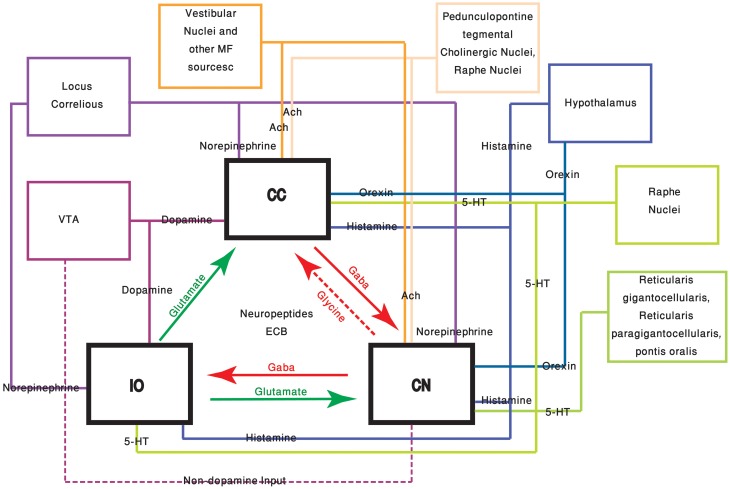
Cerebellar anatomy is known for its crystal like structure, where neurons and connections are precisely and repeatedly organized with minor variations across the Cerebellar Cortex. The olivo-cerebellar loop, denoting the connections between the Cerebellar cortex, Inferior Olive and Cerebellar Nuclei (CN), is also modularly organized to form what is known as the cerebellar module. In contrast to the relatively organized and static anatomy, the cerebellum is innervated by a wide variety of neuromodulator carrying axons that are heterogeneously distributed along the olivo-cerebellar loop, providing heterogeneity to the static structure. In this manuscript we review modulatory processes in the olivo-cerebellar loop. We start by discussing the relationship between neuromodulators and the animal behavioral states. This is followed with an overview of the cerebellar neuromodulatory signals and a short discussion of why and when the cerebellar activity should be modulated. We then devote a section for three types of neurons where we briefly review its properties and propose possible neuromodulation scenarios.
小脑解剖结构以其晶体般的结构而闻名,其中神经元和连接以微小的变化精确而重复地组织在小脑皮质中。橄榄小脑环路,指的是小脑皮质、下橄榄核和小脑核(CN)之间的连接,也以模块的方式组织,形成所谓的小脑模块。与相对有组织和静态的解剖结构相反,小脑由各种各样的携带神经调质的轴突支配,这些轴突沿着橄榄小脑环路不均匀地分布,为静态结构提供异质性。在本文中,我们回顾了橄榄小脑环路中的调制过程。我们首先讨论了神经调质与动物行为状态之间的关系。接下来是对小脑神经调质信号的概述,并简要讨论了为什么和何时应该调节小脑活动。然后,我们专门用一个部分来讨论三种类型的神经元,简要回顾它们的特性,并提出可能的神经调制方案。