Department of Microbial Infection and Immunity, Center for Microbial Interface Biology, The Ohio State University Columbus, OH, USA.
Front Immunol. 2013 Apr 22;4:98. doi: 10.3389/fimmu.2013.00098. eCollection 2013.
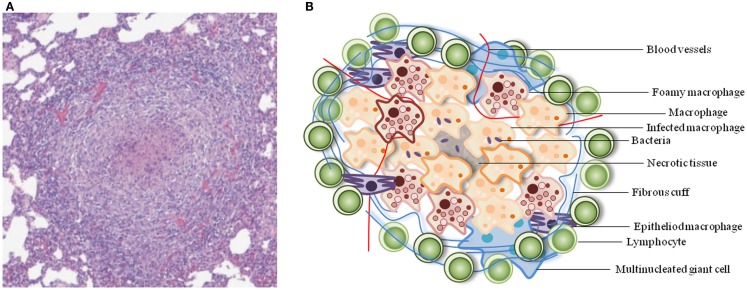
Granulomas are the hallmark of Mycobacterium tuberculosis (M.tb) infection and thus sit at the center of tuberculosis (TB) immunopathogenesis. TB can result from either early progression of a primary granuloma during the infection process or reactivation of an established granuloma in a latently infected person. Granulomas are compact, organized aggregates of immune cells consisting of blood-derived infected and uninfected macrophages, foamy macrophages, epithelioid cells (uniquely differentiated macrophages), and multinucleated giant cells (Langerhans cells) surrounded by a ring of lymphocytes. The granuloma's main function is to localize and contain M.tb while concentrating the immune response to a limited area. However, complete eradication does not occur since M.tb has its own strategies to persist within the granuloma and to reactivate and escape under certain conditions. Thus M.tb-containing granulomas represent a unique battlefield for dictating both the host immune and bacterial response. The architecture, composition, function, and maintenance of granulomas are key aspects to study since they are expected to have a profound influence on M.tb physiology in this niche. Granulomas are not only present in mycobacterial infections; they can be found in many other infectious and non-infectious diseases and play a crucial role in immunity and disease. Here we review the models currently available to study the granulomatous response to M.tb.
肉芽肿是结核分枝杆菌(M.tb)感染的标志,因此处于结核病(TB)免疫发病机制的中心。TB 可由感染过程中原发性肉芽肿的早期进展或潜伏感染个体中已建立的肉芽肿的再激活引起。肉芽肿是由血源性感染和未感染的巨噬细胞、泡沫状巨噬细胞、上皮样细胞(独特分化的巨噬细胞)和多核巨细胞(朗格汉斯细胞)组成的密集、有组织的免疫细胞聚集物,周围环绕着一圈淋巴细胞。肉芽肿的主要功能是定位和包含 M.tb,同时将免疫反应集中在有限的区域。然而,由于 M.tb 有其自身的策略在肉芽肿内持续存在,并在某些条件下重新激活和逃脱,因此不会完全消除。因此,含有 M.tb 的肉芽肿代表了一个独特的战场,决定了宿主免疫和细菌反应。肉芽肿的结构、组成、功能和维持是研究的关键方面,因为它们预计会对该小生境中的 M.tb 生理学产生深远影响。肉芽肿不仅存在于分枝杆菌感染中;它们也可以在许多其他感染和非感染性疾病中找到,并在免疫和疾病中发挥关键作用。在这里,我们综述了目前可用于研究 M.tb 肉芽肿反应的模型。