Section of Cell and Developmental Biology, University of California, San Diego, La Jolla, CA 92093-0349, USA.
Dev Comp Immunol. 2014 Jan;42(1):16-24. doi: 10.1016/j.dci.2013.04.011. Epub 2013 Apr 28.
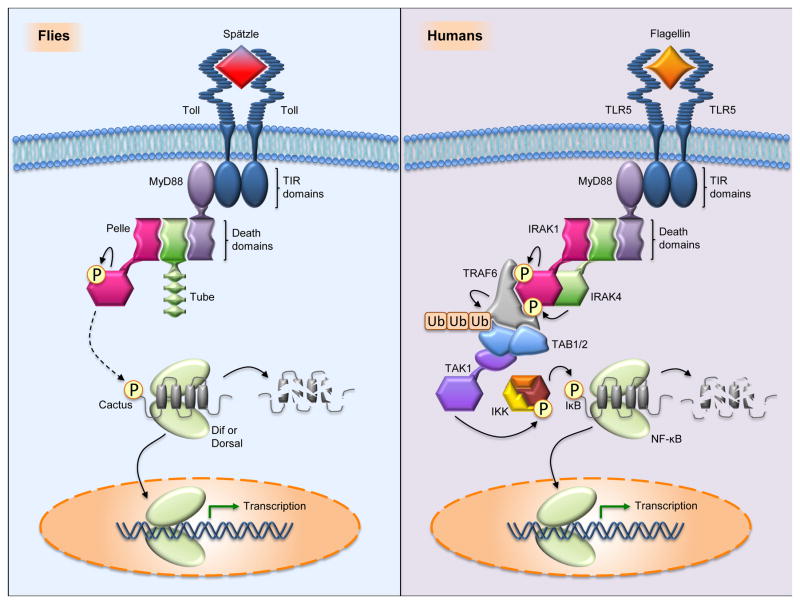
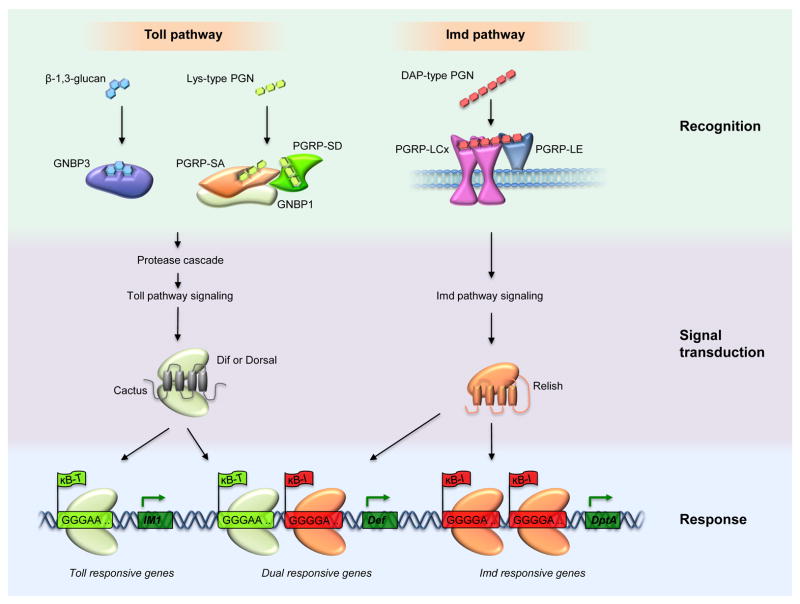
The discovery of Toll in Drosophila and of the remarkable conservation in pathway composition and organization catalyzed a transformation in our understanding of innate immune recognition and response. At the center of that picture is a cascade of interactions in which specific microbial cues activate Toll receptors, which then transmit signals driving transcription factor nuclear localization and activity. Experiments gave substance to the vision of pattern recognition receptors, linked phenomena in development, gene regulation, and immunity into a coherent whole, and revealed a rich set of variations for identifying non-self and responding effectively. More recently, research in Drosophila has illuminated the positive and negative regulation of Toll activation, the organization of signaling events at and beneath membranes, the sorting of information flow, and the existence of non-conventional signaling via Toll-related receptors. Here, we provide an overview of the Toll pathway of flies and highlight these ongoing realms of research.
在果蝇中发现 Toll 以及途径组成和组织的惊人保守性,极大地促进了我们对先天免疫识别和反应的理解的转变。在这一图景的中心是一系列相互作用,其中特定的微生物线索激活 Toll 受体,然后传递信号,驱动转录因子的核定位和活性。实验使模式识别受体的设想具体化,将发育、基因调控和免疫中的现象联系在一起,形成一个连贯的整体,并揭示了一系列用于识别非自身和有效反应的丰富变化。最近,果蝇的研究阐明了 Toll 激活的正调控和负调控、膜上和膜下信号事件的组织、信息流的分类以及通过 Toll 相关受体进行非传统信号传递的存在。在这里,我们概述了果蝇的 Toll 途径,并强调了这些正在进行的研究领域。