Department of Clinical Parasitology, Walk-in Clinic, Hospital for Tropical Diseases, University London Colleges NHS Foundation Trust, Mortimer Market, London WC1E 6JB, UK.
J Infect Dis. 2013 Aug 15;208(4):637-44. doi: 10.1093/infdis/jit183. Epub 2013 Apr 30.
Diagnosis of malaria relies on parasite detection by microscopy or antigen detection; both fail to detect low-density infections. New tests providing rapid, sensitive diagnosis with minimal need for training would enhance both malaria diagnosis and malaria control activities. We determined the diagnostic accuracy of a new loop-mediated amplification (LAMP) kit in febrile returned travelers.
The kit was evaluated in sequential blood samples from returned travelers sent for pathogen testing to a specialist parasitology laboratory. Microscopy was performed, and then malaria LAMP was performed using Plasmodium genus and Plasmodium falciparum-specific tests in parallel. Nested polymerase chain reaction (PCR) was performed on all samples as the reference standard. Primary outcome measures for diagnostic accuracy were sensitivity and specificity of LAMP results, compared with those of nested PCR.
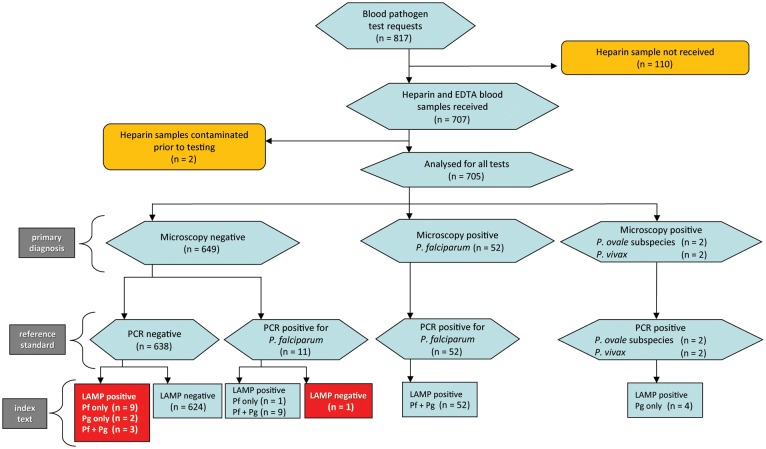
A total of 705 samples were tested in the primary analysis. Sensitivity and specificity were 98.4% and 98.1%, respectively, for the LAMP P. falciparum primers and 97.0% and 99.2%, respectively, for the Plasmodium genus primers. Post hoc repeat PCR analysis of all 15 tests with discrepant results resolved 4 results in favor of LAMP, suggesting that the primary analysis had underestimated diagnostic accuracy.
Malaria LAMP had a diagnostic accuracy similar to that of nested PCR, with a greatly reduced time to result, and was superior to expert microscopy.
疟疾的诊断依赖于显微镜检查或抗原检测来检测寄生虫;这两种方法都无法检测到低密度感染。新的测试方法具有快速、灵敏的诊断能力,且所需的培训较少,这将提高疟疾的诊断和疟疾控制活动的效果。我们评估了一种新的环介导扩增(LAMP)试剂盒在发热的归国旅行者中的诊断准确性。
该试剂盒在送到寄生虫学专家实验室进行病原体检测的归国旅行者的连续血液样本中进行了评估。进行了显微镜检查,然后同时平行进行了针对疟原虫属和恶性疟原虫的 LAMP 检测。对所有样本进行巢式聚合酶链反应(PCR)检测作为参考标准。诊断准确性的主要结果测量指标是 LAMP 结果与巢式 PCR 结果的敏感性和特异性。
共有 705 个样本进行了初步分析。LAMP 恶性疟原虫引物的敏感性和特异性分别为 98.4%和 98.1%,LAMP 疟原虫属引物的敏感性和特异性分别为 97.0%和 99.2%。对所有 15 个结果不一致的测试进行了重复 PCR 分析,其中 4 个结果有利于 LAMP,这表明初步分析低估了诊断准确性。
LAMP 对疟疾的诊断准确性与巢式 PCR 相似,但检测结果的时间大大缩短,并且优于专家显微镜检查。