Mohon Abu Naser, Elahi Rubayet, Khan Wasif A, Haque Rashidul, Sullivan David J, Alam Mohammad Shafiul
International Centre for Diarrhoeal Disease Research, Bangladesh (icddr,b), 68 Shaheed Tajuddin Ahmed Sarani, Mohakhali, Dhaka 1212, Bangladesh; Department of Microbiology and Infectious Diseases, University of Calgary, Calgary, AB, Canada T2N4N1.
International Centre for Diarrhoeal Disease Research, Bangladesh (icddr,b), 68 Shaheed Tajuddin Ahmed Sarani, Mohakhali, Dhaka 1212, Bangladesh; Department of Neurobiology and Developmental Sciences, University of Arkansas for Medical Sciences (UAMS), Little Rock, AR 72205, USA.
Acta Trop. 2014 Jun;134:52-7. doi: 10.1016/j.actatropica.2014.02.016. Epub 2014 Mar 5.
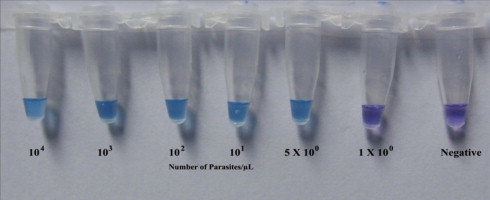
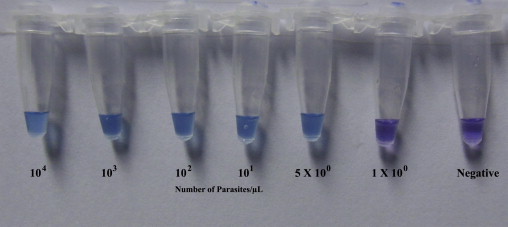
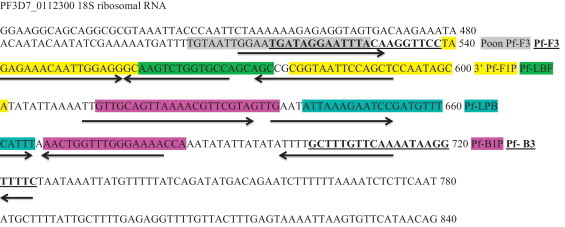
Molecular diagnosis of malaria by nucleotide amplification requires sophisticated and expensive instruments, typically found only in well-established laboratories. Loop-mediated isothermal amplification (LAMP) has provided a new platform for an easily adaptable molecular technique for molecular diagnosis of malaria without the use of expensive instruments. A new primer set has been designed targeting the 18S rRNA gene for the detection of Plasmodium falciparum in whole blood samples. The efficacy of LAMP using the new primer set was assessed in this study in comparison to that of a previously described set of LAMP primers as well as with microscopy and real-time PCR as reference methods for detecting P. falciparum. Pre-addition of hydroxy napthol blue (HNB) in the LAMP reaction caused a distinct color change, thereby improving the visual detection system. The new LAMP assay was found to be 99.1% sensitive compared to microscopy and 98.1% when compared to real-time PCR. Meanwhile, its specificity was 99% and 100% in contrast to microscopy and real-time PCR, respectively. Moreover, the LAMP method was in very good agreement with microscopy and real-time PCR (0.94 and 0.98, respectively). This new LAMP method can detect at least 5parasites/μL of infected blood within 35min, while the other LAMP method tested in this study, could detect a minimum of 100parasites/μL of human blood after 60min of amplification. Thus, the new method is sensitive and specific, can be carried out in a very short time, and can substitute PCR in healthcare clinics and standard laboratories.
通过核苷酸扩增进行疟疾的分子诊断需要精密且昂贵的仪器,这些仪器通常只有在成熟的实验室中才能找到。环介导等温扩增技术(LAMP)为疟疾分子诊断提供了一个易于应用的分子技术新平台,且无需使用昂贵的仪器。针对全血样本中恶性疟原虫的检测,已设计出一套新的引物,靶向18S rRNA基因。本研究评估了使用这套新引物的LAMP的效能,并与先前描述的一组LAMP引物以及作为检测恶性疟原虫参考方法的显微镜检查和实时PCR进行比较。在LAMP反应中预先添加羟基萘酚蓝(HNB)会导致明显的颜色变化,从而改进了视觉检测系统。结果发现,新的LAMP检测法与显微镜检查相比灵敏度为99.1%,与实时PCR相比为98.1%。同时,与显微镜检查和实时PCR相比,其特异性分别为99%和100%。此外,LAMP方法与显微镜检查和实时PCR的一致性非常好(分别为0.94和0.98)。这种新的LAMP方法能够在35分钟内检测出每微升感染血液中至少5个疟原虫,而本研究中测试的另一种LAMP方法在扩增60分钟后,能够检测出每微升人血中至少100个疟原虫。因此,这种新方法灵敏且特异,能在很短时间内完成,可在医疗诊所和标准实验室中替代PCR。