Biasini M, Schmidt T, Bienert S, Mariani V, Studer G, Haas J, Johner N, Schenk A D, Philippsen A, Schwede T
Biozentrum Universität Basel, University of Basel, Klingelbergstrasse 50-70, 4056 Basel, Switzerland.
Acta Crystallogr D Biol Crystallogr. 2013 May;69(Pt 5):701-9. doi: 10.1107/S0907444913007051. Epub 2013 Apr 19.
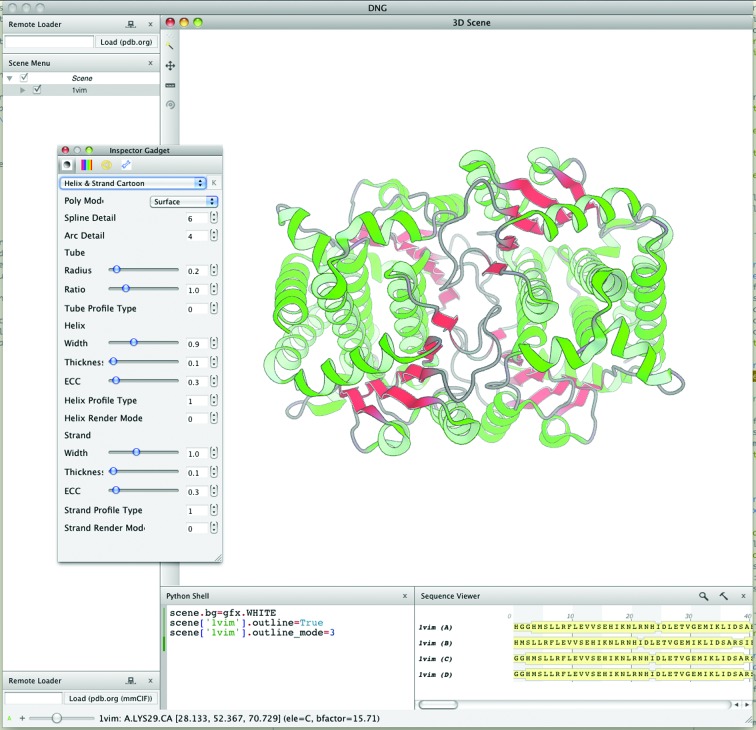
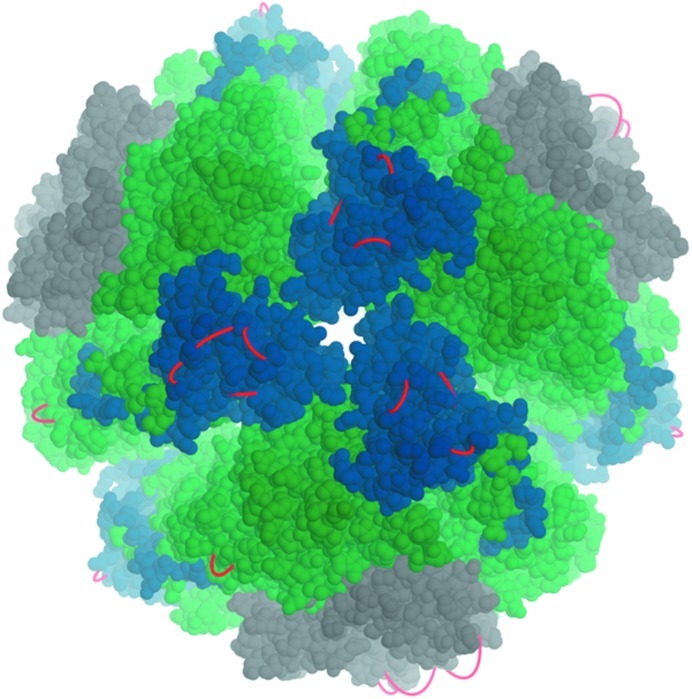
Research projects in structural biology increasingly rely on combinations of heterogeneous sources of information, e.g. evolutionary information from multiple sequence alignments, experimental evidence in the form of density maps and proximity constraints from proteomics experiments. The OpenStructure software framework, which allows the seamless integration of information of different origin, has previously been introduced. The software consists of C++ libraries which are fully accessible from the Python programming language. Additionally, the framework provides a sophisticated graphics module that interactively displays molecular structures and density maps in three dimensions. In this work, the latest developments in the OpenStructure framework are outlined. The extensive capabilities of the framework will be illustrated using short code examples that show how information from molecular-structure coordinates can be combined with sequence data and/or density maps. The framework has been released under the LGPL version 3 license and is available for download from http://www.openstructure.org.
结构生物学领域的研究项目越来越依赖于多种异构信息源的组合,例如来自多序列比对的进化信息、密度图形式的实验证据以及蛋白质组学实验中的邻近约束。此前已引入了OpenStructure软件框架,它能够无缝集成不同来源的信息。该软件由C++库组成,可通过Python编程语言完全访问。此外,该框架还提供了一个复杂的图形模块,可交互式地三维显示分子结构和密度图。在这项工作中,概述了OpenStructure框架的最新进展。将使用简短的代码示例来说明该框架的广泛功能,这些示例展示了如何将来自分子结构坐标的信息与序列数据和/或密度图相结合。该框架已根据LGPL第3版许可发布,可从http://www.openstructure.org下载。