Obaji Nc, Elom Ha, Agwu Um, Nwigwe Cg, Ezeonu Po, Umeora Ouj
Department of Obstetrics and Gynaecology, Faculty of Clinical Medicine, Ebonyi State University, Abakaliki, Nigeria.
Ann Med Health Sci Res. 2013 Jan;3(1):7-12. doi: 10.4103/2141-9248.109457.
Breast cancer is the most common female malignancy and commonly associated with high levels of morbidity and mortality in developing countries due to late presentation. Breast self-examination (BSE) can help in early detection of the disease.
This study aims to determine the awareness and practice of BSE among market women in Abakailiki, Southeast Nigeria.
This cross-sectional descriptive study involved the use of questionnaire among market women in Abakaliki. Inclusion criteria were women from the age of 18 years and above who own or sell in a shop, while females less than 18 years of age and women who came to the market to buy products were excluded. Questionnaires were distributed randomly among women who met the criteria in every shop visited based on willingness to participate. Analysis was done using Epi info version 3:5:3 (Atlanta Geogia USA.2008). The association between variables was tested using Chi square for trend statistics. Significance was set at P < 0.05. Binomial logistic regression analysis was used to test for relationship between the age group categories against ever heard of BSE.
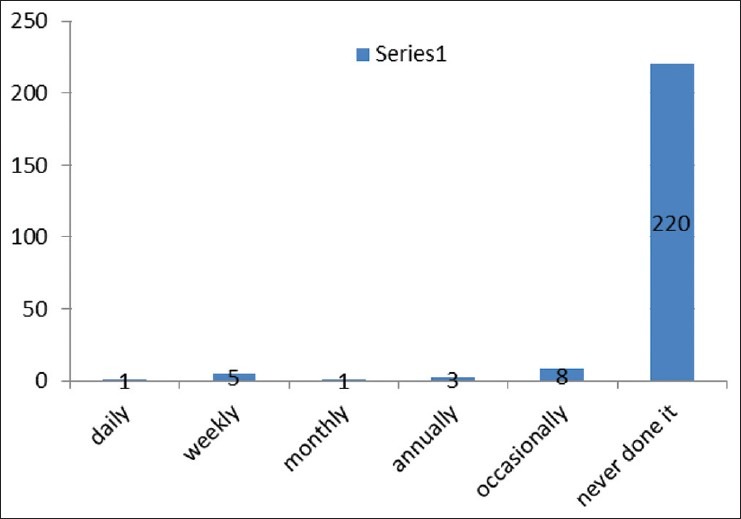
The age range of participants was between 20 and 65 years, with a mean age of 34.3 (10.8) years. The age range between 20 and 29 years constituted the highest age group 35.3% (84/238). Majority 54.2% (129/238) had a maximum of secondary education. Of the 238 participants, 77.7% have heard of breast cancer, of which 73.9% thought that early detection would aid treatment. Only 38.9% (6/195), 13% and 13.4% have heard of BSE, clinical breast examination and mammography, respectively. Just 23.9% have been taught how to perform BSE, while 21.8% had done it in the past. One person 0.4% knew the correct frequency of BSE, and also did it regularly. There was a statistically significant difference between the level of education and awareness of BSE. However, there was no statistical significant difference between participants age and awareness of BSE.
There was a low level of awareness of BSE among market women in Abakiliki, and there is a need to increase the level of awareness through campaigns.
乳腺癌是最常见的女性恶性肿瘤,在发展中国家,由于就诊延迟,其发病率和死亡率通常较高。乳房自我检查(BSE)有助于早期发现该病。
本研究旨在确定尼日利亚东南部阿巴卡利基市场女性对乳房自我检查的认知和实践情况。
本横断面描述性研究采用问卷调查阿巴卡利基市场的女性。纳入标准为18岁及以上拥有店铺或在店内售卖商品的女性,排除未满18岁的女性以及来市场购买商品的女性。根据参与意愿,在访问的每家符合标准的店铺中随机向女性发放问卷。使用Epi info 3:5:3版本(美国佐治亚州亚特兰大,2008年)进行分析。使用卡方趋势统计检验变量之间的关联。显著性设定为P < 0.05。采用二项逻辑回归分析检验年龄组类别与是否听说过乳房自我检查之间的关系。
参与者年龄范围在20至65岁之间,平均年龄为34.3(10.8)岁。20至29岁年龄组占比最高,为35.3%(84/238)。大多数人(54.2%,129/238)最高接受过中等教育。在238名参与者中,77.7%听说过乳腺癌,其中73.9%认为早期发现有助于治疗。分别只有38.9%(6/195)、13%和13.4%听说过乳房自我检查、临床乳房检查和乳房X线摄影。仅有23.9%的人学过如何进行乳房自我检查,而21.8%的人过去做过。1人(0.4%)知道乳房自我检查的正确频率,并且定期进行。教育水平与乳房自我检查认知之间存在统计学显著差异。然而,参与者年龄与乳房自我检查认知之间无统计学显著差异。
阿巴卡利基市场女性对乳房自我检查的认知水平较低,需要通过开展宣传活动提高认知水平。