Max Planck Society, Center for Lifespan Psychology, Max Planck Institute for Human Development Berlin, Germany.
Front Hum Neurosci. 2013 Apr 26;7:157. doi: 10.3389/fnhum.2013.00157. eCollection 2013.
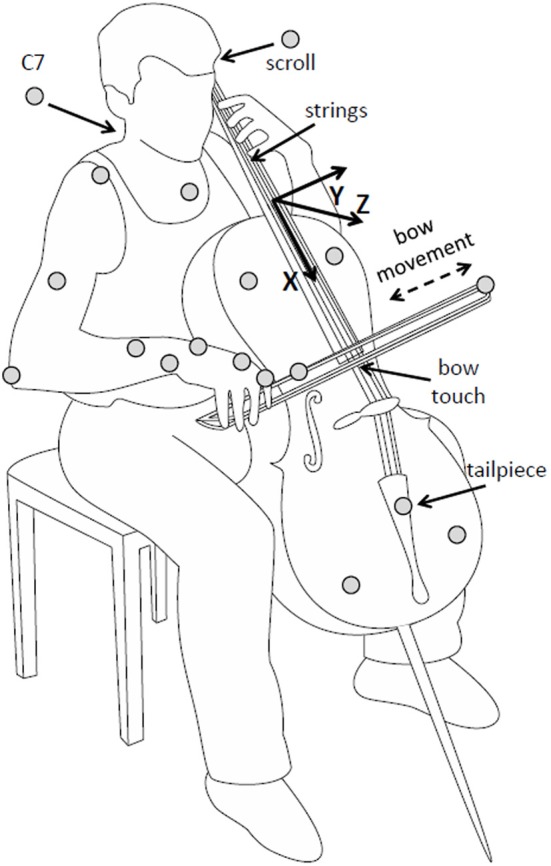
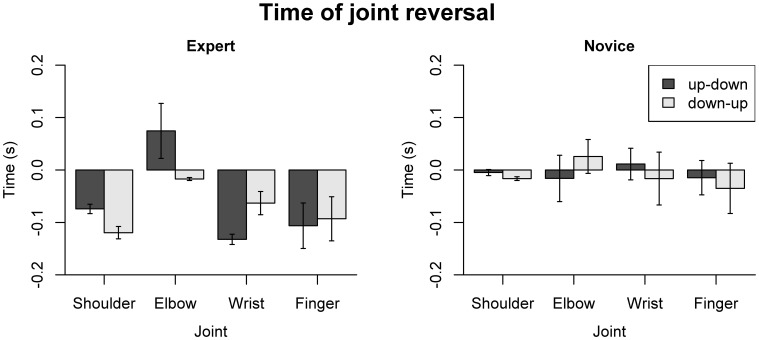
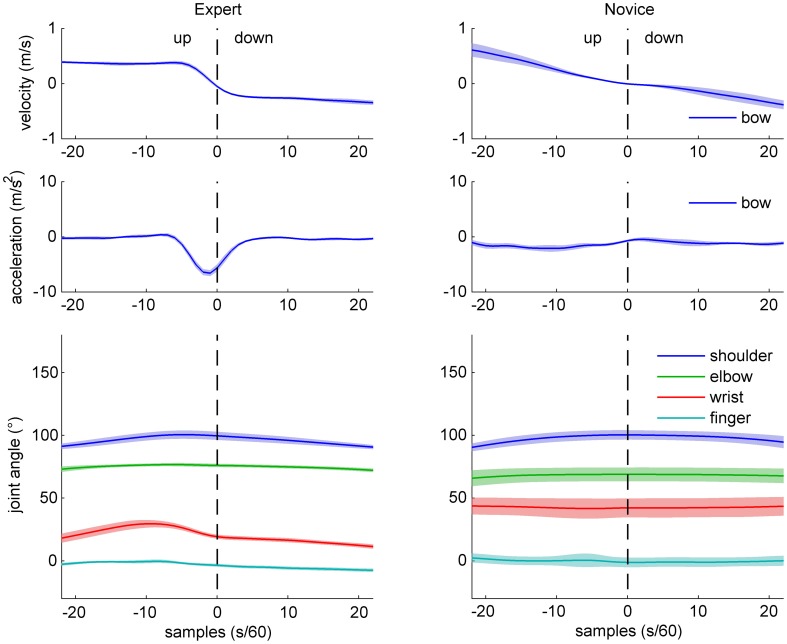
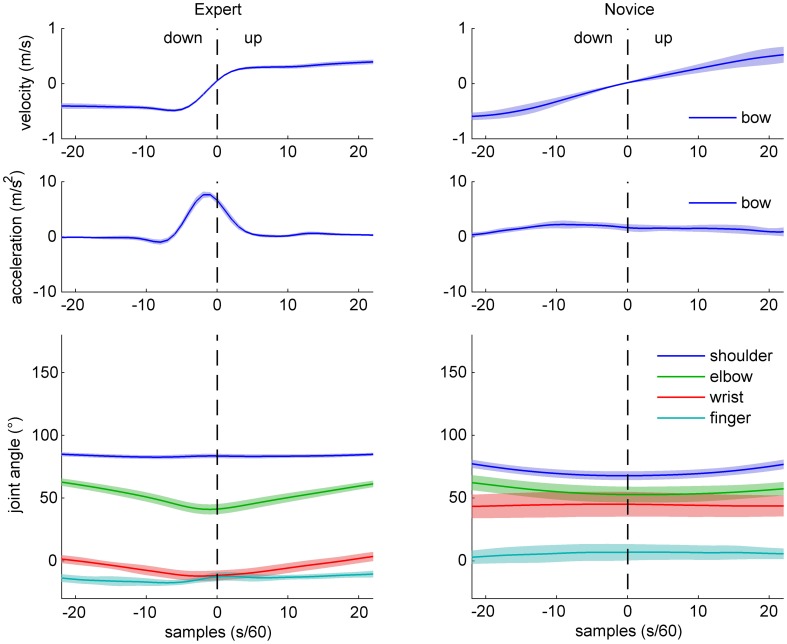
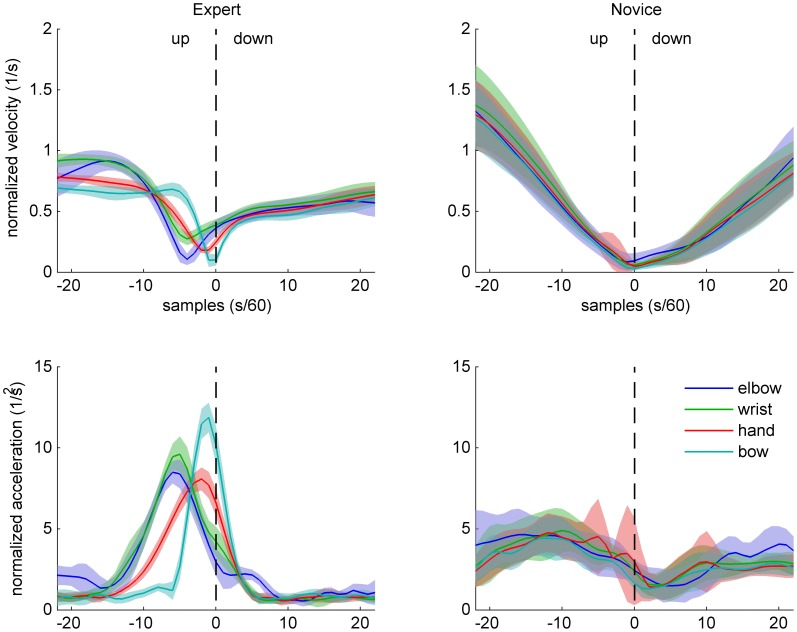
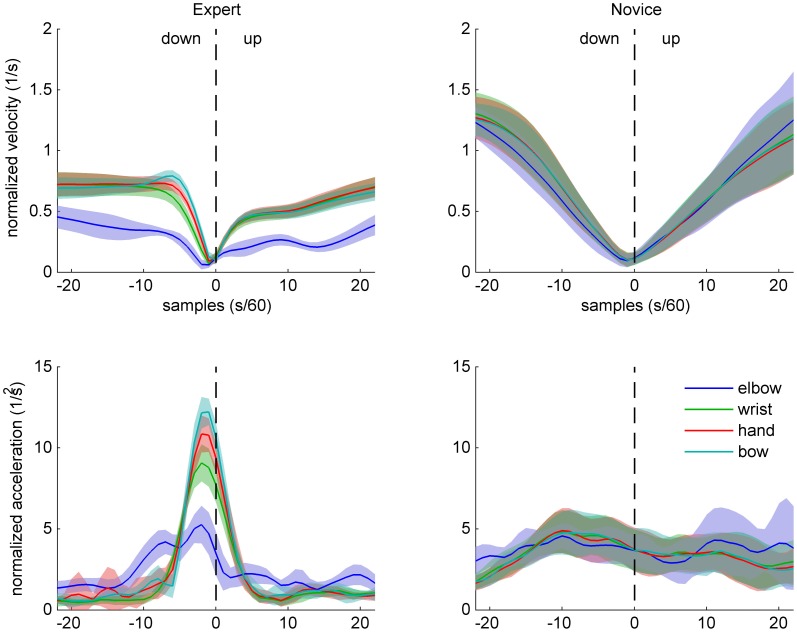
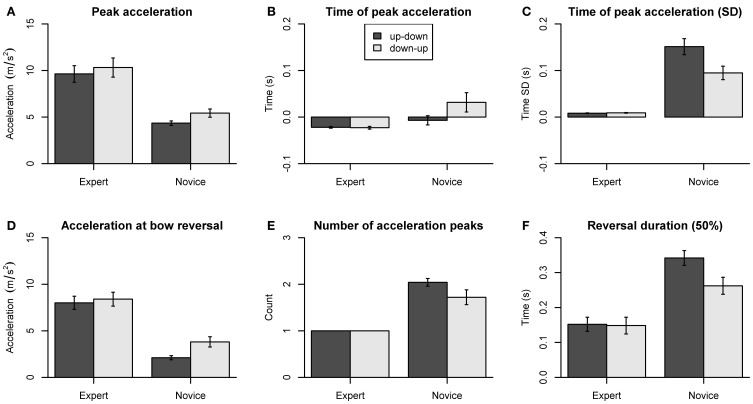
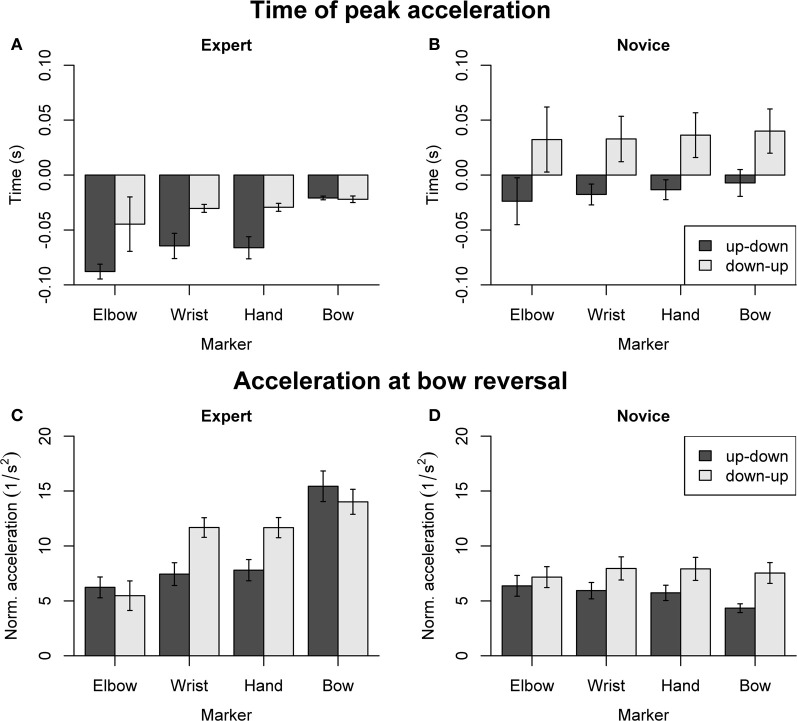
Theoretical and empirical evidence suggests that accurate and efficient motor performance may be achieved by task-specific exploitation of biomechanical degrees of freedom. We investigate coordination of the right arm in a task requiring a sudden yet precisely controlled reversal of movement direction: bow reversals during continuous ("legato") tone production on a stringed instrument. Ten advanced or professional cello players (at least 10 years of practice) and ten age-matched novice players took part in the study. Kinematic data from the bow and the right arm were analyzed in terms of velocity and acceleration profiles, as well as temporal coordination along the arm. As expected, experts' bow velocity and acceleration profiles differed markedly from those of novice participants, with higher peak accelerations and quicker direction changes. Importantly, experts achieved the change in movement direction with a single acceleration peak while novices tended to use multiple smaller acceleration peaks. Experts moreover showed a proximal-distal gradient in timing and amplitudes of acceleration peaks, with earlier and lower-amplitude reversals at more proximal joints. We suggest that this coordination pattern allows generating high accelerations at the end effector while reducing the required joint torques at the proximal joints. This may underlie experts' ability to produce fast bow reversals efficiently and with high spatiotemporal accuracy. The findings are discussed in terms of motor control theory as well as potential implications for musicians' performance and health.
理论和经验证据表明,通过针对生物力学自由度的特定任务利用,可能实现准确和高效的运动表现。我们研究了在需要突然但精确控制运动方向反转的任务中右臂的协调:在弦乐器上连续(“连奏”)产生音调时进行弓的反转。十位高级或专业的大提琴演奏者(至少有 10 年的练习经验)和十位年龄匹配的新手演奏者参加了这项研究。根据速度和加速度曲线以及手臂的时间协调,分析了弓和右臂的运动学数据。正如预期的那样,专家的弓速度和加速度曲线与新手参与者明显不同,具有更高的峰值加速度和更快的方向变化。重要的是,专家在一次加速峰值时实现了运动方向的变化,而新手则倾向于使用多个较小的加速度峰值。此外,专家在加速度峰值的时间和幅度上表现出近-远梯度,近端关节的反转时间更早,幅度更低。我们认为这种协调模式允许在末端效应器上产生高加速度,同时降低近端关节的所需关节扭矩。这可能是专家能够高效且具有高时空准确性地产生快速弓反转的原因。该研究结果从运动控制理论的角度进行了讨论,并探讨了其对音乐家表现和健康的潜在影响。