Department of Electrical Engineering, Vanderbilt University, Nashville, Tennessee, United States of America.
PLoS One. 2013 Apr 30;8(4):e61737. doi: 10.1371/journal.pone.0061737. Print 2013.
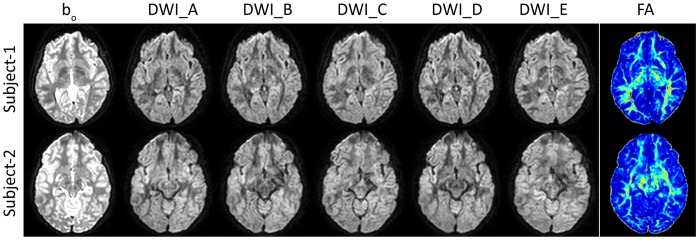
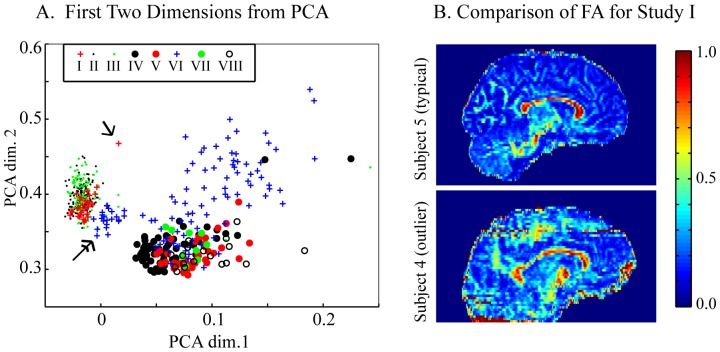
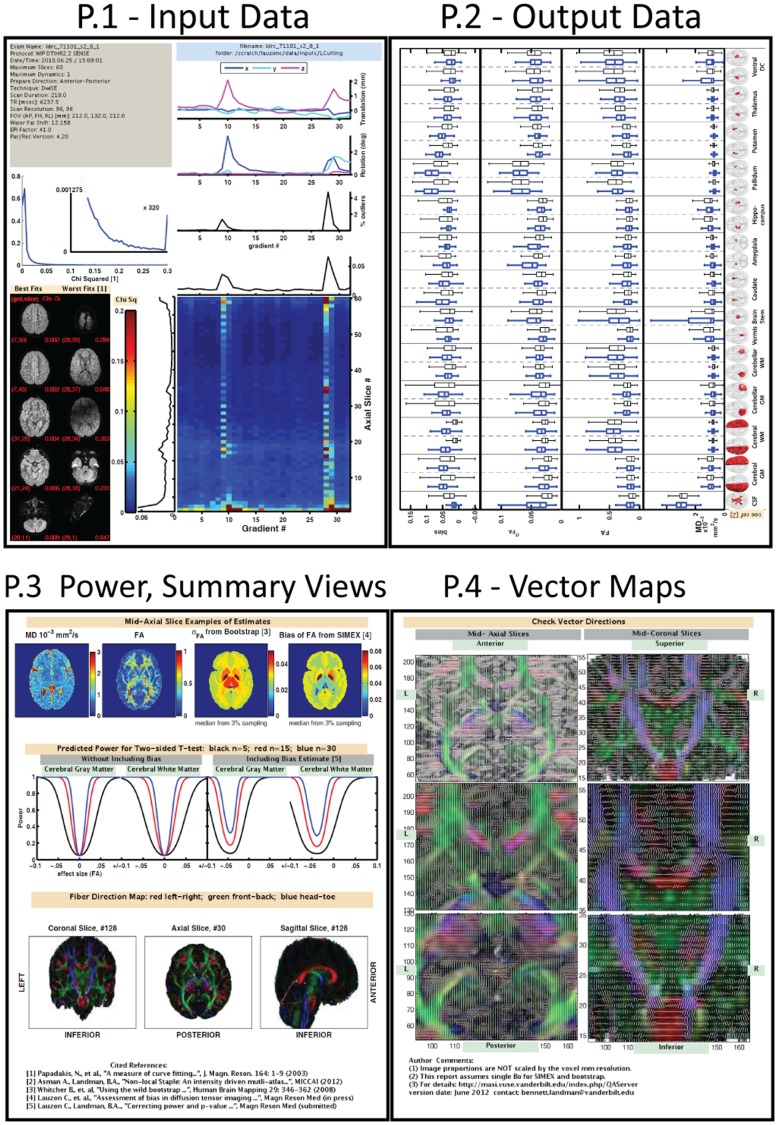
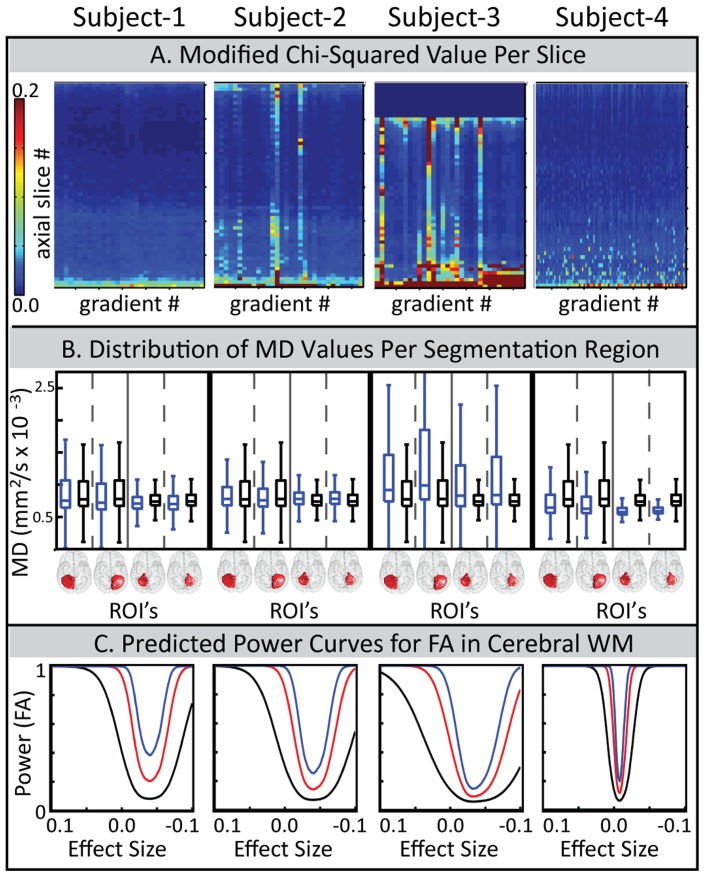
Diffusion tensor imaging (DTI) enables non-invasive, cyto-architectural mapping of in vivo tissue microarchitecture through voxel-wise mathematical modeling of multiple magnetic resonance imaging (MRI) acquisitions, each differently sensitized to water diffusion. DTI computations are fundamentally estimation processes and are sensitive to noise and artifacts. Despite widespread adoption in the neuroimaging community, maintaining consistent DTI data quality remains challenging given the propensity for patient motion, artifacts associated with fast imaging techniques, and the possibility of hardware changes/failures. Furthermore, the quantity of data acquired per voxel, the non-linear estimation process, and numerous potential use cases complicate traditional visual data inspection approaches. Currently, quality inspection of DTI data has relied on visual inspection and individual processing in DTI analysis software programs (e.g. DTIPrep, DTI-studio). However, recent advances in applied statistical methods have yielded several different metrics to assess noise level, artifact propensity, quality of tensor fit, variance of estimated measures, and bias in estimated measures. To date, these metrics have been largely studied in isolation. Herein, we select complementary metrics for integration into an automatic DTI analysis and quality assurance pipeline. The pipeline completes in 24 hours, stores statistical outputs, and produces a graphical summary quality analysis (QA) report. We assess the utility of this streamlined approach for empirical quality assessment on 608 DTI datasets from pediatric neuroimaging studies. The efficiency and accuracy of quality analysis using the proposed pipeline is compared with quality analysis based on visual inspection. The unified pipeline is found to save a statistically significant amount of time (over 70%) while improving the consistency of QA between a DTI expert and a pool of research associates. Projection of QA metrics to a low dimensional manifold reveal qualitative, but clear, QA-study associations and suggest that automated outlier/anomaly detection would be feasible.
弥散张量成像(DTI)通过对多个磁共振成像(MRI)采集的体素进行数学建模,实现了对活体组织微观结构的非侵入性、细胞结构映射,这些采集分别对水分子扩散敏感。DTI 计算是一种基本的估计过程,对噪声和伪影敏感。尽管在神经影像学领域得到了广泛应用,但由于患者运动、快速成像技术相关的伪影以及硬件变化/故障的可能性,保持一致的 DTI 数据质量仍然具有挑战性。此外,每个体素采集的数据量、非线性估计过程以及许多潜在的应用案例使得传统的视觉数据检查方法变得复杂。目前,DTI 数据的质量检查依赖于视觉检查和 DTI 分析软件程序(如 DTIPrep、DTI-studio)中的个体处理。然而,应用统计学方法的最新进展已经产生了几种不同的指标来评估噪声水平、伪影倾向、张量拟合质量、估计量的方差以及估计量的偏差。迄今为止,这些指标在很大程度上是孤立地进行研究的。在这里,我们选择互补的指标来整合到自动 DTI 分析和质量保证管道中。该管道在 24 小时内完成,存储统计输出,并生成图形总结质量分析(QA)报告。我们评估了这种简化方法在 608 个儿科神经影像学研究的 DTI 数据集上进行经验质量评估的效用。与基于视觉检查的质量分析相比,所提出的管道在质量分析的效率和准确性方面具有优势。发现统一的管道在节省大量时间(超过 70%)的同时,还提高了 DTI 专家和一组研究助理之间 QA 的一致性。QA 指标的投影到低维流形上揭示了定性的,但明确的,QA-研究关联,并表明自动异常/异常检测是可行的。