ARC Centre of Excellence in Cognition and its Disorders, Macquarie University , Sydney, NSW , Australia.
PeerJ. 2013 Feb 19;1:e38. doi: 10.7717/peerj.38. Print 2013.
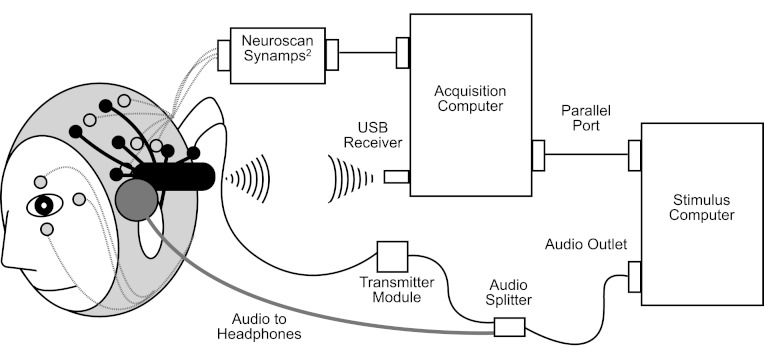
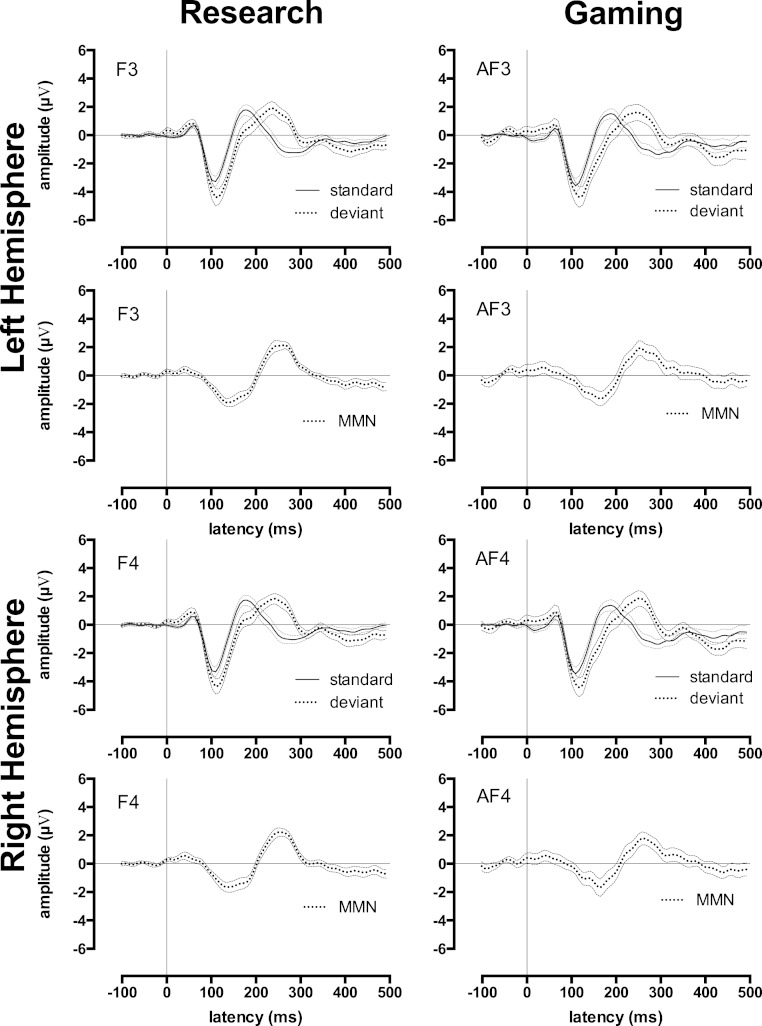
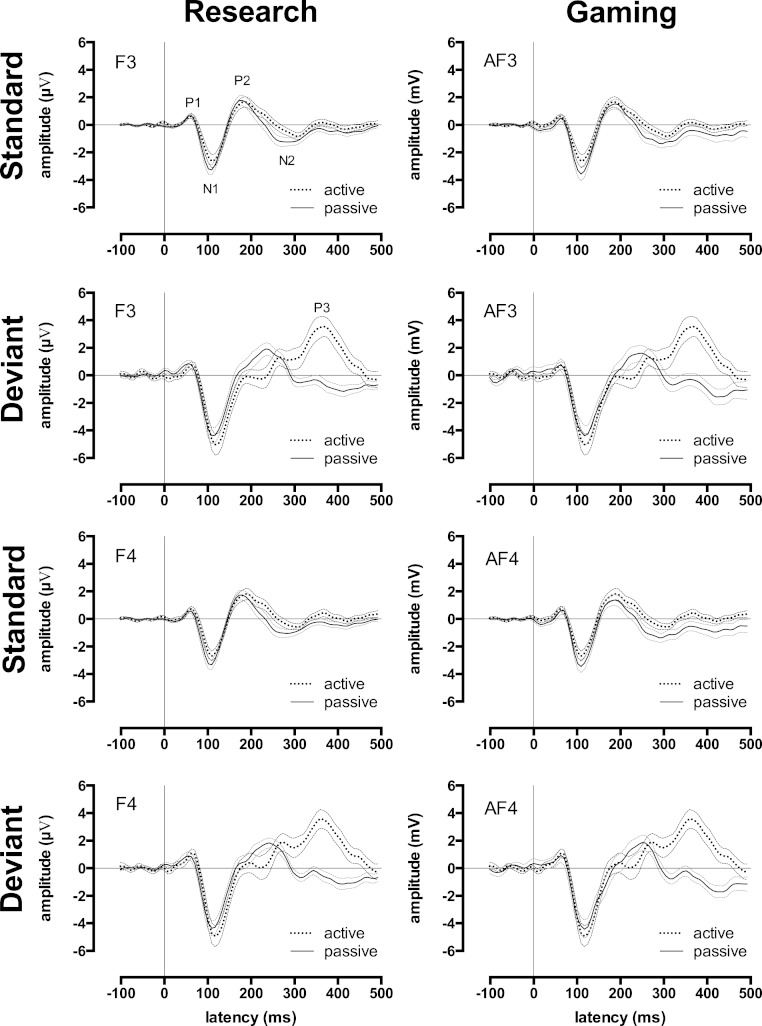
Background. Auditory event-related potentials (ERPs) have proved useful in investigating the role of auditory processing in cognitive disorders such as developmental dyslexia, specific language impairment (SLI), attention deficit hyperactivity disorder (ADHD), schizophrenia, and autism. However, laboratory recordings of auditory ERPs can be lengthy, uncomfortable, or threatening for some participants - particularly children. Recently, a commercial gaming electroencephalography (EEG) system has been developed that is portable, inexpensive, and easy to set up. In this study we tested if auditory ERPs measured using a gaming EEG system (Emotiv EPOC(®), www.emotiv.com) were equivalent to those measured by a widely-used, laboratory-based, research EEG system (Neuroscan). Methods. We simultaneously recorded EEGs with the research and gaming EEG systems, whilst presenting 21 adults with 566 standard (1000 Hz) and 100 deviant (1200 Hz) tones under passive (non-attended) and active (attended) conditions. The onset of each tone was marked in the EEGs using a parallel port pulse (Neuroscan) or a stimulus-generated electrical pulse injected into the O1 and O2 channels (Emotiv EPOC(®)). These markers were used to calculate research and gaming EEG system late auditory ERPs (P1, N1, P2, N2, and P3 peaks) and the mismatch negativity (MMN) in active and passive listening conditions for each participant. Results. Analyses were restricted to frontal sites as these are most commonly reported in auditory ERP research. Intra-class correlations (ICCs) indicated that the morphology of the research and gaming EEG system late auditory ERP waveforms were similar across all participants, but that the research and gaming EEG system MMN waveforms were only similar for participants with non-noisy MMN waveforms (N = 11 out of 21). Peak amplitude and latency measures revealed no significant differences between the size or the timing of the auditory P1, N1, P2, N2, P3, and MMN peaks. Conclusions. Our findings suggest that the gaming EEG system may prove a valid alternative to laboratory ERP systems for recording reliable late auditory ERPs (P1, N1, P2, N2, and the P3) over the frontal cortices. In the future, the gaming EEG system may also prove useful for measuring less reliable ERPs, such as the MMN, if the reliability of such ERPs can be boosted to the same level as late auditory ERPs.
背景。听觉事件相关电位(ERP)已被证明在研究听觉处理在认知障碍中的作用方面非常有用,例如发育性阅读障碍、特定语言障碍(SLI)、注意力缺陷多动障碍(ADHD)、精神分裂症和自闭症。然而,对于一些参与者,特别是儿童来说,实验室记录听觉 ERP 可能既冗长又不舒服,甚至具有威胁性。最近,一种商业游戏脑电图(EEG)系统已经开发出来,它便携、廉价且易于设置。在这项研究中,我们测试了使用游戏 EEG 系统(Emotiv EPOC®,www.emotiv.com)测量的听觉 ERP 是否与广泛使用的实验室研究 EEG 系统(Neuroscan)测量的 ERP 等效。方法。我们同时使用研究和游戏 EEG 系统记录脑电图,同时向 21 名成年人呈现 566 个标准(1000 Hz)和 100 个偏差(1200 Hz)音,处于被动(非注意)和主动(注意)条件下。每个音的起始都使用并行端口脉冲(Neuroscan)或注入 O1 和 O2 通道的刺激产生的电脉冲在 EEG 中标记(Emotiv EPOC®)。这些标记用于计算每个参与者在主动和被动聆听条件下的研究和游戏 EEG 系统晚期听觉 ERP(P1、N1、P2、N2 和 P3 峰)和失匹配负波(MMN)。结果。分析仅限于额叶部位,因为这些部位在听觉 ERP 研究中最常被报道。组内相关系数(ICC)表明,研究和游戏 EEG 系统晚期听觉 ERP 波形的形态在所有参与者中相似,但研究和游戏 EEG 系统 MMN 波形仅在 MMN 波形无噪声的参与者中相似(21 名参与者中有 11 名)。峰幅度和潜伏期测量结果表明,听觉 P1、N1、P2、N2、P3 和 MMN 峰的大小或时间没有显著差异。结论。我们的研究结果表明,对于记录额叶皮质上可靠的晚期听觉 ERP(P1、N1、P2、N2 和 P3),游戏 EEG 系统可能是实验室 ERP 系统的有效替代方案。在未来,如果此类 ERP 的可靠性可以提高到与晚期听觉 ERP 相同的水平,那么游戏 EEG 系统也可能有助于测量不太可靠的 ERP,例如 MMN。