Department of Psychiatry, Harvard Medical School, Boston, MA, USA.
McLean Hospital, Cognitive Neuroscience Laboratory, Belmont, MA, USA.
Clin EEG Neurosci. 2020 Jul;51(4):198-206. doi: 10.1177/1550059419868115. Epub 2019 Aug 7.
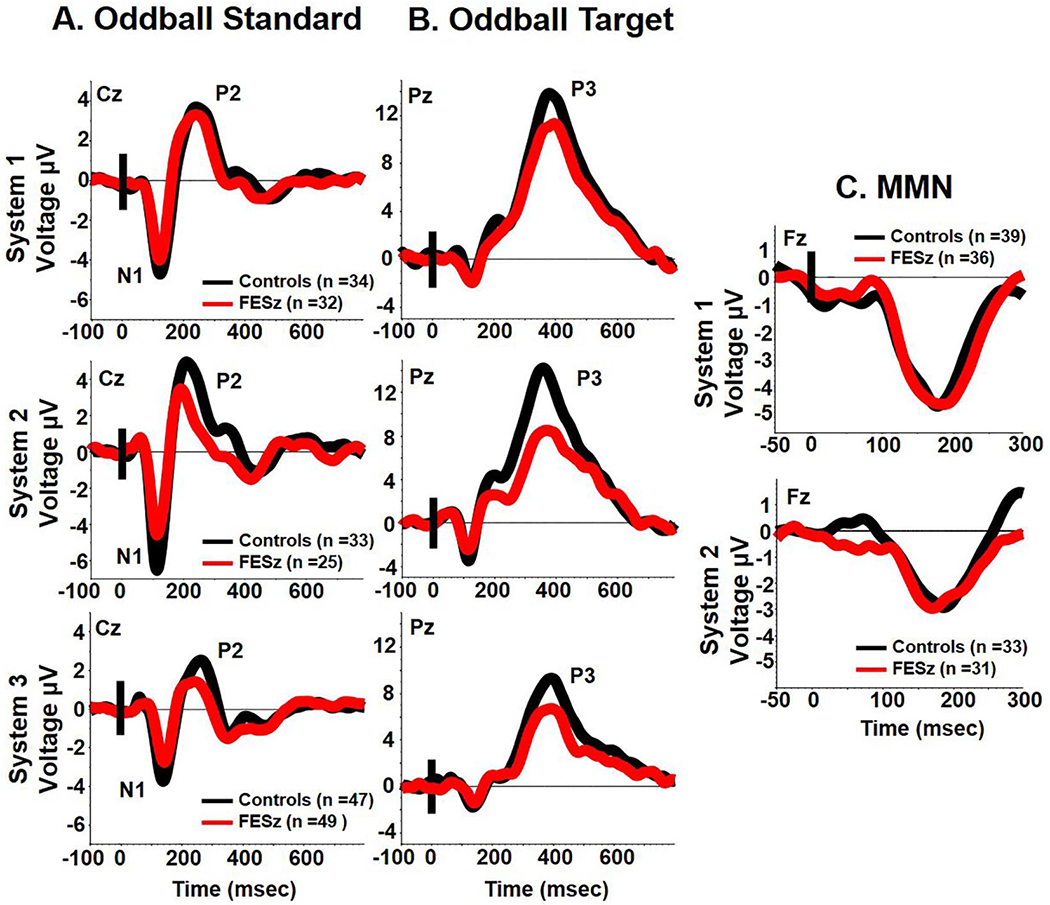
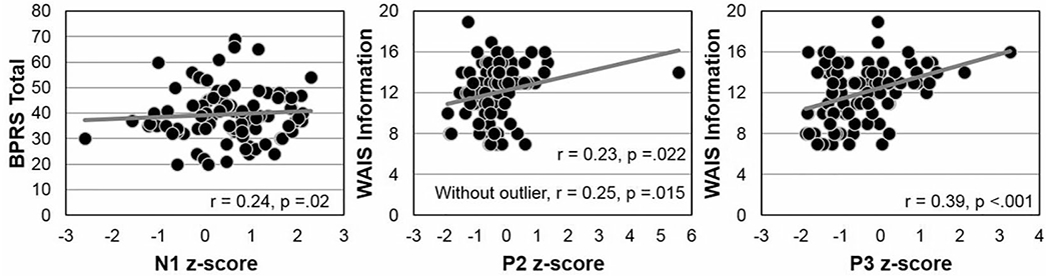
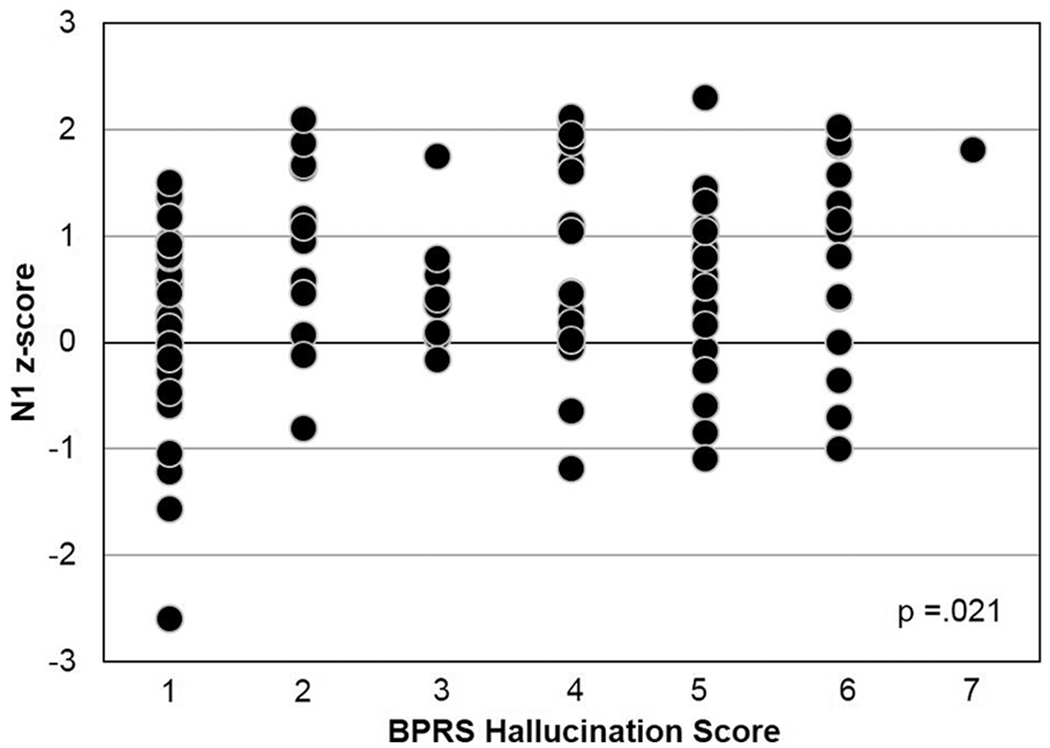
The N1, P2, and P3 event-related potentials (ERPs) are impaired in first-episode schizophrenia (FESz). Reduced pitch-deviant mismatch negativity (MMN) is present in chronic schizophrenia but not FESz. We examined effect sizes of, and correlations between, N1, P2, P3, and MMN in 106 FESz and 114 matched psychiatrically well controls to determine which ERPs maximally differentiated groups, and whether late sensory/perceptual deficits (N1, P2) affected preattentive memory (MMN) and conscious attention (P3). Furthermore, we compared hallucinators and nonhallucinators within FESz. Participants completed 1 of 3 oddball tasks, silently counting target tones among standard tones. Sixty-seven FESz and 72 matched participants also completed pitch-deviant MMN testing. Measures were -scored from task appropriate controls before merging samples. Mean -scores for N1, P2, and P3 were significantly abnormal in FESz, while pitch-deviant MMN was not. N1 showed the largest deficit ( = 0.53), and only N1 was smaller in hallucinators (n = 71) than nonhallucinators (n = 27). Among all participants, early sensory processing (N1, P2) correlated with later cognitive processing (P3), and P2 and P3 also correlated with automatic preattentive memory (pitch-deviant MMN). In well individuals, N1 was associated with MMN. These data are consistent with bottom-up sensory/perceptual processes affecting more cognitive processes. However, N1 and MMN were not associated in FESz, suggesting different auditory cortex physiology underlie these ERPs, which is differentially affected in FESz. Larger P2 and P3 with greater estimated premorbid intellect in patients indicate a possible neuroprotective effect of intellect in FESz.
N1、P2 和 P3 事件相关电位(ERPs)在首发精神分裂症(FESz)中受损。慢性精神分裂症中存在音高偏离性失匹配负波(MMN),但 FESz 中不存在。我们检查了 106 例 FESz 和 114 例匹配的精神病学良好对照组中的 N1、P2、P3 和 MMN 的效应大小和相关性,以确定哪些 ERPs 最大程度地区分了两组,以及迟发性感觉/知觉缺陷(N1、P2)是否影响前注意记忆(MMN)和意识注意(P3)。此外,我们比较了 FESz 中的幻觉患者和非幻觉患者。参与者完成了 1 项oddball 任务之一,在标准音中无声地计数目标音。67 例 FESz 和 72 例匹配的参与者还完成了音高偏离性 MMN 测试。在合并样本之前,对与任务相关的对照进行了-score 评分。FESz 中的 N1、P2 和 P3 的平均-评分明显异常,而音高偏离性 MMN 则没有。N1 显示出最大的缺陷(=0.53),并且仅在幻觉患者(n=71)中 N1 小于非幻觉患者(n=27)。在所有参与者中,早期感觉处理(N1、P2)与后期认知处理(P3)相关,并且 P2 和 P3 也与自动前注意记忆(音高偏离性 MMN)相关。在健康个体中,N1 与 MMN 相关。这些数据与自下而上的感觉/知觉过程影响更多认知过程一致。然而,在 FESz 中,N1 和 MMN 之间没有关联,这表明这些 ERPs 的听觉皮层生理学不同,并且在 FESz 中受到不同的影响。患者中较大的 P2 和 P3 与较高的预期前病智力表明智力在 FESz 中可能具有神经保护作用。