Center for Biomedical Informatics, Harvard Medical School, Boston, Massachusetts, USA.
Genet Med. 2013 Nov;15(11):882-7. doi: 10.1038/gim.2013.58. Epub 2013 May 2.
Whether and how to return individual genetic results to study participants is among the most contentious policy issues in contemporary genomic research.
We surveyed corresponding authors of genome-wide association studies, identified through the National Human Genome Research Institute's Catalog of Published Genome-Wide Association Studies, to describe the experiences and attitudes of these stakeholders.
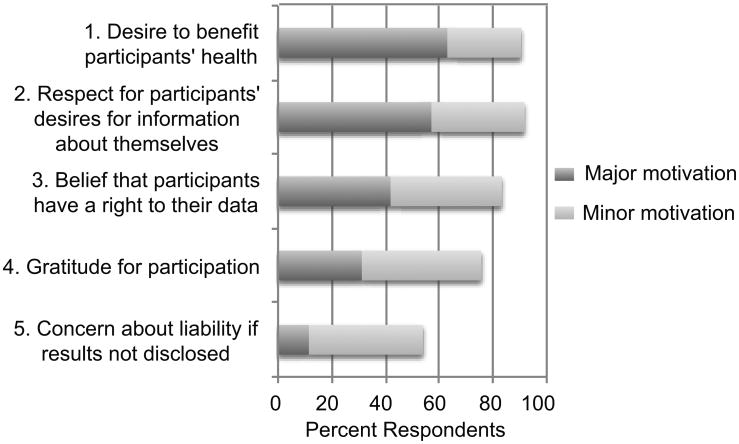
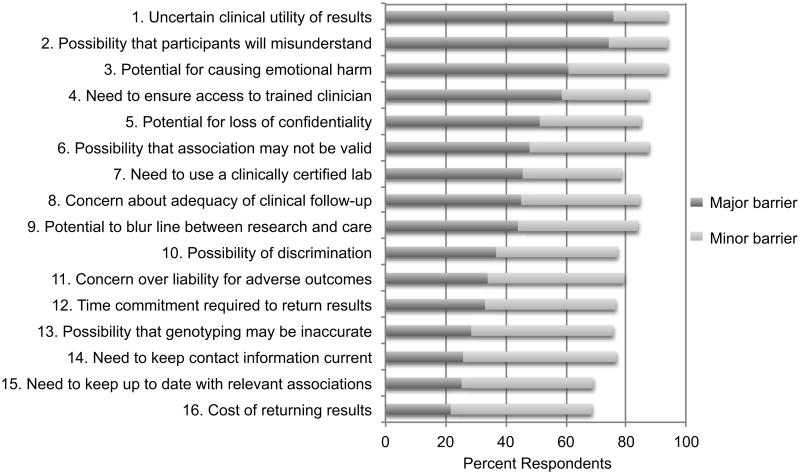
Of 357 corresponding authors, 200 (56%) responded. One hundred twenty-six (63%) had been responsible for primary data and sample collection, whereas 74 (37%) had performed secondary analyses. Only 7 (4%) had returned individual results within their index genome-wide association studies. Most (69%) believed that return of results to individual participants was warranted under at least some circumstances. Most respondents identified a desire to benefit participants' health (63%) and respect for participants' desire for information (57%) as major motivations for returning results. Most also identified uncertain clinical utility (76%), the possibility that participants will misunderstand results (74%), the potential for emotional harm (61%), the need to ensure access to trained clinicians (59%), and the potential for loss of confidentiality (51%) as major barriers to return of results.
Investigators have limited experience returning individual results from genome-scale research, yet most are motivated to do so in at least some circumstances.
是否以及如何将个体基因结果返还给研究参与者是当代基因组研究中最具争议的政策问题之一。
我们调查了通过国家人类基因组研究所已发表的全基因组关联研究目录确定的全基因组关联研究的对应作者,以描述这些利益相关者的经验和态度。
在 357 位对应作者中,有 200 位(56%)做出了回应。其中 126 位(63%)负责原始数据和样本收集,而 74 位(37%)进行了二次分析。仅有 7 位(4%)在其索引全基因组关联研究中返回了个体结果。大多数(69%)认为在至少某些情况下,将结果返还给个体参与者是合理的。大多数受访者将为参与者的健康带来益处(63%)和尊重参与者获取信息的愿望(57%)视为返还结果的主要动机。大多数人还认为临床应用的不确定性(76%)、参与者误解结果的可能性(74%)、潜在的情绪伤害(61%)、确保获得训练有素的临床医生的必要性(59%)以及可能失去保密性(51%)是返还结果的主要障碍。
调查人员在从基因组规模的研究中返回个体结果方面经验有限,但大多数人在至少某些情况下都有动力这样做。