Lam Chun Bun, McHale Susan M, Updegraff Kimberly A
Sex Roles. 2012 Jul 1;67(1-2):17-28. doi: 10.1007/s11199-012-0137-3.
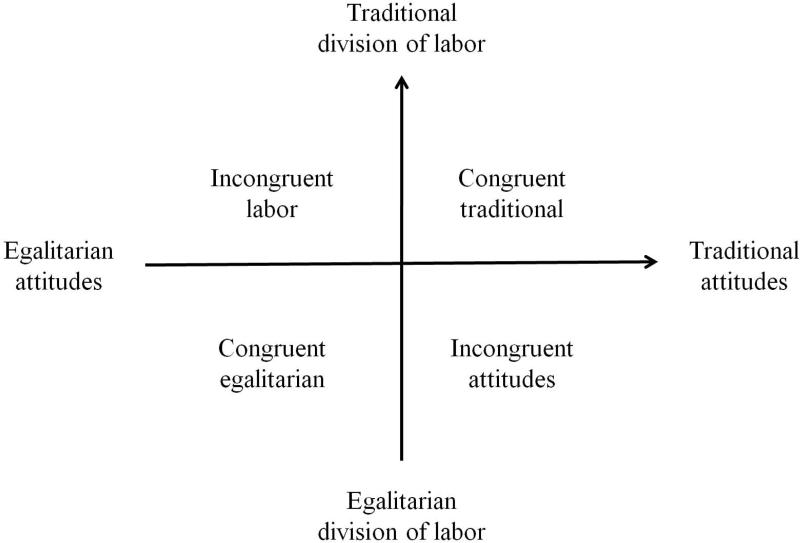
Study goals were to examine the conditions under which congruent and incongruent patterns of parents' division of household labor and gender role attitudes emerged, and the implications of these patterns for youth gender development. Questionnaire and phone diary data were collected from mothers, fathers, and youths from 236 Mexican American families in the southwestern US. Preliminary cluster analysis identified three patterns: Traditional divisions of labor and traditional attitudes, egalitarian divisions of labor and egalitarian attitudes, and an incongruent pattern, with a traditional division of labor but egalitarian attitudes. MANOVAs, and follow-up, mixed- and between-group ANOVAs, revealed that these groups of families differed in parents' time constraints, socioeconomic resources, and cultural orientations. Mothers in the congruent egalitarian group worked more hours and earned higher incomes as compared to mothers in the congruent traditional and incongruent groups, and the emergence of the incongruent group was grounded in within-family, inter-parental differences in work hours and incomes. Parents' patterns of gendered practices and beliefs were linked to their youths' housework participation, time with mothers versus fathers, and gender role attitudes. Youths in the congruent traditional group had more traditional gender role attitudes than those in the congruent egalitarian and incongruent groups, and gender atypical housework participation and time with parents were only observed in the congruent egalitarian group. Findings demonstrate the utility of a within-family design to understand complex gendered phenomena, and highlight the multidimensional nature of gender and the importance of contextualizing the study of ethnic minorities.
研究目标是考察父母家务分工与性别角色态度一致和不一致模式出现的条件,以及这些模式对青少年性别发展的影响。我们从美国西南部236个墨西哥裔美国家庭的母亲、父亲和青少年那里收集了问卷调查和电话日记数据。初步聚类分析确定了三种模式:传统的劳动分工和传统态度、平等的劳动分工和平等态度,以及一种不一致的模式,即传统的劳动分工但平等的态度。多变量方差分析以及后续的混合组和组间方差分析表明,这些家庭组在父母的时间限制、社会经济资源和文化取向方面存在差异。与传统一致组和不一致组的母亲相比,平等一致组的母亲工作时间更长,收入更高,不一致组的出现基于家庭内部父母在工作时间和收入上的差异。父母的性别化行为和信念模式与他们青少年的家务参与、与母亲和父亲相处的时间以及性别角色态度有关。传统一致组的青少年比平等一致组和不一致组的青少年有更传统的性别角色态度,只有在平等一致组中观察到了性别非典型的家务参与和与父母相处的时间。研究结果证明了家庭内部设计对于理解复杂性别现象的效用,并强调了性别的多维度性质以及将少数民族研究置于背景中的重要性。