Department of Internal Medicine, Konkuk University School of Medicine, Seoul, Korea.
Diabetes Metab J. 2013 Apr;37(2):117-24. doi: 10.4093/dmj.2013.37.2.117. Epub 2013 Apr 16.
The purpose of this study was to evaluate change in glycosylated hemoglobin (HbA1c), side effects, and quality of life (QOL) after a 16-week treatment period with Biphasic insulin aspart 30/70 (BIasp30) in patients with type 2 diabetes mellitus (T2DM) who had been suboptimally controlled with oral antidiabetic drugs (OADs).
The study consisted of a 4-week titration period when concurrent OAD(s) were replaced with BIasp30 and followed by a 12-week maintenance period. All patients completed the Diabetes Treatment Satisfaction Questionnaire at the beginning and the end of the trial. Hypoglycemic episodes were recorded by the patient throughout the trial.
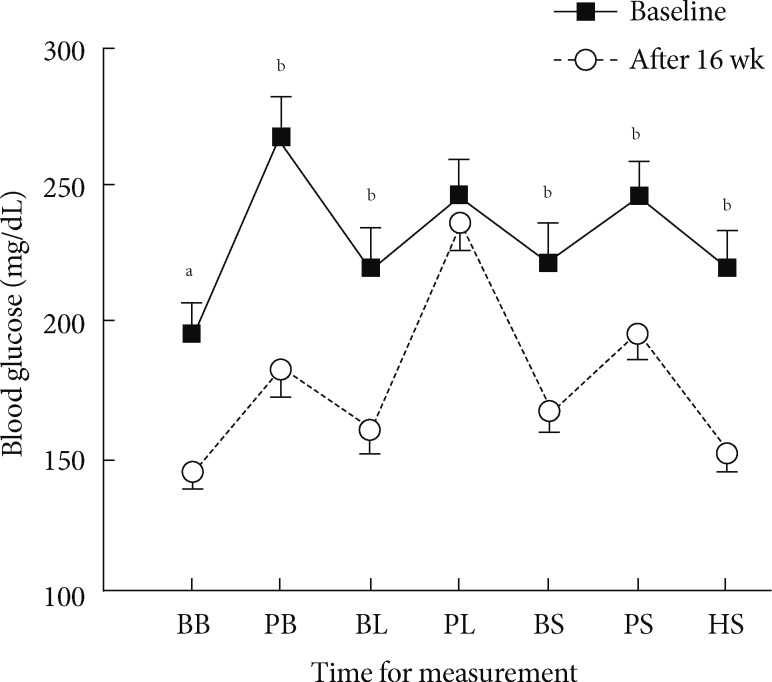
Sixty patients were included, of whom 55 patients (92%) completed the full 16-week treatment period. Seven-point blood glucose was significantly improved as compared with the baseline, except for the postlunch blood glucose level. HbA1c at the end of period was significantly improved from 9.2% to 8.2% (P<0.001). Eleven percent (n=6) of patients achieved HbA1c values ≤6.5% and 22% (n=12) of patients achieved <7.0%. There were 3.4 episodes/patients-year of minor hypoglycemia and 0.05 episodes/patients-year of major hypoglycemia. QOL showed significant changes only in the acceptability of high blood glucose category (P=0.003).
Treatment with once or twice daily BIasp30 may be an option for the patients with T2DM suboptimally controlled with OADs in Korea. However, considering the low number of patients achieving the HbA1c target and the high postlunch blood glucose levels, additional management with another modality may be required for optimal control.
本研究旨在评估接受预混胰岛素类似物 30/70(BIasp30)治疗 16 周后,糖化血红蛋白(HbA1c)的变化、不良反应和生活质量(QOL),这些患者在接受口服抗糖尿病药物(OAD)治疗时血糖控制不佳。
研究包括 4 周的滴定期,在此期间,同时使用的 OAD 被 BIasp30 替代,随后是 12 周的维持期。所有患者在试验开始和结束时都完成了糖尿病治疗满意度问卷。整个试验过程中,患者记录了低血糖发作情况。
共纳入 60 例患者,其中 55 例(92%)完成了完整的 16 周治疗期。与基线相比,除了午餐后血糖水平外,七点血糖均显著改善。治疗期末 HbA1c 显著从 9.2%改善至 8.2%(P<0.001)。11%(n=6)的患者 HbA1c 值达到≤6.5%,22%(n=12)的患者 HbA1c 值达到<7.0%。低血糖发作率为 3.4 例/患者/年,严重低血糖发作率为 0.05 例/患者/年。QOL 仅在接受高血糖分类方面有显著变化(P=0.003)。
在韩国,对于 OAD 控制不佳的 T2DM 患者,每日一次或两次 BIasp30 治疗可能是一种选择。然而,考虑到达到 HbA1c 目标的患者数量较少,且午餐后血糖水平较高,可能需要额外的治疗方法来达到最佳控制。