School of Biological Sciences, E249 Beadle Center, University of Nebraska-Lincoln, USA.
Genome Biol Evol. 2013;5(6):1079-86. doi: 10.1093/gbe/evt069.
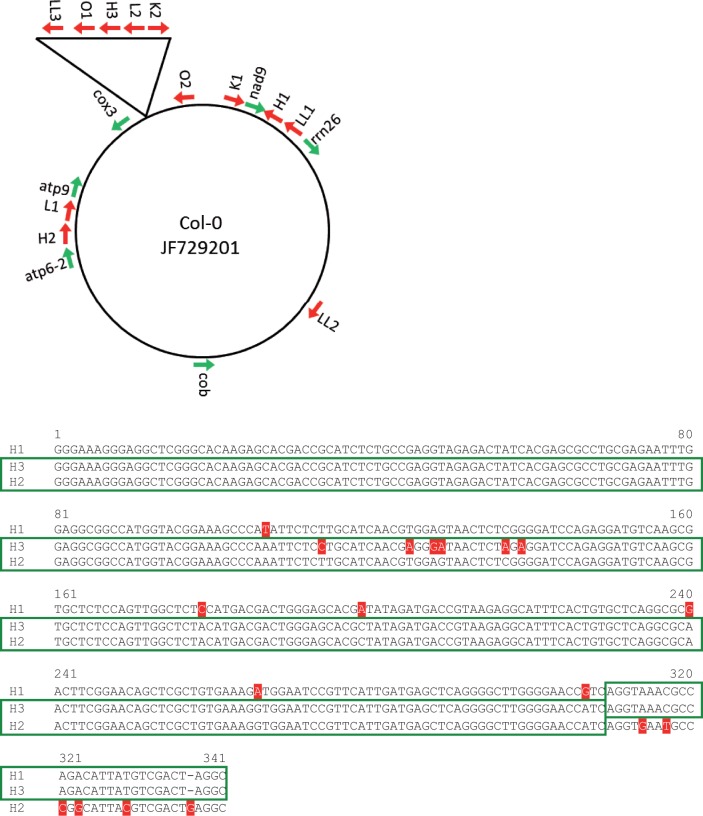
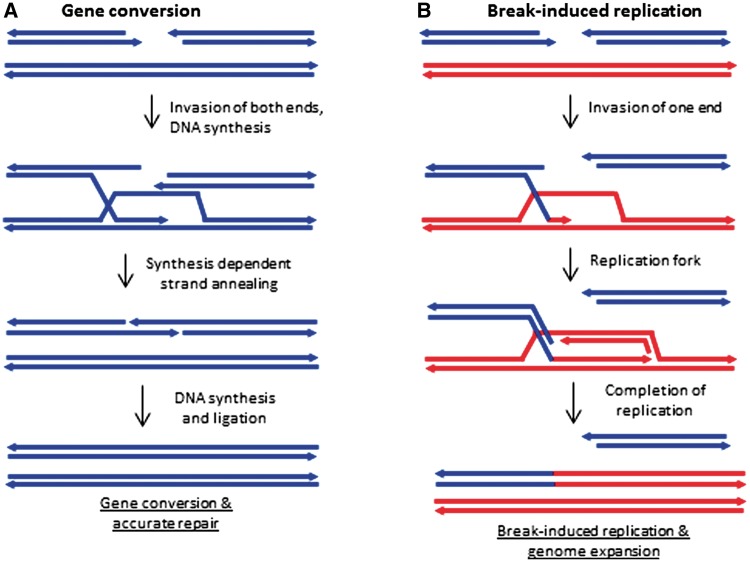
Plant mitochondrial genomes are notorious for their large and variable size, nonconserved open reading frames of unknown function, and high rates of rearrangement. Paradoxically, the mutation rates are very low. However, mutation rates can only be measured in sequences that can be aligned--a very small part of plant mitochondrial genomes. Comparison of the complete mitochondrial genome sequences of two ecotypes of Arabidopsis thaliana allows the alignment of noncoding as well as coding DNA and estimation of the mutation rates in both. A recent chimeric duplication is also analyzed. A hypothesis is proposed that the mechanisms of plant mitochondrial DNA repair account for these features and includes different mechanisms in transcribed and nontranscribed regions. Within genes, a bias toward gene conversion would keep measured mutation rates low, whereas in noncoding regions, break-induced replication (BIR) explains the expansion and rearrangements. Both processes are types of double-strand break repair, but enhanced second-strand capture in transcribed regions versus BIR in nontranscribed regions can explain the two seemingly contradictory features of plant mitochondrial genome evolution--the low mutation rates in genes and the striking expansions of noncoding sequences.
植物线粒体基因组因其大小和变异性大、未知功能的非保守开放阅读框以及高重排率而臭名昭著。矛盾的是,突变率非常低。然而,只有在可以对齐的序列中才能测量突变率——这只是植物线粒体基因组的一小部分。比较拟南芥两个生态型的完整线粒体基因组序列,可以对齐非编码和编码 DNA,并估计两者的突变率。还分析了最近的嵌合重复。提出了一个假设,即植物线粒体 DNA 修复的机制解释了这些特征,并包括转录和非转录区域中的不同机制。在基因内,偏向于基因转换将保持测量的突变率较低,而在非编码区域中,断裂诱导复制(BIR)解释了扩张和重排。这两个过程都是双链断裂修复的类型,但转录区增强的第二链捕获与非转录区的 BIR 可以解释植物线粒体基因组进化的两个看似矛盾的特征——基因中的低突变率和非编码序列的惊人扩张。