Lunkenheimer Erika S, Kemp Christine J, Albrecht Erin C
Colorado State University.
Soc Dev. 2013 May 1;22(2):319-339. doi: 10.1111/sode.12016.
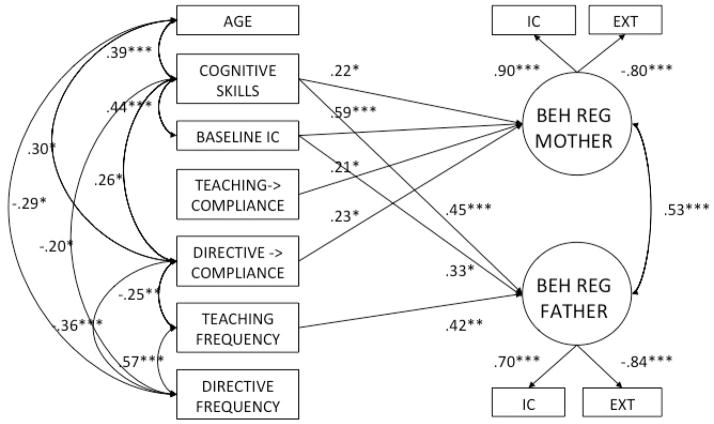
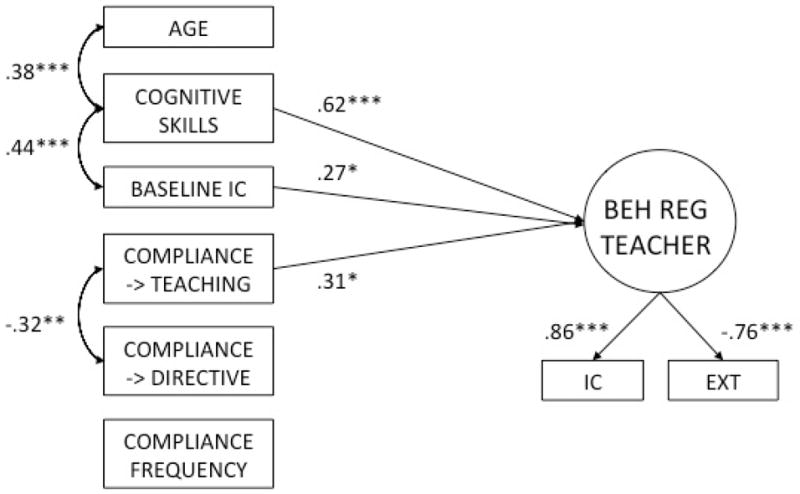
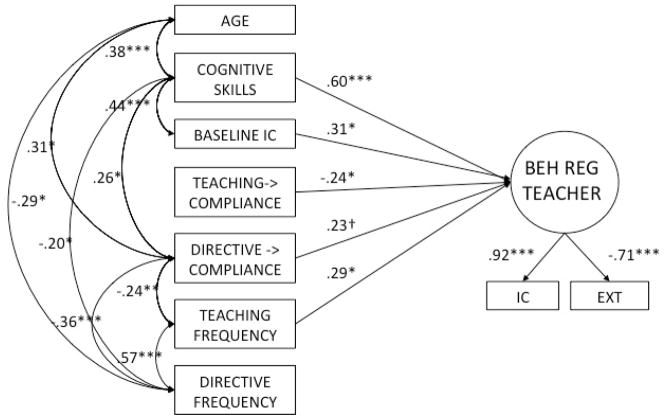
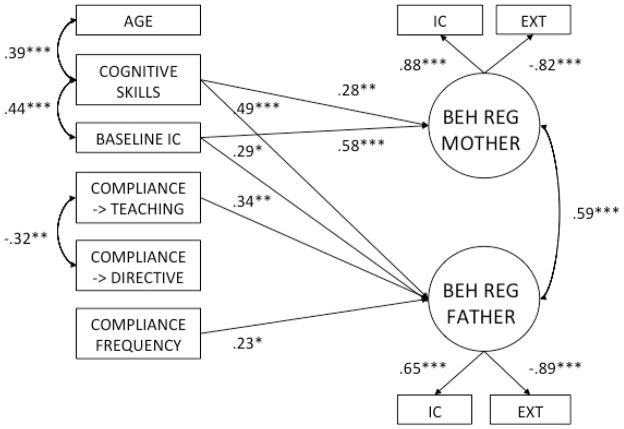
Predictable patterns in early parent-child interactions may help lay the foundation for how children learn to self-regulate. The present study examined contingencies between maternal teaching and directives and child compliance in mother-child problem-solving interactions at age 3.5 and whether they predicted children's behavioral regulation and dysregulation (inhibitory control and externalizing behaviors) as rated by mothers, fathers, and teachers at a 4-month follow-up ( = 100). The predictive utility of mother- and child-initiated contingencies was also compared to that of frequencies of individual mother and child behaviors. Structural equation models revealed that a higher probability that maternal directives were followed by child compliance predicted better child behavioral regulation, whereas the reverse pattern and the overall frequency of maternal directives did not. For teaching, stronger mother- and child-initiated contingencies and the overall frequency of maternal teaching all showed evidence for predicting better behavioral regulation. Findings depended on which caregiver was rating child outcomes. We conclude that dyadic measures are useful for understanding how parent-child interactions impact children's burgeoning regulatory abilities in early childhood.
早期亲子互动中可预测的模式可能有助于为儿童学习自我调节奠定基础。本研究考察了3.5岁时母子解决问题互动中母亲教导与指令及儿童顺从之间的偶发关系,以及它们是否能预测4个月随访时(N = 100)母亲、父亲和教师对儿童行为调节和失调(抑制控制和外化行为)的评定。还比较了母子发起的偶发关系与个体母亲和儿童行为频率的预测效用。结构方程模型显示,母亲指令后儿童顺从的概率越高,预测儿童行为调节越好,而相反的模式和母亲指令的总体频率则不然。对于教导,母子发起的较强偶发关系和母亲教导的总体频率均显示出预测更好行为调节的证据。研究结果取决于哪位照顾者对儿童结果进行评定。我们得出结论,二元测量有助于理解亲子互动如何影响幼儿早期新兴的调节能力。