Foody Joanne, Huo Yong, Ji Linong, Zhao Dong, Boyd Dylan, Meng Hai Jin, Shiff Susan, Hu Dayi
Cardiovascular Wellness Program, Brigham and Women's Hospital, Boston, MA, USA.
Clin Med Insights Cardiol. 2013 Apr 4;7:59-86. doi: 10.4137/CMC.S10225. Print 2013.
This study is the first systematic review of risk factors for stroke in China and supports the importance of current public health initiatives to manage the risk factors appropriately to reduce risk of stroke in high risk patients. Additionally, this study has been co-authored by prominent Chinese and US physicians and researchers with expertise in cardiovascular disease, neurologic disorders, epidemiology, and real world data. While there have been several systematic reviews of real world associations of risk factors for coronary artery disease, none focus specifically on the population of China, where there is growing evidence that such risk factors are poorly treated or uncontrolled, especially in rural areas.
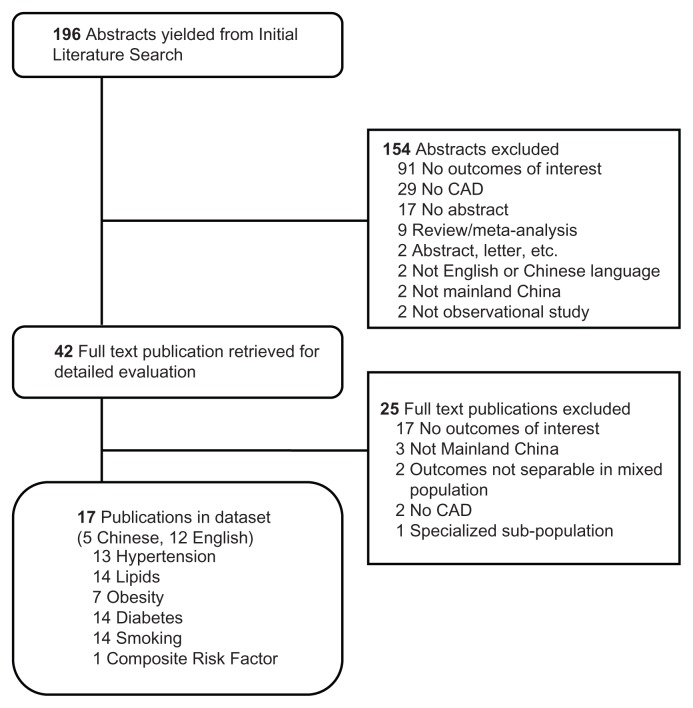
To better understand the impact of traditional cardiovascular risk factors on risk of coronary artery disease (CAD) in China, a systematic review of all Chinese observational studies published in either English or Chinese in MEDLINE and EMBASE over the last 5 years was performed and the association between any of 5 traditional risk factors (ie, hypertension, diabetes, elevated lipid levels, obesity, and smoking) and the risk of CAD was studied.
The study found a consistent relationship between lipid levels and CAD. Higher low-density lipoprotein cholesterol values were associated with greater risk of CAD, with an odds ratio as high as 3.31. Other factors found to be significant contributors to the risk of CAD included hypertension (crude odds ratio range of 1.40-5.11), diabetes (1.50-5.97), and smoking (1.37-5.19). An association between obesity and CAD in China was observed, but the evidence supporting this was considered weak due to the paucity of studies found as part of this review.
This review provides a systematic summary of CAD risk factors in China and demonstrates the important differences that exist in CAD risk factors between countries and regions. Approaches to reduce CAD globally must take into account the unique risk factors that drive CAD in each country and region as is demonstrated by these findings.
本研究是对中国中风危险因素的首次系统综述,支持当前公共卫生举措对适当管理危险因素以降低高危患者中风风险的重要性。此外,本研究由中美著名的心血管疾病、神经系统疾病、流行病学及真实世界数据方面的医生和研究人员共同撰写。虽然已有多项关于冠状动脉疾病危险因素的真实世界关联的系统综述,但没有一项专门针对中国人群,在中国,越来越多的证据表明这些危险因素未得到充分治疗或控制,尤其是在农村地区。
为了更好地了解传统心血管危险因素对中国冠状动脉疾病(CAD)风险的影响,对过去5年在MEDLINE和EMBASE上以英文或中文发表的所有中国观察性研究进行了系统综述,并研究了5种传统危险因素(即高血压、糖尿病、血脂升高、肥胖和吸烟)中的任何一种与CAD风险之间的关联。
该研究发现血脂水平与CAD之间存在一致的关系。较高的低密度脂蛋白胆固醇值与CAD风险增加相关,比值比高达3.31。其他被发现是CAD风险重要因素的包括高血压(粗比值比范围为1.40 - 5.11)、糖尿病(1.50 - 5.97)和吸烟(1.37 - 5.19)。在中国观察到肥胖与CAD之间存在关联,但由于作为本综述一部分所发现的研究较少,支持这一关联的证据被认为较弱。
本综述提供了中国CAD危险因素的系统总结,并展示了不同国家和地区CAD危险因素存在的重要差异。正如这些研究结果所示,全球范围内降低CAD的方法必须考虑到每个国家和地区导致CAD的独特危险因素。