School of Public Health affiliated with School of Medicine, Shanghai Jiaotong University, Shanghai, PR China.
PLoS One. 2013 Apr 30;8(4):e62787. doi: 10.1371/journal.pone.0062787. Print 2013.
Due to the increase of premarital sex and the lack of reproductive health services, unmarried rural-to-urban female migrants experience more risks of sex and reproductive health (SRH). This study was designed to describe SRH related knowledge, attitude and risk behaviors among unmarried rural-to-urban female migrants and examine the predictors of reducing sexual and reproductive risk behaviors based on information-motivation-behavioral skills (IMB) model and to describe the relationships between the constructs.
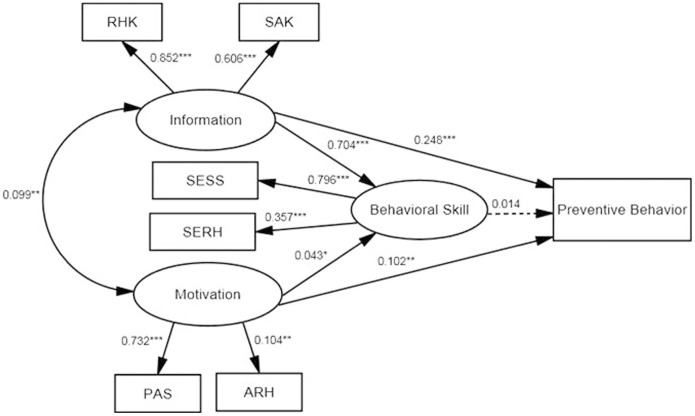
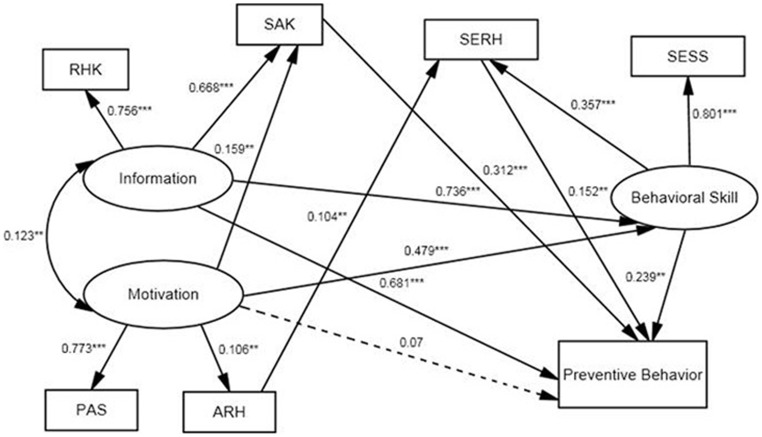
We conducted a cross-sectional study to assess SRH related information, motivation, behavioral skills and preventive behaviors among unmarried rural-to-urban female migrants in Shanghai, one of the largest importers of migrant laborers in China. Structural equation modeling (SEM) was used to assess the IMB model.
A total of 944 subjects completed their questionnaires. The mean age was 21.2 years old (SD = 2.3; range 16 to 28). Over one-fourth of participants reported having had premarital sex (N = 261, 27.6%) and among whom 15.3% reported having had the experience of unintended pregnancy, 14.6% with the experience of abortion. The final IMB model provided acceptable fit to the data (CFI = 0.99, RMSEA = 0.034). Reducing sexual and reproductive risk behaviors was significantly predicted by SRH related information (β = 0.681, P<0.001) and behavioral skills(β = 0.239, P<0.001). Motivation (β = 0.479, P<0.001) was the significant indirect predictor of reducing sexual and reproductive risk behaviors mediated through behavioral skills.
The results highlight the importance and necessity of conducting reproductive health promotion among unmarried rural-to-urban female migrants in China. The IMB model could be used to predict reducing sexual and reproductive risk behaviors and it suggests future interventions should focus on improving SRH related information and behavioral skills.
由于婚前性行为的增加和生殖健康服务的缺乏,未婚的农村到城市的女性移民面临更多的性和生殖健康风险。本研究旨在描述未婚农村到城市的女性移民的性健康相关知识、态度和风险行为,并根据信息-动机-行为技能(IMB)模型检验减少性和生殖风险行为的预测因素,并描述各结构之间的关系。
我们在中国最大的农民工输入地之一上海进行了一项横断面研究,以评估未婚农村到城市的女性移民的性健康相关信息、动机、行为技能和预防行为。结构方程模型(SEM)用于评估 IMB 模型。
共有 944 名参与者完成了问卷。平均年龄为 21.2 岁(标准差=2.3;范围 16 至 28)。超过四分之一的参与者报告有婚前性行为(N=261,27.6%),其中 15.3%报告有意外怀孕经历,14.6%有堕胎经历。最终的 IMB 模型为数据提供了可接受的拟合度(CFI=0.99,RMSEA=0.034)。减少性和生殖风险行为的显著预测因素是性健康相关信息(β=0.681,P<0.001)和行为技能(β=0.239,P<0.001)。动机(β=0.479,P<0.001)是通过行为技能中介来预测减少性和生殖风险行为的显著间接预测因素。
结果强调了在中国对未婚农村到城市的女性移民进行生殖健康促进的重要性和必要性。IMB 模型可用于预测减少性和生殖风险行为,这表明未来的干预措施应侧重于提高性健康相关信息和行为技能。