Institute of Radiation Medicine, Chinese Academy of Medical Science and Peking Union Medical College, Tianjin Key Laboratory of Molecular Nuclear Medicine, Tianjin, China.
PLoS One. 2013 Apr 30;8(4):e62921. doi: 10.1371/journal.pone.0062921. Print 2013.
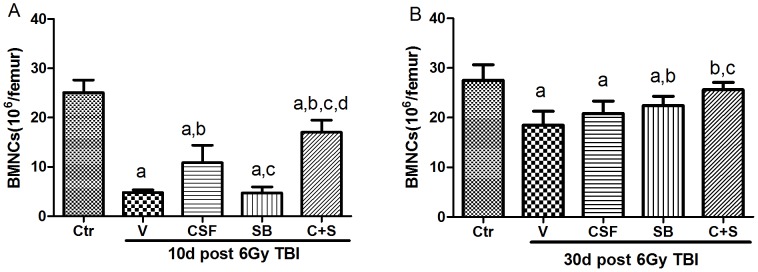
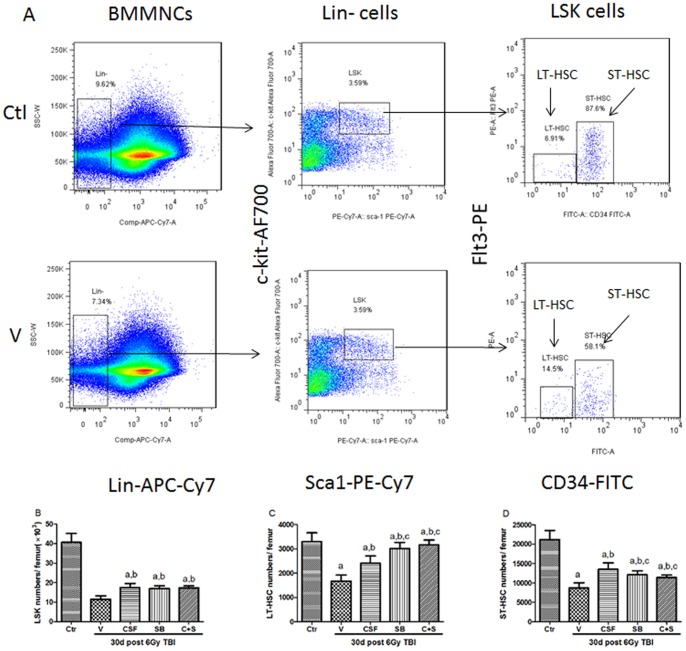
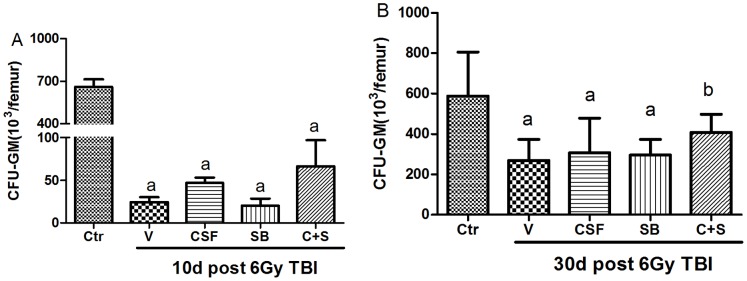
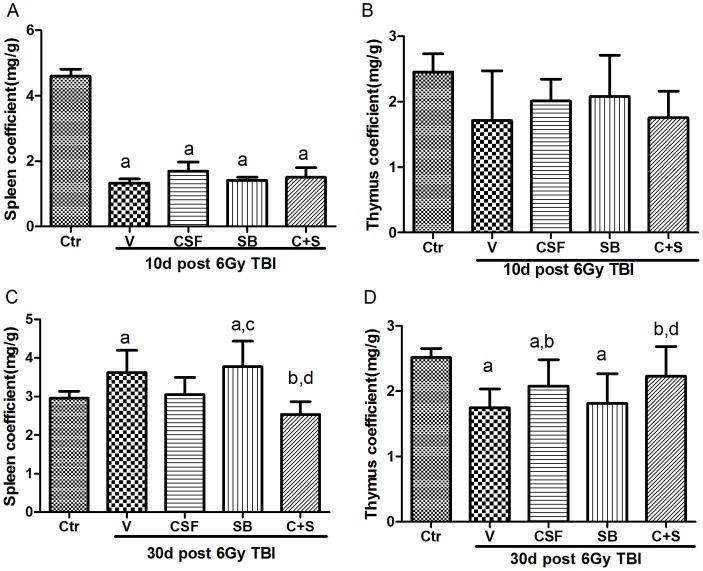
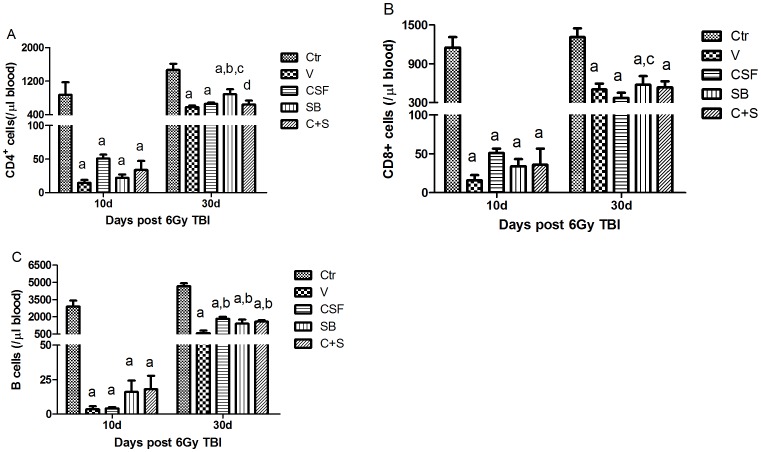
The acute and residual (or long-term) bone marrow (BM) injury induced by ionizing radiation (IR) is a major clinic concern for patients receiving conventional radiotherapy and victims accidentally exposed to a moderate-to-high dose of IR. In this study, we investigated the effects of the treatment with the p38 inhibitor SB203580 (SB) and/or granulocyte colony-stimulating factor (G-CSF) on the hematoimmune damage induced by IR in a mouse model. Specifically, C57BL/6 mice were exposed to a sublethal dose (6 Gy) of total body irradiation (TBI) and then treated with vehicle, G-CSF, SB, and G-CSF plus SB. G-CSF (1 µg/mouse) was administrated to mice by intraperitoneal (ip) injection twice a day for six successive days; SB (15 mg/kg) by ip injection every other day for 10 days. It was found that the treatment with SB and/or G-CSF significantly enhanced the recovery of various peripheral blood cell counts and the number of BM mononuclear cells 10 and 30 days after the mice were exposed to TBI compared with vehicle treatment. Moreover, SB and/or G-CSF treatment also increased the clonogenic function of BM hematopoietic progenitor cells (HPCs) and the frequency of BM lineage -Sca1+c-kit+ cells (LSK cells) and short-term and long term hematopoietic stem cells (HSCs) 30 days after TBI, in comparison with vehicle treated controls. However, the recovery of peripheral blood B cells and CD4+ and CD8+ T cells was not significantly affected by SB and/or G-CSF treatment. These results suggest that the treatment with SB and/or G-CSF can reduce IR-induced BM injury probably in part via promoting HSC and HPC regeneration.
电离辐射(IR)引起的急性和残留(或长期)骨髓(BM)损伤是接受常规放疗的患者和意外暴露于中高剂量 IR 的患者的主要临床关注点。在这项研究中,我们研究了 p38 抑制剂 SB203580(SB)和/或粒细胞集落刺激因子(G-CSF)治疗对小鼠模型中 IR 引起的血液免疫损伤的影响。具体来说,C57BL/6 小鼠接受亚致死剂量(6 Gy)全身照射(TBI),然后用载体、G-CSF、SB 和 G-CSF 加 SB 治疗。G-CSF(1 µg/只)通过腹腔(ip)注射每天两次连续 6 天给予小鼠;SB(15 mg/kg)每隔一天 ip 注射一次,共 10 天。结果发现,与载体处理相比,SB 和/或 G-CSF 处理可显著提高 TBI 后 10 和 30 天小鼠各种外周血细胞计数和 BM 单核细胞数的恢复。此外,SB 和/或 G-CSF 处理还增加了 BM 造血祖细胞(HPC)的集落形成功能和 BM 谱系 -Sca1+c-kit+细胞(LSK 细胞)和短期和长期造血干细胞(HSCs)的频率30 天 TBI 后与载体处理的对照相比。然而,外周血 B 细胞以及 CD4+和 CD8+T 细胞的恢复不受 SB 和/或 G-CSF 处理的显著影响。这些结果表明,SB 和/或 G-CSF 的治疗可减轻 IR 引起的 BM 损伤,可能部分通过促进 HSC 和 HPC 再生。