Lu Lu, Wang Yue-Ying, Zhang Jun-Ling, Li De-Guan, Meng Ai-Min
Institute of Radiation Medicine, Chinese Academy of Medical Science and Peking Union Medical Collage, Tianjin Key Laboratory of Radiation Medicine and Molecular Nuclear Medicine, Tianjin 300192, China.
Institute of Laboratory Animal Science, Chinese Academy of Medical Science and Peking Union Medical Collage, Beijing 100021, China.
Int J Mol Sci. 2016 Jun 8;17(6):905. doi: 10.3390/ijms17060905.
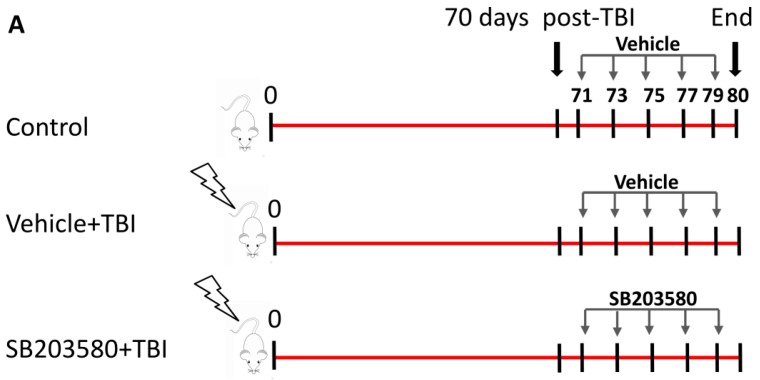
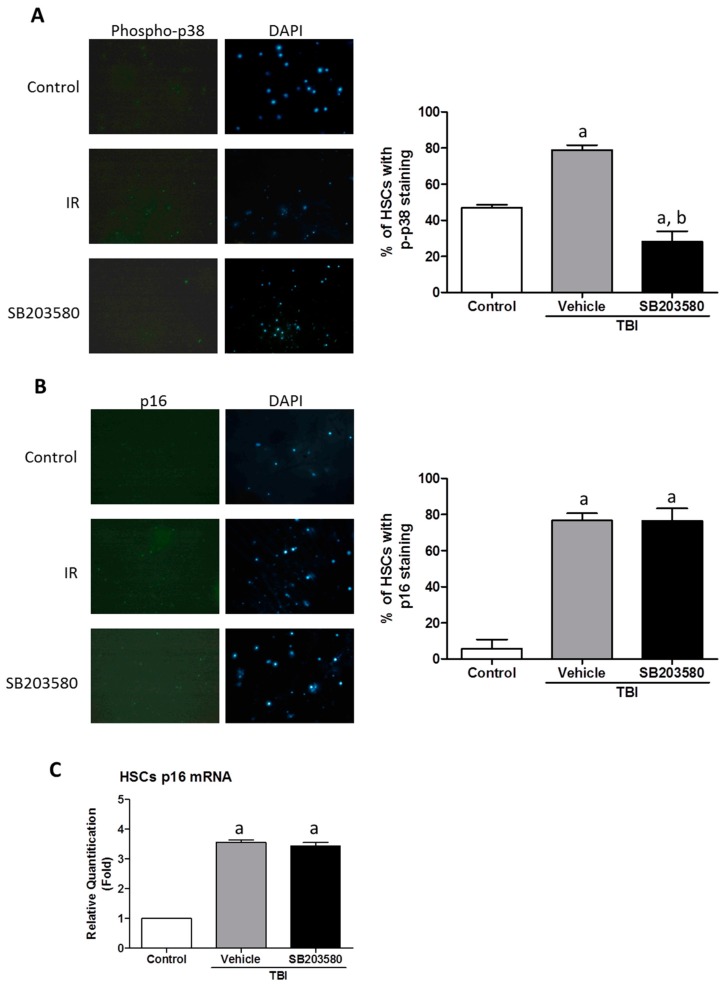
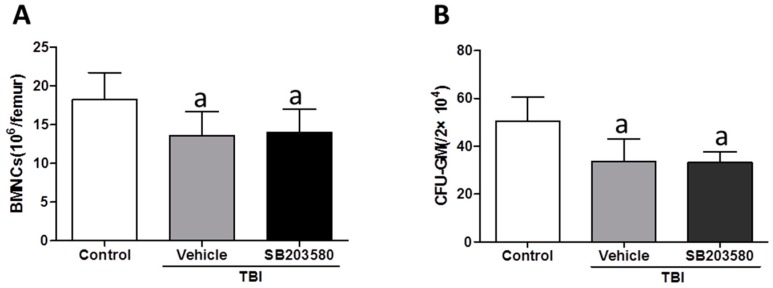
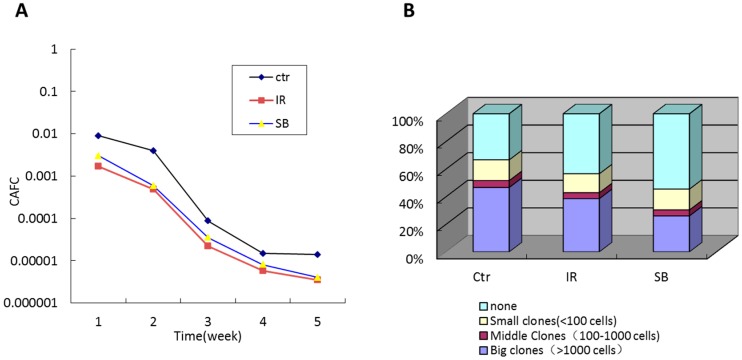
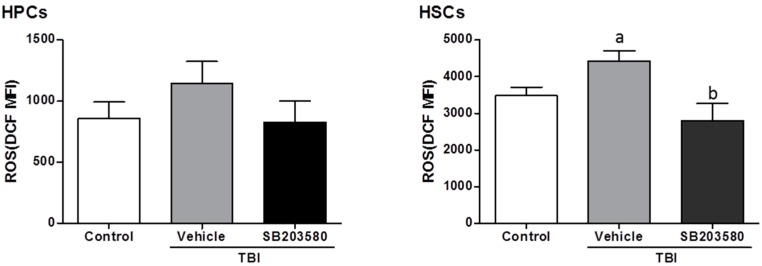
Senescent hematopoietic stem cells (HSCs) accumulate with age and exposure to stress, such as total-body irradiation (TBI), which may cause long-term myelosuppression in the clinic. However, the methods available for long-term myelosuppression remain limited. Previous studies have demonstrated that sustained p38 mitogen-activated protein kinases (p38 MAPK) activation in HSCs following exposure to TBI in mice and the administration of its inhibitor twenty-four hours after TBI may partially prevent long-term myelosuppression. However, long-term myelosuppression is latent and identified long after the administration of radiation. In this study, we investigated the effects of SB203580 (a small molecule inhibitor of p38 MAPK) on long-term myelosuppression induced by TBI. Mice with hematopoietic injury were injected intraperitoneally with SB203580 every other day five times beginning 70 days after 6 Gy of (137)Cs γ ray TBI. Our results at 80 days demonstrated that SB203580 did not significantly improve the TBI-induced long-term reduction of peripheral blood cell and bone marrow nucleated cell (BMNC) counts, or defects in hematopoietic progenitor cells (HPCs) and HSC clonogenic function. SB203580 reduced reactive oxygen species (ROS) production and p-p38 expression; however, SB203580 had no effect on p16 expression in the HSCs of mice. In conclusion, these findings suggest that treatment with SB203580 70 days after TBI in mice inhibits the ROS-p38 oxidative stress pathway; however, it has no therapeutic effect on long-term myelosuppression induced by TBI.
衰老的造血干细胞(HSCs)会随着年龄增长以及暴露于应激状态(如全身照射(TBI))而积累,这在临床上可能导致长期骨髓抑制。然而,可用于长期骨髓抑制的方法仍然有限。先前的研究表明,小鼠在接受TBI后造血干细胞中p38丝裂原活化蛋白激酶(p38 MAPK)持续激活,且在TBI后24小时给予其抑制剂可能部分预防长期骨髓抑制。然而,长期骨髓抑制具有潜伏性,在放疗后很长时间才被发现。在本研究中,我们调查了SB203580(一种p38 MAPK小分子抑制剂)对TBI诱导的长期骨髓抑制的影响。在接受6 Gy(137)Csγ射线TBI 70天后,每隔一天给造血损伤的小鼠腹腔注射SB203580,共注射5次。我们在第80天的结果表明,SB203580并没有显著改善TBI诱导的外周血细胞和骨髓有核细胞(BMNC)计数的长期减少,也没有改善造血祖细胞(HPCs)和造血干细胞克隆形成功能的缺陷。SB203580减少了活性氧(ROS)的产生和p-p38的表达;然而,SB203580对小鼠造血干细胞中p16的表达没有影响。总之,这些发现表明,小鼠在TBI后70天用SB203580治疗可抑制ROS-p38氧化应激途径;然而,它对TBI诱导的长期骨髓抑制没有治疗作用。