Vanderbilt University Department of Biomedical Engineering, Nashville, Tennessee, USA.
J Magn Reson Imaging. 2013 Aug;38(2):299-305. doi: 10.1002/jmri.23963. Epub 2013 May 6.
To evaluate the feasibility of measuring T1ρ values in epiphyseal cartilage in children, we have conducted a novel study of spin locking techniques. Adult articular cartilage has been widely studied with spin locking techniques by magnetic resonance imaging. However, no results are available for in vivo T1ρ imaging of developing cartilage.
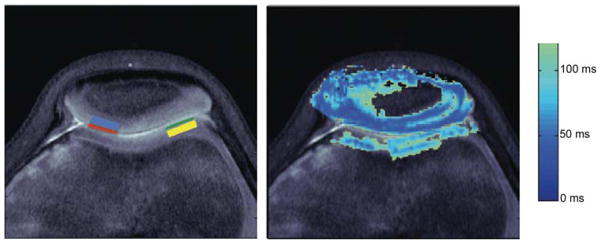
Ten volunteers of age 6 ± 3 years were recruited to have T1ρ mapping performed on the knee at the conclusion of their clinical study. T1ρ maps were generated using a spin-lock cluster followed by a fast spin-echo imaging sequence. Regions of interest (ROIs) were placed in non-load-bearing (NLB), load-bearing (LB), and articular cartilage.
Student's t-tests were performed to compare means among the ROIs. Mean T1ρ for epiphyseal and articular cartilage was 49.8 ± 9 and 76.6 ± 7 ms, respectively. LB and NLB T1ρ vales were 47.1 ± 9.5 and 52.5 ± 9 ms, respectively. Significant differences were found in T1ρ values between epiphyseal and articular cartilage layers (P = 0.0001). No difference in T1ρ was observed between NLB and LB layers. A modest trend was also noted for epiphyseal and articular cartilage regions with age.
It is feasible to quantify differences in epiphyseal and articular cartilage layers with SL techniques. T1ρ holds promise as a noninvasive method of studying normal and abnormal developmental states of cartilage in children.
为了评估在儿童骺软骨中测量 T1ρ 值的可行性,我们进行了一项新的自旋锁定技术研究。磁共振成像已广泛研究了成人关节软骨的自旋锁定技术,但尚无关于发育中软骨的体内 T1ρ 成像的结果。
招募了 10 名年龄为 6 ± 3 岁的志愿者,在完成临床研究后对膝关节进行 T1ρ 图谱分析。T1ρ 图谱是通过自旋锁定簇后快速自旋回波成像序列生成的。感兴趣区(ROI)放置在非承重区(NLB)、承重区(LB)和关节软骨区。
对 ROI 之间的平均值进行了学生 t 检验。骺软骨和关节软骨的平均 T1ρ 值分别为 49.8 ± 9ms 和 76.6 ± 7ms。LB 和 NLB 的 T1ρ 值分别为 47.1 ± 9.5ms 和 52.5 ± 9ms。骺软骨和关节软骨层之间的 T1ρ 值存在显著差异(P = 0.0001)。NLB 和 LB 层之间的 T1ρ 值无差异。骺软骨和关节软骨区域与年龄也存在适度的趋势。
SL 技术可以定量分析骺软骨和关节软骨层之间的差异。T1ρ 有望成为一种非侵入性方法,用于研究儿童软骨的正常和异常发育状态。