Fatigue Consultation Clinic, Salt Lake City, UT.
J Pain Res. 2013 Apr 26;6:311-8. doi: 10.2147/JPR.S43395. Print 2013.
The purpose of this study was to evaluate the safety, tolerability, and efficacy of milnacipran following a direct switch from duloxetine in fibromyalgia patients experiencing inadequate clinical response to duloxetine after receiving treatment for 6 weeks or longer.
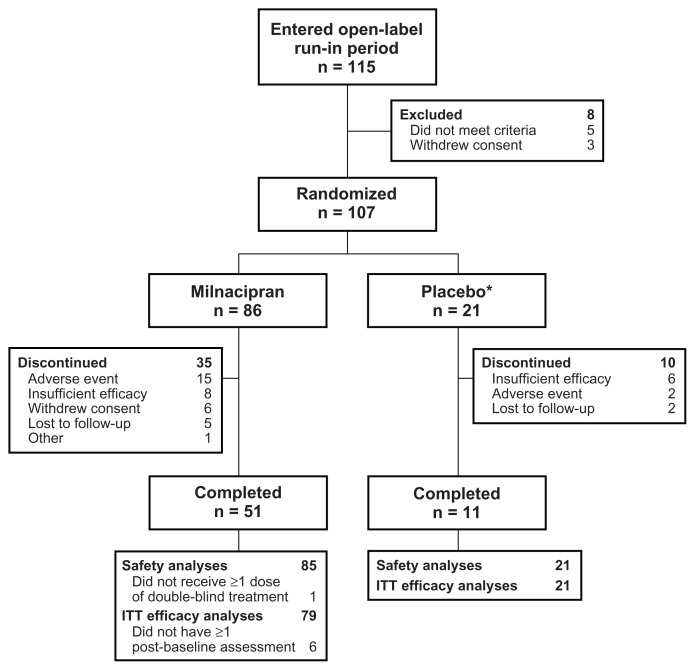
This exploratory study included 107 patients with fibromyalgia who had been treated with duloxetine 60 mg/day for at least 4 weeks prior to enrollment. Following a 2-week open-label period on duloxetine, patients who had visual analog scale pain scores ≥ 40 and were dissatisfied with current treatment were randomized 4:1 to milnacipran 100 mg/day (n = 86) or placebo (n = 21) for 10 weeks of double-blind treatment. The small placebo group was included solely to blind the study and minimize expectation bias among patients and investigators, and there was no preplanned statistical comparison between treatment groups. The primary efficacy parameter was the percentage of patients rating themselves as "much improved" or "very much improved" on the Patient Global Impression of Change (PGIC) at the final visit. Other efficacy parameters included changes in one-week recall visual analog scale pain, Fibromyalgia Impact Questionnaire Revised (FIQR), and Multiple Ability Self-Report Questionnaire (MASQ).
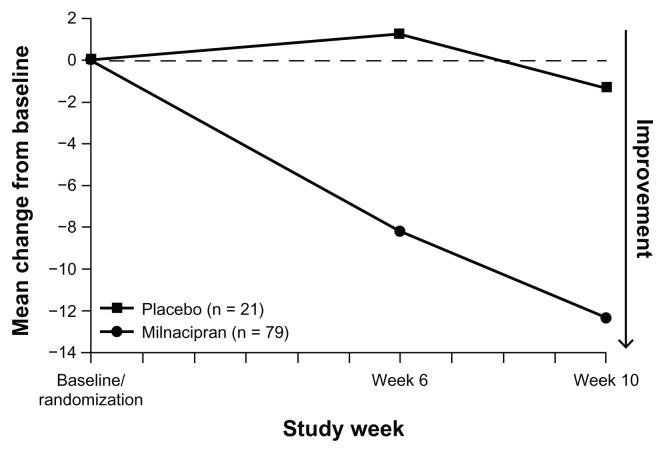
Of patients switched to milnacipran, 32.9% were classified as PGIC responders, and they also demonstrated improvement in visual analog scale pain, FIQR total, and MASQ total scores (mean changes from baseline were -12.3, -7.77, and -2.39, respectively). Nausea and dizziness were the most common treatment-emergent adverse events in patients switched to milnacipran, reported in 21% and 15%, respectively, of patients in this group.
Results from this exploratory study suggest that switching from duloxetine to milnacipran may be beneficial in some patients with fibromyalgia who have an inadequate response to duloxetine. Further research investigating the efficacy and safety of switching fibromyalgia therapies is warranted.
本研究旨在评估米那普仑在接受度洛西汀治疗 6 周或更长时间后对度洛西汀反应不足的纤维肌痛患者中的安全性、耐受性和疗效。
这项探索性研究纳入了 107 例纤维肌痛患者,这些患者在入组前已接受度洛西汀 60mg/天治疗至少 4 周。在度洛西汀 2 周的开放性治疗期后,视觉模拟量表疼痛评分≥40 且对当前治疗不满意的患者,按 4:1 的比例随机分为米那普仑 100mg/天组(n=86)或安慰剂组(n=21),进行 10 周的双盲治疗。小剂量安慰剂组仅用于使研究设盲并最大程度减少患者和研究者的期望偏倚,并且两个治疗组之间没有预先计划的统计学比较。主要疗效参数为末次就诊时患者自我报告的“有很大改善”或“非常大改善”的百分比,用患者总体印象变化量表(PGIC)评估。其他疗效参数包括一周回忆视觉模拟量表疼痛、纤维肌痛影响问卷修订版(FIQR)和多能力自我报告问卷(MASQ)的变化。
转用米那普仑的患者中,32.9%被归类为 PGIC 应答者,他们的视觉模拟量表疼痛、FIQR 总分和 MASQ 总分也有所改善(与基线相比的平均变化分别为-12.3、-7.77 和-2.39)。转用米那普仑的患者中最常见的治疗后不良事件为恶心和头晕,分别有 21%和 15%的患者出现这些不良事件。
这项探索性研究的结果表明,对于对度洛西汀反应不足的纤维肌痛患者,从度洛西汀转为米那普仑可能有益。有必要进一步研究纤维肌痛治疗方案转换的疗效和安全性。