Department of Bioengineering and Therapeutic Sciences, California Institute for Quantitative Biosciences, University of California San Francisco, San Francisco, California, USA.
PLoS One. 2013 Apr 26;8(4):e62961. doi: 10.1371/journal.pone.0062961. Print 2013.
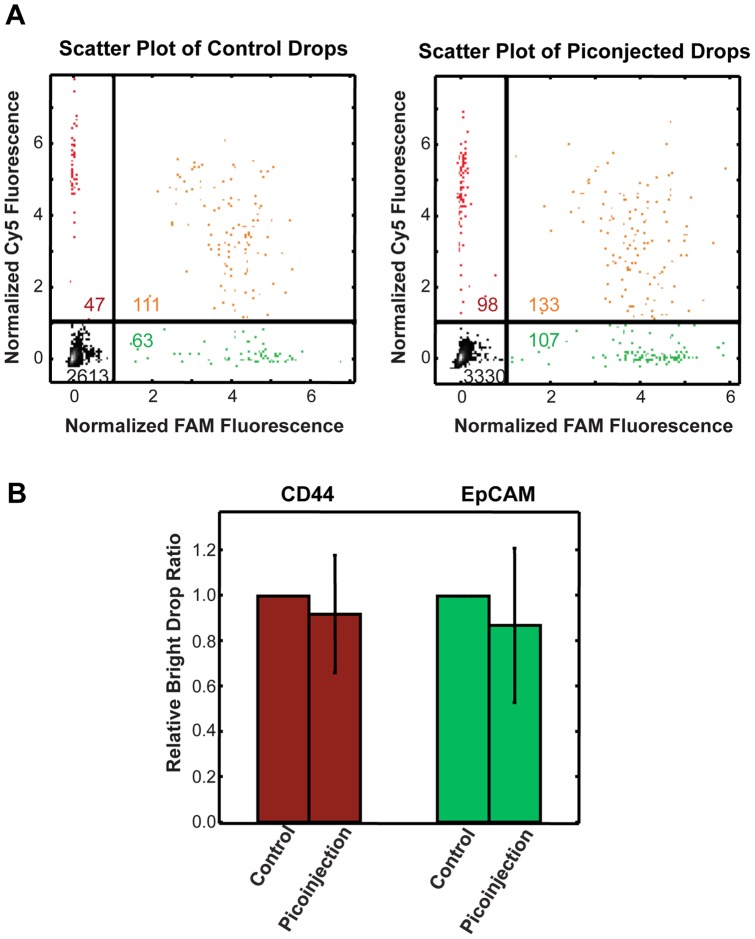
The ability to add reagents to drops in a sequential fashion is necessary for numerous applications of microfluidics in biology. An important method for accomplishing this is picoinjection, a technique in which reagents are injected into aqueous drops using an electric field. While picoinjection has been shown to allow the precise addition of reagents to drops, its compatibility with biological reactions is yet to be thoroughly demonstrated. Here, we investigate the compatibility of picoinjection with digital RT-PCR Taqman assays, reactions that incorporate nucleic acids, enzymes, and other common biological reagents. We find that picoinjection is compatible with this assay and enables the detection of RNA transcripts at rates comparable to workflows not incorporating picoinjection. We also find that picoinjection results in negligible transfer of material between drops and that the drops faithfully retain their compartmentalization.
在生物学中,能够按顺序向微滴中添加试剂是微流控技术的众多应用所必需的。实现这一目标的一种重要方法是皮升级注,这是一种使用电场将试剂注入水相微滴的技术。虽然已经证明皮升级注允许将试剂精确地添加到微滴中,但它与生物反应的兼容性尚未得到彻底证明。在这里,我们研究了皮升级注与数字 RT-PCR Taqman 测定的兼容性,该测定包含核酸、酶和其他常见生物试剂的反应。我们发现皮升级注与该测定兼容,并能够以与不包含皮升级注的工作流程相当的速率检测 RNA 转录物。我们还发现皮升级注导致微滴之间的物质转移可以忽略不计,并且微滴忠实地保留其分隔。