Department of Pediatrics, University of Alabama at Birmingham, Birmingham, AL 35249, USA.
J Pediatr. 2013 Sep;163(3):652-7.e1-2. doi: 10.1016/j.jpeds.2013.03.081. Epub 2013 May 8.
To test the hypothesis that increasing severity of the fetal inflammatory response (FIR) would have a dose-dependent relationship with severe neurodevelopmental impairment or death in extremely preterm infants.
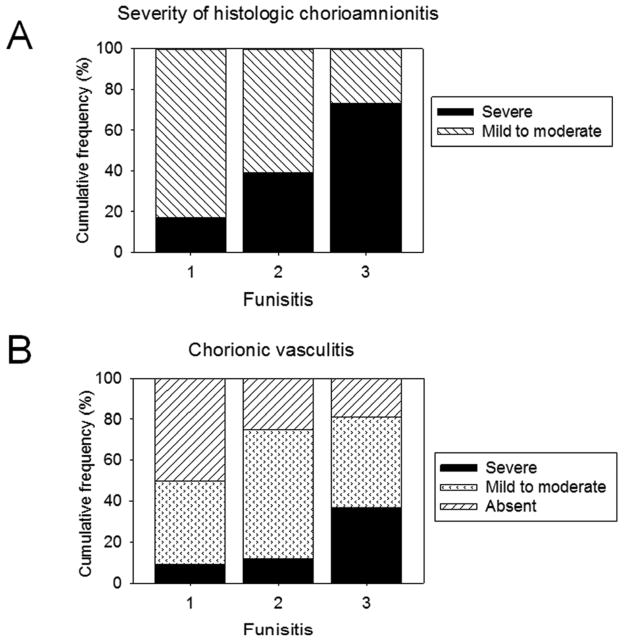
We report 347 infants of 23-28 weeks gestational age admitted to a tertiary neonatal intensive care unit between 2006 and 2008. The primary outcome was death or neurodevelopmental impairment at the 18- to 22-month follow-up. Exposure status was defined by increasing stage of funisitis (stage 1, phlebitis; stage 2, arteritis with or without phlebitis; stage 3, subacute necrotizing funisitis) and severity of chorionic plate vasculitis (inflammation with or without thrombosis).
A FIR was detected in 110 placentas (32%). The rate of severe neurodevelopmental impairment/death was higher in infants with subacute necrotizing funisitis compared with infants without placental/umbilical cord inflammation (60% vs 35%; P < .05). Among infants with stage 1 or 2 funisitis, the presence of any chorionic vasculitis was associated with a higher rate of severe neurodevelopmental impairment/death (47% vs 23%; P < .05). After adjustment for confounding factors, only subacute necrotizing funisitis (risk ratio, 1.87; 95% CI, 1.04-3.35; P = .04) and chorionic plate vasculitis with thrombosis (risk ratio, 2.21; 95% CI, 1.10-4.46; P = .03) were associated with severe neurodevelopmental impairment/death.
Severe FIR, characterized by subacute necrotizing funisitis and severe chorionic plate vasculitis with thrombosis, is associated with severe neurodevelopmental impairment/death in preterm infants.
检验胎儿炎症反应(FIR)严重程度与极早产儿严重神经发育损伤或死亡之间存在剂量依赖性关系的假设。
我们报告了 2006 年至 2008 年间在一家三级新生儿重症监护病房住院的 23-28 周龄的 347 名婴儿。主要结局是 18-22 个月随访时的死亡或神经发育损伤。暴露状态通过增加脐带炎的阶段(1 期,静脉炎;2 期,动脉炎伴或不伴静脉炎;3 期,亚急性坏死性脐带炎)和绒毛膜板血管炎的严重程度来定义(伴有或不伴有血栓形成的炎症)。
在 110 个胎盘(32%)中检测到 FIR。与无胎盘/脐带炎的婴儿相比,患有亚急性坏死性脐带炎的婴儿发生严重神经发育损伤/死亡的比率更高(60%比 35%;P<.05)。在患有 1 期或 2 期脐带炎的婴儿中,任何绒毛膜血管炎的存在与严重神经发育损伤/死亡的发生率较高相关(47%比 23%;P<.05)。在调整混杂因素后,只有亚急性坏死性脐带炎(风险比,1.87;95%置信区间,1.04-3.35;P=0.04)和伴有血栓形成的绒毛膜板血管炎(风险比,2.21;95%置信区间,1.10-4.46;P=0.03)与严重神经发育损伤/死亡相关。
以亚急性坏死性脐带炎和伴有血栓形成的严重绒毛膜板血管炎为特征的严重 FIR 与极早产儿严重神经发育损伤或死亡相关。