Laboratory of Ophthalmic Optics, Krieger Children's Eye Center, Pediatric Ophthalmology and Adult Strabismus, Wilmer Ophthalmological Institute, Johns Hopkins University School of Medicine, Rm. 233, 600 N. Wolfe St, Baltimore, Maryland, USA.
Biomed Eng Online. 2013 May 13;12:41. doi: 10.1186/1475-925X-12-41.
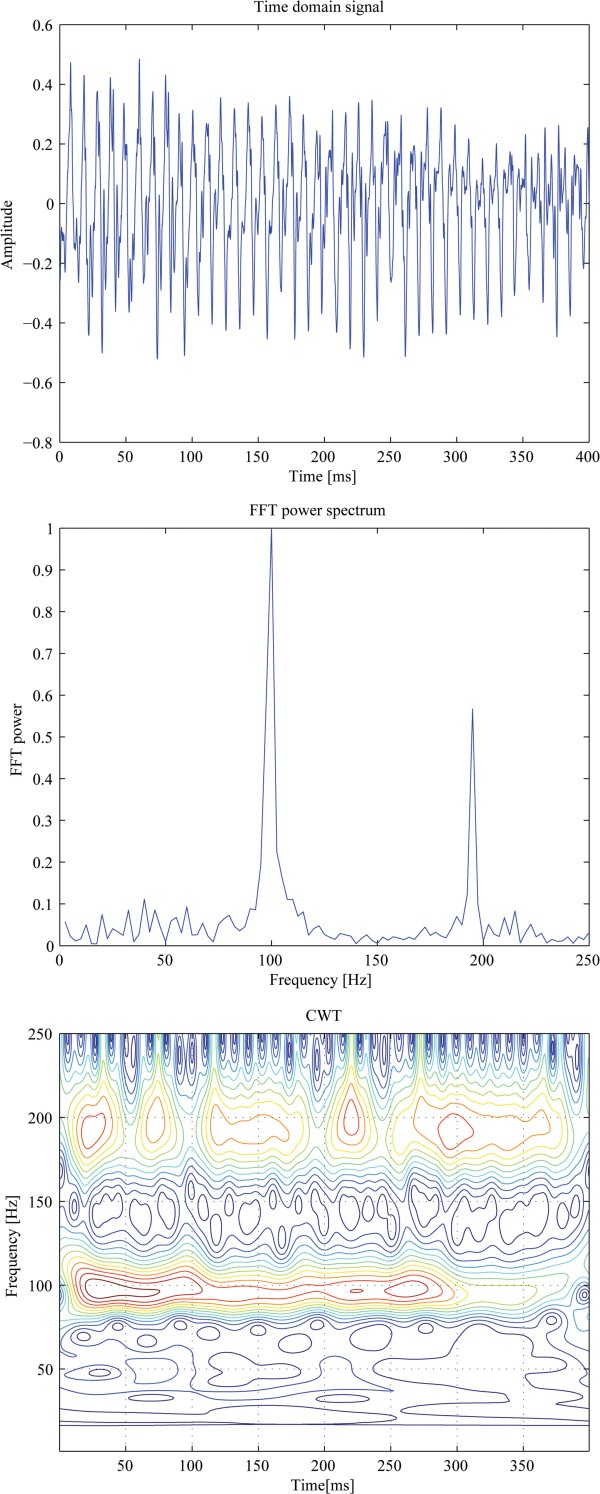
The fovea, which is the most sensitive part of the retina, is known to have birefringent properties, i.e. it changes the polarization state of light upon reflection. Existing devices use this property to obtain information on the orientation of the fovea and the direction of gaze. Such devices employ specific frequency components that appear during moments of fixation on a target. To detect them, previous methods have used solely the power spectrum of the Fast Fourier Transform (FFT), which, unfortunately, is an integral method, and does not give information as to where exactly the events of interest occur. With very young patients who are not cooperative enough, this presents a problem, because central fixation may be present only during very short-lasting episodes, and can easily be missed by the FFT.
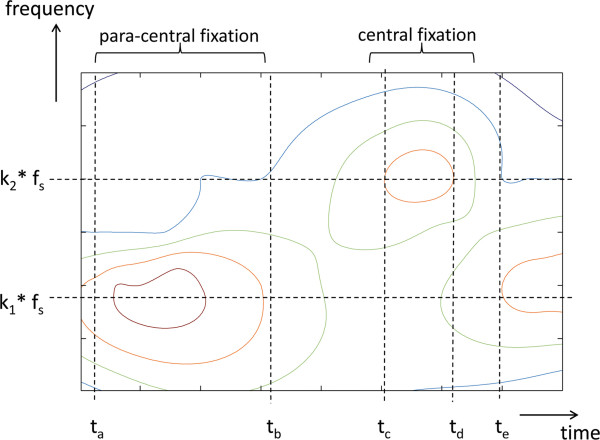
This paper presents a method for detecting short-lasting moments of central fixation in existing devices for retinal birefringence scanning, with the goal of a reliable detection of eye alignment. Signal analysis is based on the Continuous Wavelet Transform (CWT), which reliably localizes such events in the time-frequency plane. Even though the characteristic frequencies are not always strongly expressed due to possible artifacts, simple topological analysis of the time-frequency distribution can detect fixation reliably.
In all six subjects tested, the CWT allowed precise identification of both frequency components. Moreover, in four of these subjects, episodes of intermittent but definitely present central fixation were detectable, similar to those in Figure 4. A simple FFT is likely to treat them as borderline cases, or entirely miss them, depending on the thresholds used.
Joint time-frequency analysis is a powerful tool in the detection of eye alignment, even in a noisy environment. The method is applicable to similar situations, where short-lasting diagnostic events need to be detected in time series acquired by means of scanning some substrate along a specific path.
黄斑,即视网膜最敏感的部分,具有双折射特性,即光在反射时会改变其偏振状态。现有的设备利用这一特性来获取黄斑的方位和注视方向的信息。这些设备采用特定的频率分量,这些频率分量在注视目标时的瞬间出现。为了检测这些分量,之前的方法仅使用快速傅里叶变换(FFT)的功率谱,遗憾的是,FFT 是一种积分方法,无法提供感兴趣的事件的确切位置的信息。对于不够配合的年幼患者来说,这是一个问题,因为中央注视可能仅在非常短暂的发作期间存在,而 FFT 很容易错过这些发作。
本文提出了一种在现有的视网膜双折射扫描设备中检测短暂中央注视的方法,目的是可靠地检测眼球对准情况。信号分析基于连续小波变换(CWT),它可以在时频平面中可靠地定位这些事件。即使由于可能的伪影,特征频率并不总是强烈表达,对时频分布的简单拓扑分析也可以可靠地检测注视。
在所有测试的六名受试者中,CWT 允许精确识别两个频率分量。此外,在其中四名受试者中,可检测到间歇性但确实存在的中央注视发作,类似于图 4 中的发作。简单的 FFT 可能会将它们视为边界情况,或者根据使用的阈值完全错过它们。
联合时频分析是检测眼球对准的强大工具,即使在嘈杂的环境中也是如此。该方法适用于类似的情况,即在通过沿特定路径扫描某些基底来获取时间序列的情况下,需要检测短暂的诊断事件。