Department of Vertebrate Zoology, Faculty of Biology, M.V. Lomonosov Moscow State University, Moscow, Russia.
PLoS One. 2013 May 6;8(5):e60879. doi: 10.1371/journal.pone.0060879. Print 2013.
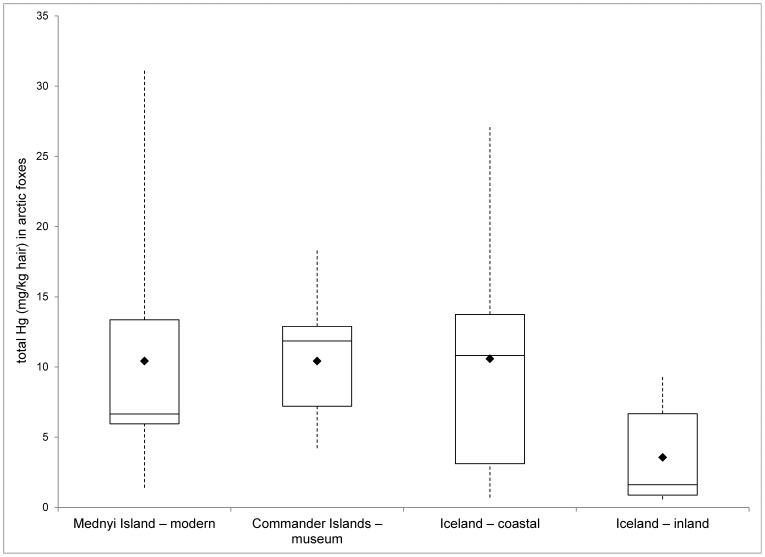
Changes in concentration of pollutants and pathogen distribution can vary among ecotypes (e.g. marine versus terrestrial food resources). This may have important implications for the animals that reside within them. We examined 1) canid pathogen presence in an endangered arctic fox (Vulpes lagopus) population and 2) relative total mercury (THg) level as a function of ecotype ('coastal' or 'inland') for arctic foxes to test whether the presence of pathogens or heavy metal concentration correlate with population health. The Bering Sea populations on Bering and Mednyi Islands were compared to Icelandic arctic fox populations with respect to inland and coastal ecotypes. Serological and DNA based pathogen screening techniques were used to examine arctic foxes for pathogens. THg was measured by atomic absorption spectrometry from hair samples of historical and modern collected arctic foxes and samples from their prey species (hair and internal organs). Presence of pathogens did not correlate with population decline from Mednyi Island. However, THg concentration correlated strongly with ecotype and was reflected in the THg concentrations detected in available food sources in each ecotype. The highest concentration of THg was found in ecotypes where foxes depended on marine vertebrates for food. Exclusively inland ecotypes had low THg concentrations. The results suggest that absolute exposure to heavy metals may be less important than the feeding ecology and feeding opportunities of top predators such as arctic foxes which may in turn influence population health and stability. A higher risk to wildlife of heavy metal exposure correlates with feeding strategies that rely primarily on a marine based diet.
污染物浓度和病原体分布的变化可能因生态型而异(例如,海洋与陆地食物资源)。这可能对栖息在其中的动物产生重要影响。我们检查了 1)濒危北极狐(Vulpes lagopus)种群中的犬科病原体存在情况,2)作为生态型(“沿海”或“内陆”)的相对总汞(THg)水平,以测试病原体的存在或重金属浓度是否与种群健康相关。与内陆和沿海生态型有关,我们比较了白令海的别林斯高晋岛和梅德内岛的种群与冰岛的北极狐种群。血清学和基于 DNA 的病原体筛选技术用于检查北极狐的病原体。通过原子吸收光谱法从历史和现代采集的北极狐的毛发样本以及它们的猎物物种(毛发和内脏器官)中测量 THg。病原体的存在与梅德内岛的种群减少无关。然而,THg 浓度与生态型密切相关,并反映在每种生态型中可利用食物来源中检测到的 THg 浓度。在狐狸依赖海洋脊椎动物作为食物的生态型中,发现了最高浓度的 THg。完全内陆生态型的 THg 浓度较低。结果表明,绝对暴露于重金属的情况可能不如北极狐等顶级捕食者的摄食生态和摄食机会重要,这反过来可能影响种群健康和稳定性。野生动物接触重金属的风险更高,这与主要依赖海洋饮食的摄食策略有关。