Department of Ocean Ecosystems, Energy and Sustainability Research Institute, University of Groningen, Nijenborgh 7, Groningen, 9747 AG, The Netherlands.
AMB Express. 2013 May 14;3(1):26. doi: 10.1186/2191-0855-3-26.
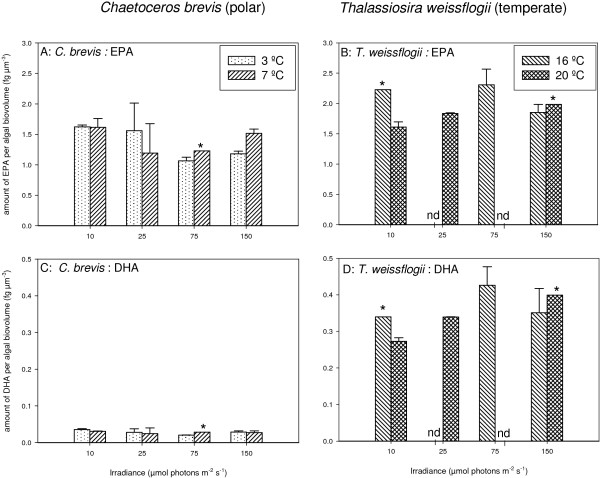
Long chain polyunsaturated fatty acids (LC-PUFAs) such as eicosapentaenoic acid (EPA) and docosahexaenoic acid (DHA) are considered essential omega-3 fatty acids in human nutrition. In marine microalgae EPA and/or DHA are allegedly involved in the regulation of membrane fluidity and thylakoid membrane functioning. The cellular content of EPA and DHA may therefore be enhanced at low temperature and irradiance conditions. As a result, polar and cold temperate marine microalgal species might potentially be suitable candidates for commercial EPA and DHA production, given their adaptation to low temperature and irradiance habitats.In the present study we investigated inter- and intraspecific EPA and DHA variability in five polar and (cold) temperate microalgae. Intraspecific EPA and DHA content did not vary significantly in an Antarctic (Chaetoceros brevis) and a temperate (Thalassiosira weissflogii) centric diatom after acclimation to a range of irradiance levels at two temperatures. Interspecific variability was investigated for two Antarctic (Chaetoceros brevis and Pyramimonas sp. (Prasinophyceae)) and three cold-temperate species (Thalassiosira weissflogii, Emiliania huxleyi (Prymnesiophyceae) and Fibrocapsa japonica (Raphidophyceae)) during exponential growth. Interspecific variability was shown to be much more important than intraspecific variability. Highest relative and absolute levels of DHA were measured in the prymnesiophyte E. huxleyi and the prasinophyte Pyramimonas sp., while levels of EPA were high in the raphidophyte F. japonica and the diatoms C. brevis and T. weissflogii. Yet, no significant differences in LC-PUFA content were found between polar and cold-temperate species. Also, EPA and DHA production rates varied strongly between species. Highest EPA production rate (174 μg L-1 day-1) was found in the Antarctic diatom Chaetoceros brevis, while DHA production was highest in the cold-temperate prymnesiophyte Emiliania huxleyi (164 μg L-1 day-1). We show that, following careful species selection, effective mass cultivation of marine microalgae for EPA and DHA production may be possible under low temperature and irradiance conditions.
长链多不饱和脂肪酸(LC-PUFAs),如二十碳五烯酸(EPA)和二十二碳六烯酸(DHA),被认为是人类营养中必需的ω-3 脂肪酸。在海洋微藻中,EPA 和/或 DHA 据称参与调节膜流动性和类囊体膜功能。因此,在低温和光照条件下,细胞内的 EPA 和 DHA 含量可能会增加。因此,鉴于极地和冷温带海洋微藻对低温和光照生境的适应,它们可能是商业生产 EPA 和 DHA 的潜在候选物种。
在本研究中,我们研究了五种极地和(冷)温带微藻中种内和种间的 EPA 和 DHA 变异性。在两个温度下,经过一系列光照水平的驯化后,一种南极(Chaetoceros brevis)和一种温带(Thalassiosira weissflogii)中心硅藻的种内 EPA 和 DHA 含量没有显著差异。在两种南极(Chaetoceros brevis 和 Pyramimonas sp.(Prasinophyceae))和三种冷温带物种(Thalassiosira weissflogii、Emiliania huxleyi(Prymnesiophyceae)和 Fibrocapsa japonica(Raphidophyceae))的指数生长期内,研究了种间变异性。结果表明,种间变异性比种内变异性更为重要。在 prymnesiophyte E. huxleyi 和 prasinophyte Pyramimonas sp. 中测量到最高的 DHA 相对和绝对水平,而在 raphidophyte F. japonica 和硅藻 C. brevis 和 T. weissflogii 中 EPA 水平较高。然而,在极地和冷温带物种之间,LC-PUFA 含量没有显著差异。此外,EPA 和 DHA 的产生率在物种之间差异很大。在南极硅藻 Chaetoceros brevis 中发现最高的 EPA 产生率(174μg L-1 day-1),而在冷温带 prymnesiophyte Emiliania huxleyi 中发现最高的 DHA 产生率(164μg L-1 day-1)。我们表明,经过仔细的物种选择,在低温和光照条件下,可能可以有效地大规模培养海洋微藻以生产 EPA 和 DHA。