IRD, CBGP (UMR IRD/INRA/CIRAD/MontpellierSupAgro), Montferrier-sur-Lez, France.
PLoS Comput Biol. 2013;9(5):e1003039. doi: 10.1371/journal.pcbi.1003039. Epub 2013 May 9.
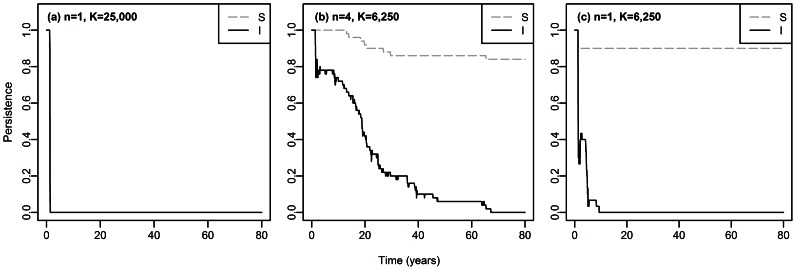
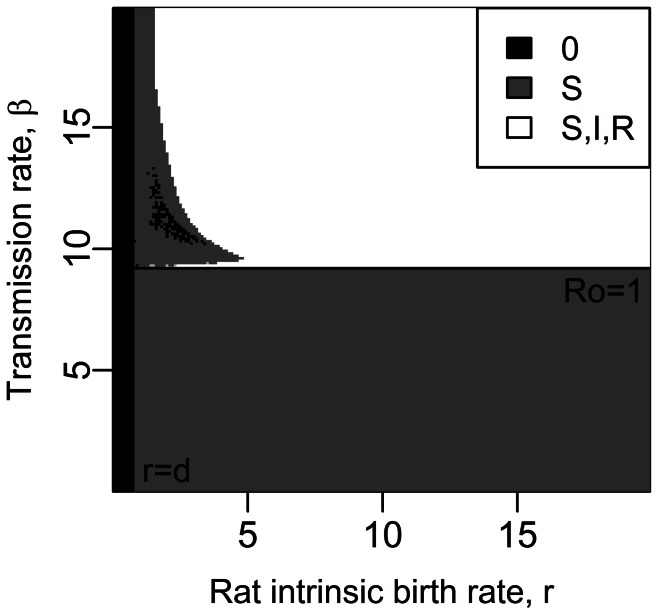
Although bubonic plague is an endemic zoonosis in many countries around the world, the factors responsible for the persistence of this highly virulent disease remain poorly known. Classically, the endemic persistence of plague is suspected to be due to the coexistence of plague resistant and plague susceptible rodents in natural foci, and/or to a metapopulation structure of reservoirs. Here, we test separately the effect of each of these factors on the long-term persistence of plague. We analyse the dynamics and equilibria of a model of plague propagation, consistent with plague ecology in Madagascar, a major focus where this disease is endemic since the 1920s in central highlands. By combining deterministic and stochastic analyses of this model, and including sensitivity analyses, we show that (i) endemicity is favoured by intermediate host population sizes, (ii) in large host populations, the presence of resistant rats is sufficient to explain long-term persistence of plague, and (iii) the metapopulation structure of susceptible host populations alone can also account for plague endemicity, thanks to both subdivision and the subsequent reduction in the size of subpopulations, and extinction-recolonization dynamics of the disease. In the light of these results, we suggest scenarios to explain the localized presence of plague in Madagascar.
虽然腺鼠疫是世界上许多国家的地方性动物传染病,但导致这种高毒力疾病持续存在的因素仍知之甚少。经典地,鼠疫的地方性持续存在被怀疑是由于在自然疫源地中存在抗鼠疫和易感鼠疫的啮齿动物共存,和/或由于储存库的集合种群结构。在这里,我们分别测试这些因素中的每一个对鼠疫长期持续存在的影响。我们分析了与马达加斯加鼠疫生态学一致的鼠疫传播模型的动力学和平衡点,马达加斯加是自 20 世纪 20 年代以来该疾病在高地中部地方性流行的主要焦点。通过对该模型进行确定性和随机分析,并结合敏感性分析,我们表明:(i)中间宿主种群大小有利于地方性;(ii)在大宿主种群中,存在抗性大鼠足以解释鼠疫的长期持续存在;(iii)易感宿主种群的集合种群结构本身也可以解释鼠疫的地方性,这要归功于细分以及随后的亚种群规模的减少,以及疾病的灭绝-再殖民化动态。根据这些结果,我们提出了一些情景来解释鼠疫在马达加斯加的局部存在。