Obesity Prevention Program, Department of Population Medicine, Harvard Medical School/Harvard Pilgrim Health Care Institute, Boston, Massachusetts, United States of America.
PLoS One. 2013 May 10;8(5):e63217. doi: 10.1371/journal.pone.0063217. Print 2013.
We examined body mass index (BMI) across place and time to determine the pattern of BMI mean and standard deviation trajectories.
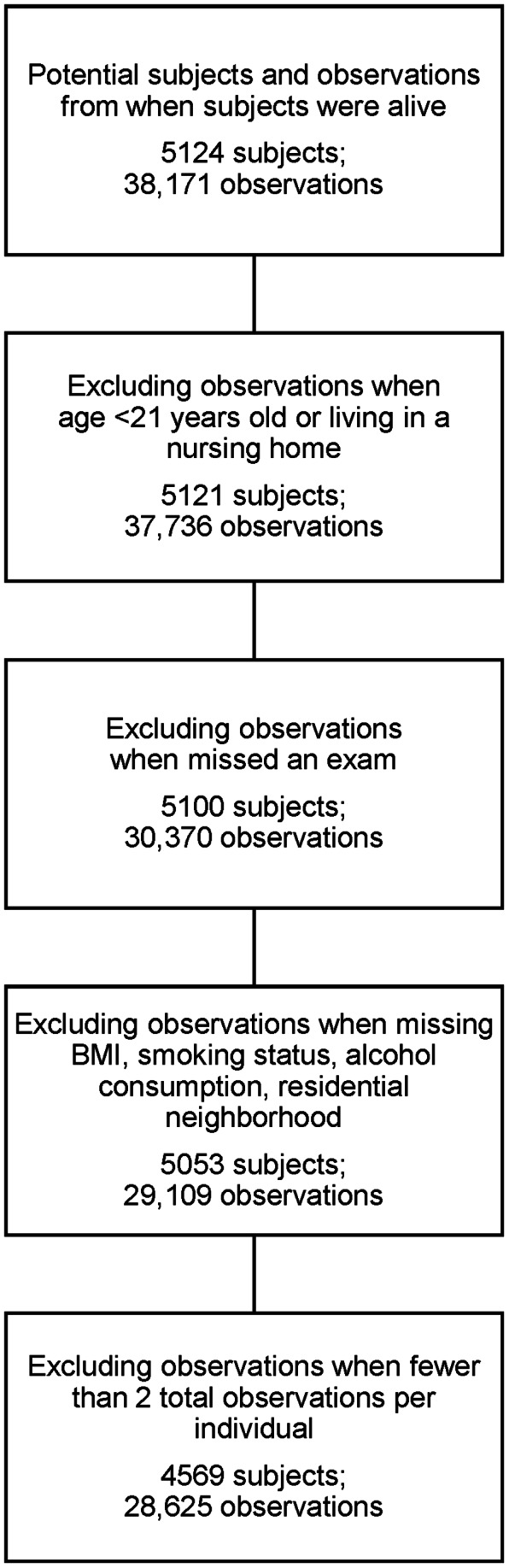
We included participants in the Framingham Heart Study (FHS) Offspring Cohort over eight waves of follow-up, from 1971 to 2008. After exclusions, the final sample size was 4569 subjects with 28,625 observations. We used multi-level models to examine population means and variation at the individual and neighborhood (census tracts) levels across time with measured BMI as the outcome, controlling for individual demographics and behaviors and neighborhood poverty. Because neighborhoods accounted for limited BMI variance, we removed this level as a source of variation in final models. We examined sex-stratified models with all subjects and models stratified by sex and baseline weight classification.
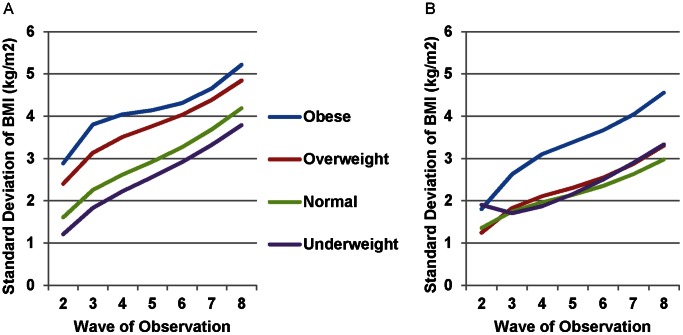
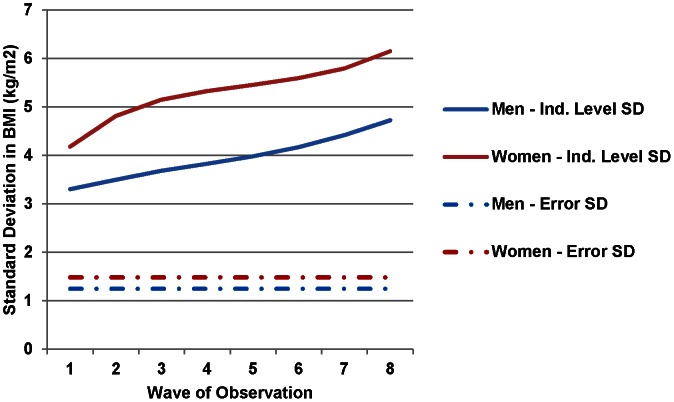
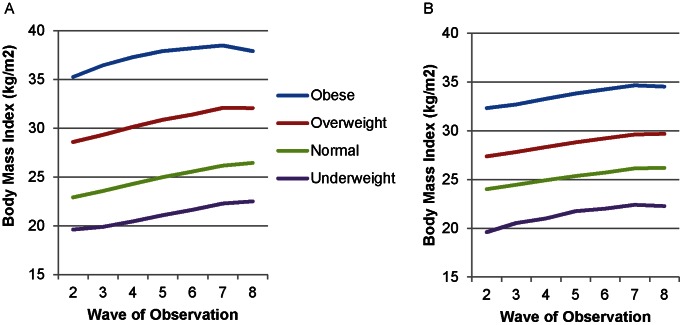
Mean BMI increased from 24.0 kg/m(2) at Wave 1 to 27.7 at Wave 8 for women and from 26.6 kg/m(2) to 29.0 for men. In final models, BMI variation also increased from Waves 1 to 8, with the standard deviation increasing from 4.18 kg/m(2) to 6.15 for women and 3.31 kg/m(2) to 4.73 for men. BMI means increased in parallel across most baseline BMI weight classifications, except for more rapid increases through middle-age for obese women followed by declines in the last wave. BMI standard deviations also increased in parallel across baseline BMI classifications for women, with greater divergence of BMI variance for obese men compared to other weight classifications.
Over nearly 40 years, BMI mean and variation increased in parallel across most baseline weight classifications in our sample. Individual-level characteristics, especially baseline BMI, were the primary factors in rising BMI. These findings have important implications not only for understanding the sources of the obesity epidemic in the United States but also for the targeting of interventions to address the epidemic.
我们通过考察地点和时间上的体重指数(BMI),来确定 BMI 平均值和标准差轨迹的模式。
我们纳入了弗雷明汉心脏研究(FHS)后代队列中的参与者,该队列在 1971 年至 2008 年期间进行了 8 次随访。排除后,最终样本量为 4569 名受试者,共 28625 次观察。我们使用多水平模型来检查个体和社区(普查区)层面的人群平均值和变化,以测量的 BMI 为结果,控制个体人口统计学和行为以及社区贫困。由于社区只解释了 BMI 变异的有限部分,我们在最终模型中去除了这一层作为变异的来源。我们检查了所有受试者的性别分层模型以及按性别和基线体重分类分层的模型。
女性的平均 BMI 从第 1 波的 24.0kg/m(2)增加到第 8 波的 27.7kg/m(2),男性从第 1 波的 26.6kg/m(2)增加到第 8 波的 29.0kg/m(2)。在最终模型中,BMI 变异也从第 1 波增加到第 8 波,女性的标准差从 4.18kg/m(2)增加到 6.15kg/m(2),男性从 3.31kg/m(2)增加到 4.73kg/m(2)。除了肥胖女性在中年后 BMI 快速增加,随后在最后一波下降外,大多数基线 BMI 体重分类的 BMI 平均值都呈平行增加。女性的 BMI 标准差也随着基线 BMI 分类平行增加,肥胖男性的 BMI 方差离散度大于其他体重分类。
在近 40 年的时间里,我们样本中大多数基线体重分类的 BMI 平均值和变异呈平行增加。个体水平的特征,特别是基线 BMI,是 BMI 上升的主要因素。这些发现不仅对理解美国肥胖流行的原因具有重要意义,而且对针对该流行进行干预的目标也具有重要意义。