Department of Biological Sciences, Korea Advanced Institute of Science and Technology, Daejeon, Korea.
PLoS One. 2013 May 13;8(5):e63255. doi: 10.1371/journal.pone.0063255. Print 2013.
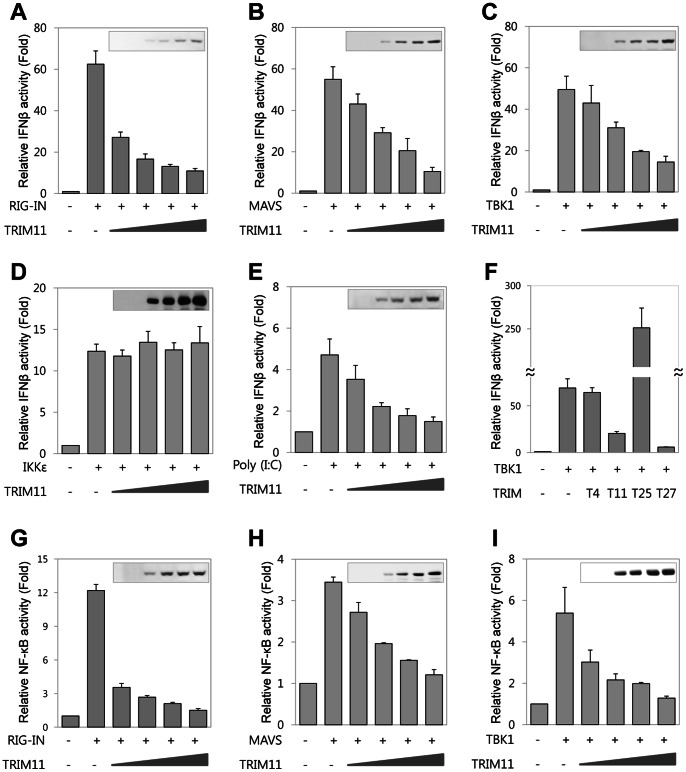
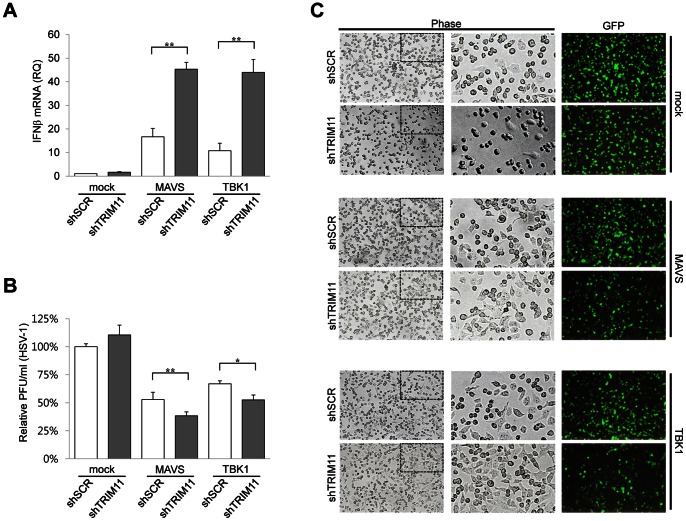
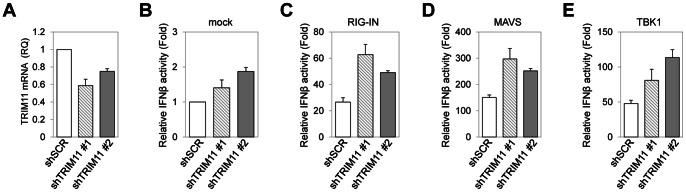
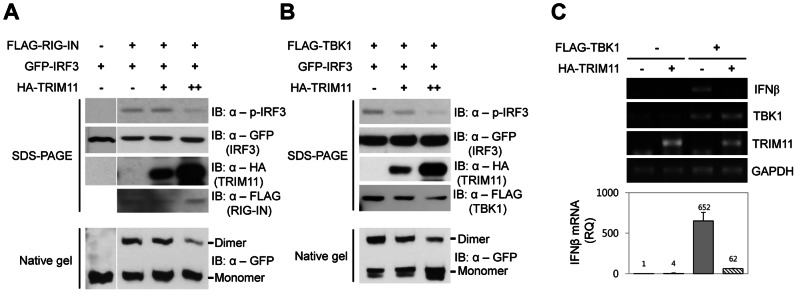
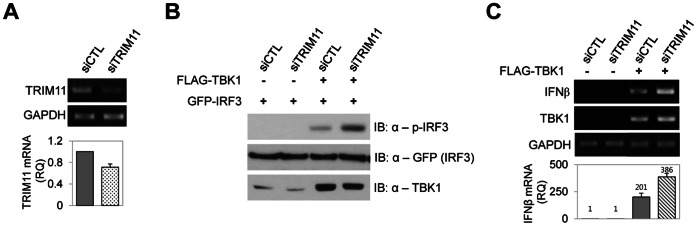
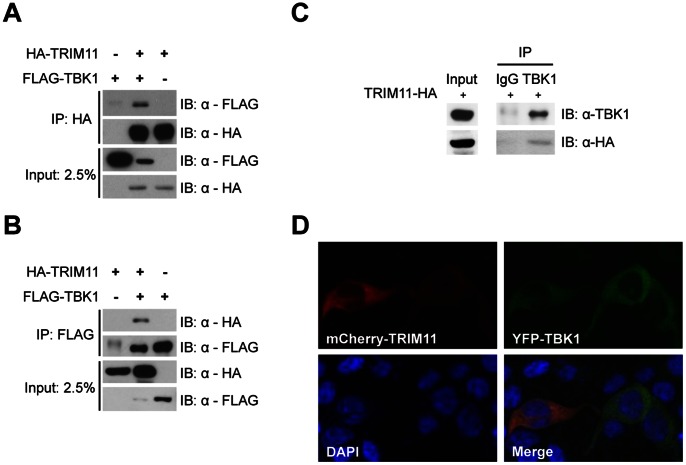
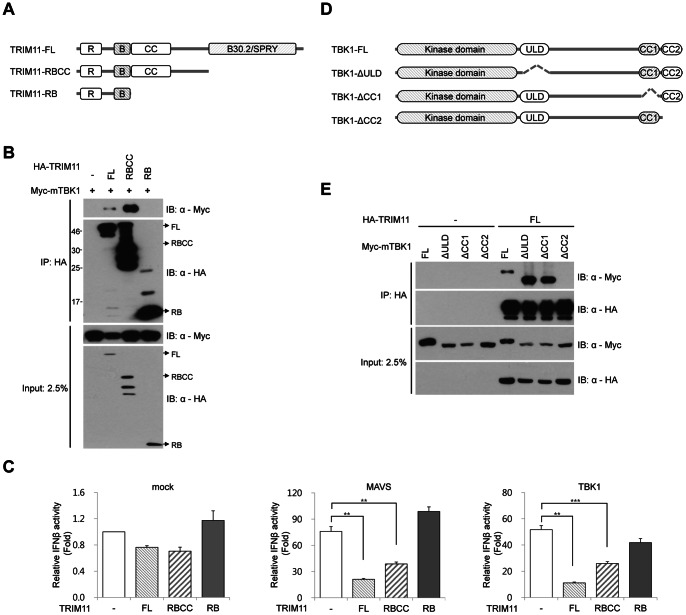
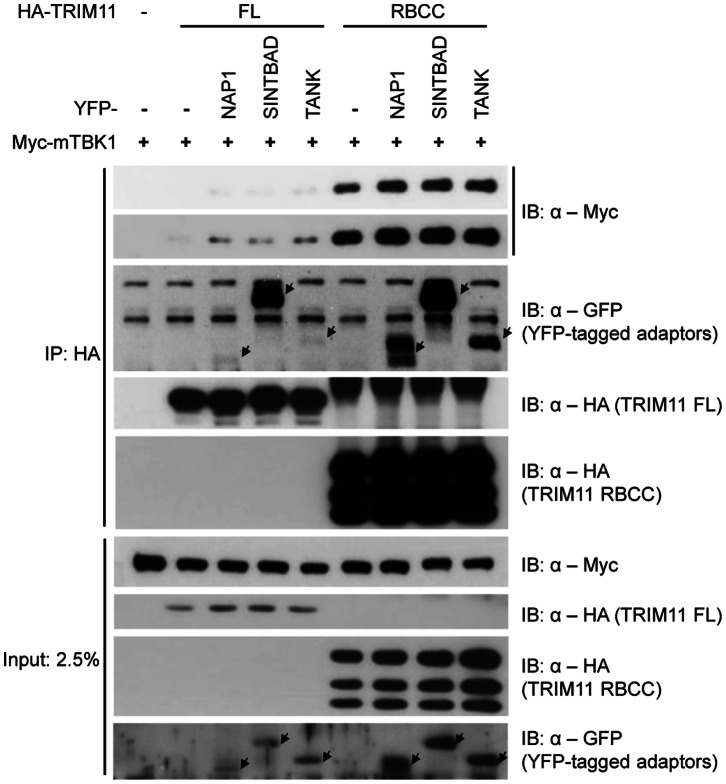
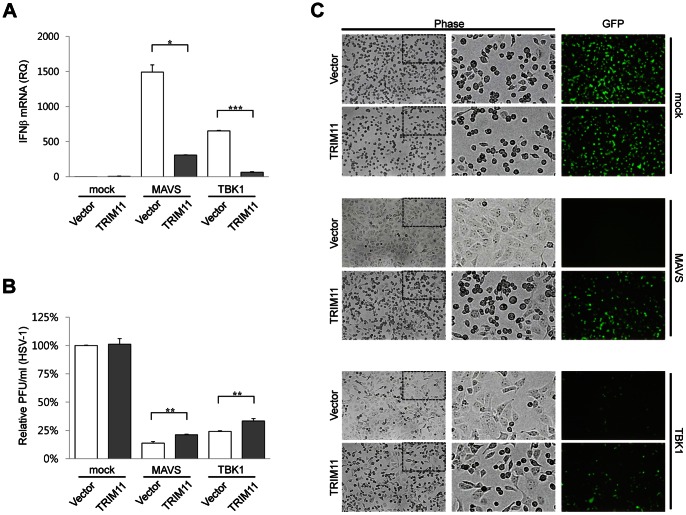
The innate immune response is a host defense mechanism against infection by viruses and bacteria. Type I interferons (IFNα/β) play a crucial role in innate immunity. If not tightly regulated under normal conditions and during immune responses, IFN production can become aberrant, leading to inflammatory and autoimmune diseases. In this study, we identified TRIM11 (tripartite motif containing 11) as a novel negative regulator of IFNβ production. Ectopic expression of TRIM11 decreased IFNβ promoter activity induced by poly (I:C) stimulation or overexpression of RIG-I (retinoic acid-inducible gene-I) signaling cascade components RIG-IN (constitutively active form of RIG-I), MAVS (mitochondrial antiviral signaling protein), or TBK1 (TANK-binding kinase-1). Conversely, TRIM11 knockdown enhanced IFNβ promoter activity induced by these stimuli. Moreover, TRIM11 overexpression inhibited the phosphorylation and dimerization of IRF3 and expression of IFNβ mRNA. By contrast, TRIM11 knockdown increased the IRF3 phosphorylation and IFNβ mRNA expression. We also found that TRIM11 and TBK1, a key kinase that phosphorylates IRF3 in the RIG-I pathway, interacted with each other through CC and CC2 domain, respectively. This interaction was enhanced in the presence of the TBK1 adaptor proteins, NAP1 (NF-κB activating kinase-associated protein-1), SINTBAD (similar to NAP1 TBK1 adaptor) or TANK (TRAF family member-associated NF-κB activator). Consistent with its inhibitory role in RIG-I-mediated IFNβ signaling, TRIM11 overexpression enhanced viral infectivity, whereas TRIM11 knockdown produced the opposite effect. Collectively, our results suggest that TRIM11 inhibits RIG-I-mediated IFNβ production by targeting the TBK1 signaling complex.
固有免疫反应是宿主防御病毒和细菌感染的机制。I 型干扰素(IFNα/β)在固有免疫中发挥关键作用。如果在正常条件下和免疫反应过程中没有得到严格调控,IFN 的产生可能会出现异常,导致炎症和自身免疫性疾病。在这项研究中,我们鉴定出 TRIM11(包含三部分基序的 11 号蛋白)是 IFNβ 产生的新型负调控因子。TRIM11 的异位表达降低了 Poly(I:C)刺激或 RIG-I(维甲酸诱导基因-I)信号级联成分 RIG-IN(RIG-I 的组成型激活形式)、MAVS(线粒体抗病毒信号蛋白)或 TBK1(TANK 结合激酶-1)过表达诱导的 IFNβ 启动子活性。相反,TRIM11 的敲低增强了这些刺激诱导的 IFNβ 启动子活性。此外,TRIM11 过表达抑制了 IRF3 的磷酸化和二聚化以及 IFNβ mRNA 的表达。相比之下,TRIM11 的敲低增加了 IRF3 的磷酸化和 IFNβ mRNA 的表达。我们还发现,TRIM11 和 TBK1,RIG-I 途径中磷酸化 IRF3 的关键激酶,通过 CC 和 CC2 结构域分别相互作用。在 TBK1 衔接蛋白 NAP1(NF-κB 激活激酶相关蛋白-1)、SINTBAD(类似于 NAP1 TBK1 衔接蛋白)或 TANK(TRAF 家族成员相关 NF-κB 激活剂)存在的情况下,这种相互作用增强。与它在 RIG-I 介导的 IFNβ 信号中的抑制作用一致,TRIM11 过表达增强了病毒感染力,而 TRIM11 敲低则产生了相反的效果。总之,我们的研究结果表明,TRIM11 通过靶向 TBK1 信号复合物抑制 RIG-I 介导的 IFNβ 产生。