Laboratory of Reproductive Biology, Institute of Biotechnology AS CR,v, v, i,, Videnska 1083, 142 20, Prague 4, Czech Republic.
Reprod Biol Endocrinol. 2013 May 15;11:42. doi: 10.1186/1477-7827-11-42.
High-throughput studies provide a wide spectrum of genes for use as predictive markers during testicular sperm extraction (TESE) in combination with ICSI. In this work, we used the specimens from testicular biopsies of men with non-obstructive azoospermia who underwent TESE to investigate the expression of spermatogenesis-related genes MND1, SPATA22, GAPDHS and ACR.
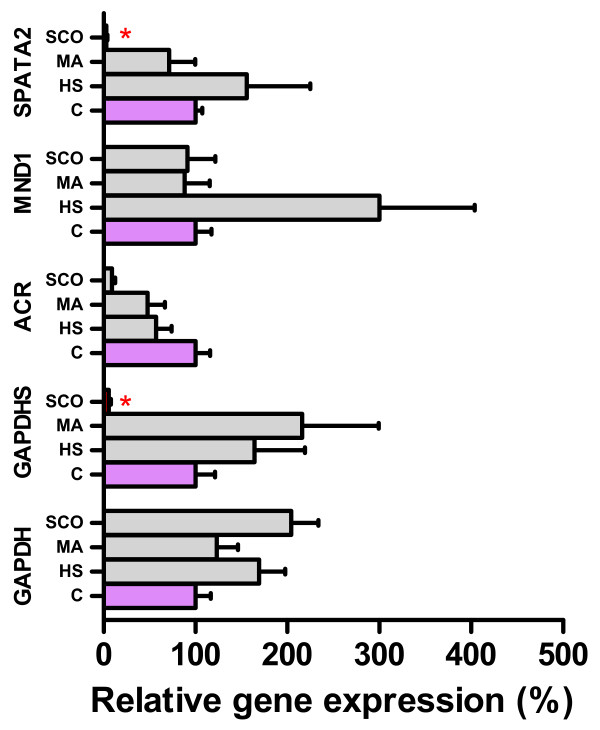
Testicular biopsy specimens were subdivided into three groups: hypospermatogenesis (HS); maturation arrest (MA); and Sertoli cell-only syndrome (SCO). The levels of expression of the spermatogenesis-related genes MND1, SPATA22, GAPDHS and ACR in the testes were compared among these three groups using the reverse transcription polymerase chain reaction (RT-PCR) technique.
Analysis of the expression of spermatogenic genes in human testes with abnormal spermatogenesis showed different expression patterns in patients from different groups. Fertilization rate for studied set of patients was 66% and pregnancy rate 29%. For HS group fertilization rate was 72% and pregnancy rate 32%, while for MA group fertilization and pregnancy rates were 54% and 26%, respectively. Fertilization rates in relation to the studied genes were uniformly around 70%, pregnancy rates for ACR and GAPDHS genes were surprisingly low at 6% and 8% correspondingly.
Analysis of the expression of genes involved in spermatogenesis can be a fast additional test for the level of spermatogenesis in testicular samples.
高通量研究为在 TESE 中结合 ICSI 使用提供了广泛的预测标记基因。在这项工作中,我们使用了非梗阻性无精子症患者睾丸活检标本,研究了与精子发生相关的基因 MND1、SPATA22、GAPDHS 和 ACR 的表达。
将睾丸活检标本分为三组:生精不良(HS);成熟阻滞(MA);和唯支持细胞综合征(SCO)。使用逆转录聚合酶链反应(RT-PCR)技术比较这三组睾丸中与精子发生相关基因 MND1、SPATA22、GAPDHS 和 ACR 的表达水平。
对具有异常精子发生的人类睾丸中精子发生基因的表达分析显示,不同组的患者表现出不同的表达模式。研究患者组的受精率为 66%,妊娠率为 29%。HS 组的受精率为 72%,妊娠率为 32%,而 MA 组的受精率和妊娠率分别为 54%和 26%。与研究基因相关的受精率均匀地约为 70%,ACR 和 GAPDHS 基因的妊娠率分别低至 6%和 8%。
分析参与精子发生的基因的表达可以作为睾丸样本中精子发生水平的快速附加测试。