Department of Emergency Medicine, University of Colorado School of Medicine, Denver, Colorado.
West J Emerg Med. 2013 May;14(3):247-52. doi: 10.5811/westjem.2012.2.6915.
To use Colorado's prescription drug monitoring program (PDMP) to describe the recent opioid prescription history of patients discharged from our emergency department (ED) with a prescription for opioid pain medications.
Retrospective cohort study of 300 adult ED patients who received an opioid prescription. We abstracted prescription histories for the six months prior to the ED visit from the PDMP, and abstracted clinical and demographic variables from the chart.
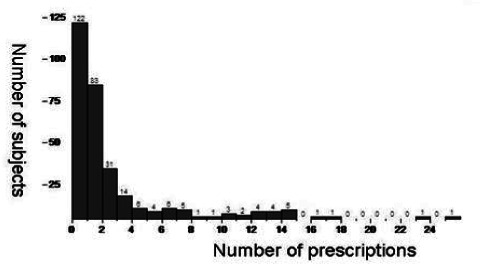
There were 5,379 ED visits during the study month, 3,732 of which were discharged. Providers wrote 1,165 prescriptions for opioid analgesics to 1,124/3,732 (30%) of the patients. Median age was 36 years. Thirty-nine percent were male. Patients were 46% Caucasian, 26% African American, 22% Hispanic, 2% Asian and 4% other. These were similar to our overall ED population. There was substantial variability in the number of prescriptions, prescribers and total number of pills. A majority (205/296) of patients had zero or one prescription. The 90th percentile for number of prescriptions was seven, while the 10th percentile was zero. Patients in the highest decile tended to be older, with a higher proportion of Caucasians and females. Patients in the lowest decile resembled the general ED population. The most common diagnoses associated with opioid prescriptions were abdominal pain (11.5%), cold/flu symptoms (9.5%), back pain (5.4%), flank pain (5.0%) and motor vehicle crash (4.7%).
Substantial variability exists in the opioid prescription histories of ED patients, but a majority received zero or one prescription in the preceding six months. The top decile of patients averaged more than two prescriptions per month over the six months prior to ED visit, written by more than 6 different prescribers. There was a trend toward these patients being older, Caucasian and female.
利用科罗拉多州的处方药物监测计划(PDMP)描述从我们的急诊部(ED)出院并开有阿片类止痛药处方的患者最近的阿片类药物处方史。
对 300 名接受阿片类药物处方的成年 ED 患者进行回顾性队列研究。我们从 PDMP 中提取了 ED 就诊前六个月的处方史,并从图表中提取了临床和人口统计学变量。
在研究月份期间有 5379 次 ED 就诊,其中 3732 次出院。医生为 1124/3732(30%)名患者开具了 1165 份阿片类镇痛药处方。中位年龄为 36 岁。39%为男性。患者 46%为白种人,26%为非裔美国人,22%为西班牙裔,2%为亚洲人,4%为其他族裔。这些与我们的整体 ED 人群相似。处方数量、医生和总药丸数量存在很大差异。大多数(205/296)患者有零个或一个处方。处方数量的第 90 个百分位数为 7,而第 10 个百分位数为 0。处于最高十分位数的患者往往年龄较大,白种人比例较高,女性比例较高。处于最低十分位数的患者与一般 ED 人群相似。与阿片类药物处方相关的最常见诊断是腹痛(11.5%)、感冒/流感症状(9.5%)、背痛(5.4%)、侧腹痛(5.0%)和机动车事故(4.7%)。
ED 患者的阿片类药物处方史存在很大差异,但大多数患者在过去六个月内接受了零个或一个处方。在 ED 就诊前六个月内,前十分位数的患者平均每月平均接受两个以上的处方,由 6 个以上不同的医生开具。这些患者往往年龄较大,白种人,女性。