Key Laboratory of Carcinogenesis and Translational Research Ministry of Education, Department of Hepato-Pancreato-Biliary Surgery, Peking University School of Oncology, Beijing Cancer Hospital & Institute, Beijing, People's Republic of China.
PLoS One. 2013 May 17;8(5):e62951. doi: 10.1371/journal.pone.0062951. Print 2013.
Considering the indication of adjuvant therapy, the recurrence risk for primary gastrointestinal stromal tumor (GIST) after surgery needs to be accurately estimated. However, current risk stratification schemes may still have room for improvement. This study seeks to analyze prognostic factors for primary GISTs from 3 aspects, including clinicopathological parameters, immunohistochemical biomarkers, and gene mutational status, and attempts to find novel valuable factors predicting the malignancy potential of GISTs.
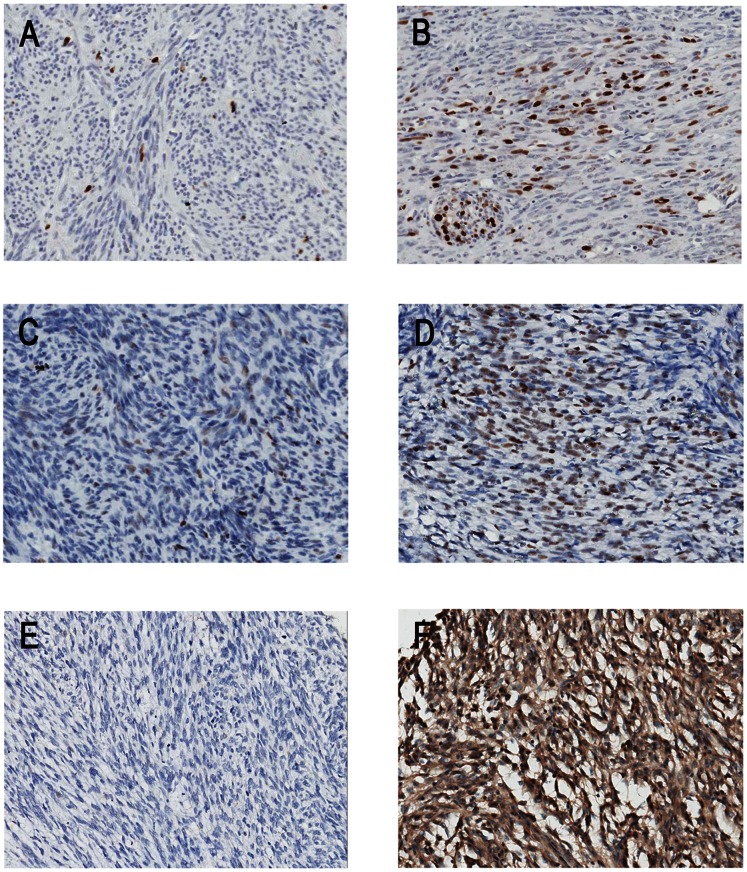
Retrospective data from 114 primary GIST patients after R0 resection were collected. Clinicopathological data was obtained from medical records and re-evaluated. Immunohistochemical analysis was performed using the Tissue Microarray method for Ki67, p16, p27, p53, SKP2, CD133, and actin. KIT gene exons 9, 11, 13, and 17 and PDGFRα gene exons 12 and 18 were tested for mutations using PCR.
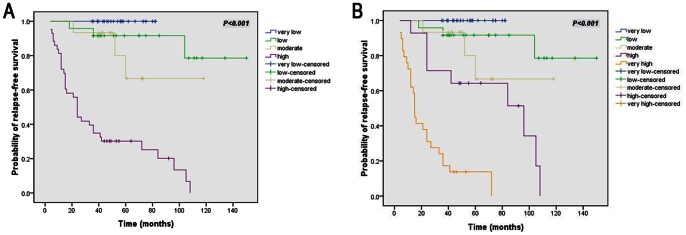
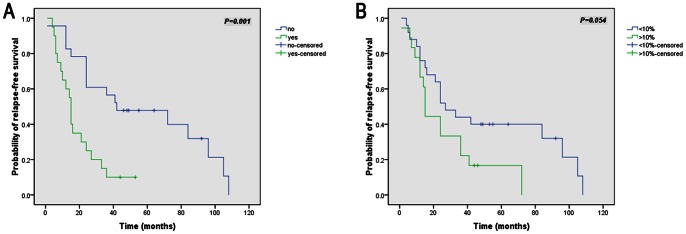
Univariate analysis revealed the following factors as poor prognostic indicators for relapse-free survival with a median follow-up of 50 months: male gender, gastrointestinal bleeding, mitotic index >5/50HPFs, tumor size >5 cm, non-gastric site, necrosis, epithelioid or mixed cell type, surrounding tissue invasion, Ki67>5%, p16>20%, p53 index >10, SKP2>10%, and KIT exon 11 deletion. Besides mitotic index, tumor size and site, SKP2 high expression (RR = 2.91, 95% CI: 1.41-5.99, P = 0.004) and KIT exon 11 deletion (RR = 2.73, 95% CI: 1.04-7.16, P = 0.041) were also independent risk factors in multivariate analysis, with gastrointestinal bleeding also showing a trend towards significance (RR = 1.88, 95% CI: 0.98-3.64, P = 0.059). In addition, gastrointestinal bleeding and SKP2 high expression showed a good ability to stratify high-risk patients further.
Our results show that gastrointestinal bleeding, SKP2 high expression, and KIT exon 11 deletions may be useful indicators of high recurrence risk for primary GIST patients.
考虑到辅助治疗的适应证,原发性胃肠道间质瘤(GIST)手术后的复发风险需要准确评估。然而,目前的风险分层方案可能仍有改进的空间。本研究从临床病理参数、免疫组织化学生物标志物和基因突变状态三个方面分析原发性 GIST 的预后因素,试图寻找新的有价值的预测 GIST 恶性潜能的因素。
收集了 114 例接受 R0 切除的原发性 GIST 患者的回顾性数据。从病历中获取临床病理数据并重新评估。采用组织微阵列法对 Ki67、p16、p27、p53、SKP2、CD133 和肌动蛋白进行免疫组织化学分析。使用 PCR 检测 KIT 基因外显子 9、11、13 和 17 和 PDGFRα 基因外显子 12 和 18 的突变。
单因素分析显示,以下因素是无复发生存率的不良预后指标,中位随访时间为 50 个月:男性、胃肠道出血、有丝分裂指数>5/50HPFs、肿瘤大小>5cm、非胃部位、坏死、上皮样或混合细胞类型、周围组织浸润、Ki67>5%、p16>20%、p53 指数>10%、SKP2>10%和 KIT 外显子 11 缺失。除有丝分裂指数、肿瘤大小和部位外,SKP2 高表达(RR=2.91,95%CI:1.41-5.99,P=0.004)和 KIT 外显子 11 缺失(RR=2.73,95%CI:1.04-7.16,P=0.041)也是多因素分析中的独立危险因素,胃肠道出血也有显著趋势(RR=1.88,95%CI:0.98-3.64,P=0.059)。此外,胃肠道出血和 SKP2 高表达显示出进一步分层高危患者的良好能力。
我们的结果表明,胃肠道出血、SKP2 高表达和 KIT 外显子 11 缺失可能是原发性 GIST 患者复发风险高的有用指标。