Wang Hao, Chen Ping, Liu Xin-Xin, Zhao Wei, Shi Lei, Gu Xue-Wen, Zhu Chang-Ren, Zhu Hai-Hang, Zong Liang
Department of Gastrointestinal Surgery, Clinical Medical College of Yangzhou University, No, 98, Nan-Tong West Road, Yangzhou, Jiangsu 225001, P,R, China.
World J Surg Oncol. 2014 Apr 9;12:89. doi: 10.1186/1477-7819-12-89.
Prognostic indicators for gastrointestinal stromal tumors (GISTs) are under investigation. The latest risk classification criteria may still have room for improvement. This study aims to investigate prognostic factors for primary GISTs from three aspects, including clinicopathological parameters, immunohistochemical (IHC) expression of PTEN, and Ki-67 labeling index (LI), and attempts to find valuable predictors for the malignancy potential of primary GISTs.
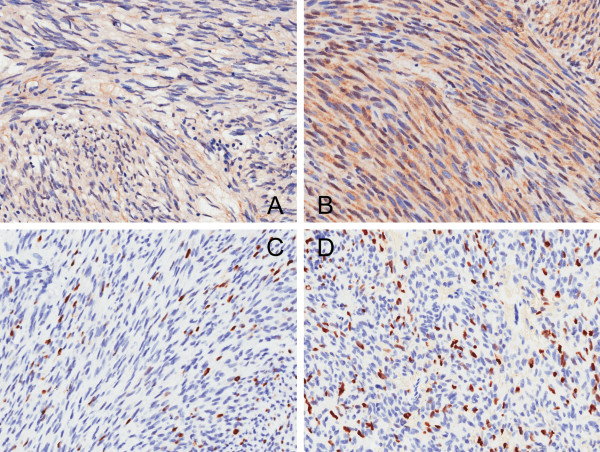
Tumor samples and clinicopathological data from 84 patients with primary GISTs after R0 resection were obtained. Immunohistochemical analysis was performed based on tissue microarray (TMA) to estimate expression of PTEN and Ki-67 in tumor cells.
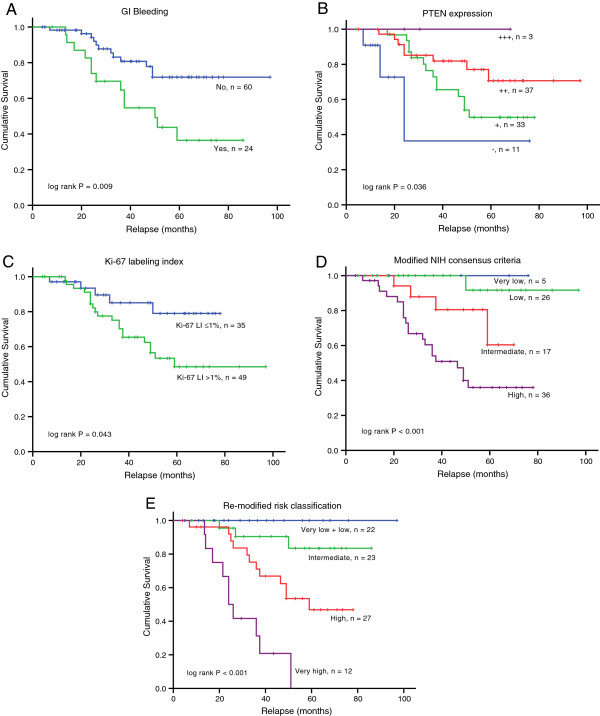
The cut-off point of Ki-67 LI was determined as 1%, using a receiver operator characteristic test with a sensitivity of 71.7% and a specificity of 64.5%. Univariate analysis demonstrated the following factors as poor prognostic indicators for relapse-free survival (RFS) against a median follow-up of 40.25 months: gastrointestinal (GI) bleeding (P = 0.009), non-gastric tumor location (P = 0.001), large tumor size (P = 0.022), high mitotic index (P < 0.001), high cellularity (P = 0.012), tumor rupture (P = 0.013), absent or low expression of PTEN (P = 0.036), and Ki-67 LI >1% (P = 0.043). Gastrointestinal bleeding (hazard ratio, 3.85; 95% confidence interval, 1.63 to 9.10; P = 0.002) was a negative independent risk predictor in multivariate analysis, in addition to tumor size (P = 0.023), and mitotic index (P = 0.002). In addition, GI bleeding showed a good ability to predict recurrence potential, when included in our re-modified risk stratification criteria.
This study suggests that GI bleeding is an independent predictor of poor prognosis for RFS in primary GISTs. Expression of PTEN and Ki-67 are correlated with high risk potential and may predict early recurrence in univariate analysis.
胃肠道间质瘤(GISTs)的预后指标正在研究中。最新的风险分类标准可能仍有改进空间。本研究旨在从临床病理参数、PTEN的免疫组化(IHC)表达和Ki-67标记指数(LI)三个方面研究原发性GISTs的预后因素,并试图找到原发性GISTs恶性潜能的有价值预测指标。
获取84例R0切除术后原发性GISTs患者的肿瘤样本和临床病理数据。基于组织芯片(TMA)进行免疫组化分析,以评估肿瘤细胞中PTEN和Ki-67的表达。
通过受试者工作特征曲线分析,确定Ki-67 LI的截断点为1%,其灵敏度为71.7%,特异性为64.5%。单因素分析显示,在中位随访40.25个月的无复发生存期(RFS)中,以下因素为不良预后指标:胃肠道(GI)出血(P = 0.009)、非胃肿瘤位置(P = 0.001)、肿瘤体积大(P = 0.022)、高有丝分裂指数(P < 0.001)、高细胞密度(P = 0.012)、肿瘤破裂(P = 0.013)、PTEN缺失或低表达(P = 0.036)以及Ki-67 LI >1%(P = 0.043)。多因素分析显示,除肿瘤大小(P = 0.023)和有丝分裂指数(P = 0.002)外,胃肠道出血(风险比,3.85;95%置信区间,1.63至9.10;P = 0.002)是独立的负性风险预测指标。此外,当纳入我们重新修订的风险分层标准时,胃肠道出血显示出良好的预测复发潜能的能力。
本研究表明,胃肠道出血是原发性GISTs无复发生存期预后不良的独立预测指标。PTEN和Ki-67的表达与高风险潜能相关,在单因素分析中可能预测早期复发。