Laboratory of Entomology, Wageningen University and Research Center, EH Wageningen, The Netherlands.
PLoS One. 2013 May 15;8(5):e63602. doi: 10.1371/journal.pone.0063602. Print 2013.
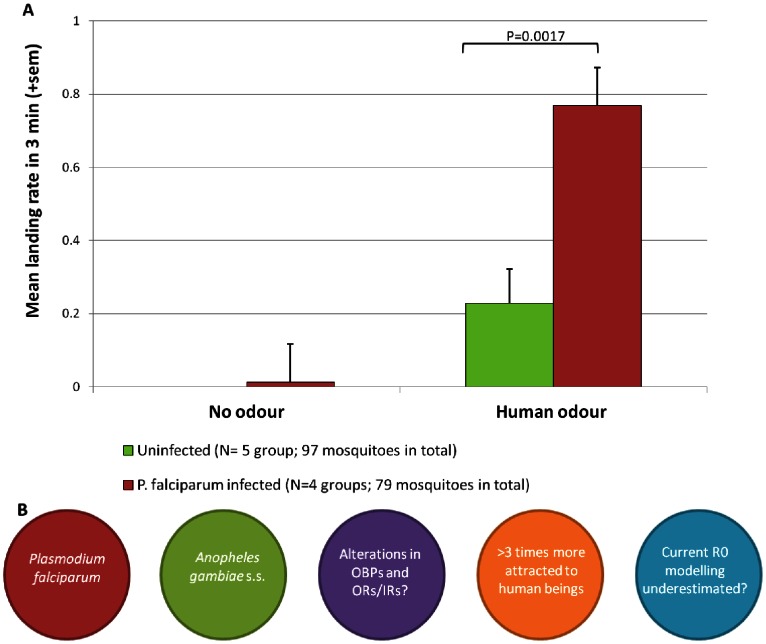
There is much evidence that some pathogens manipulate the behaviour of their mosquito hosts to enhance pathogen transmission. However, it is unknown whether this phenomenon exists in the interaction of Anopheles gambiae sensu stricto with the malaria parasite, Plasmodium falciparum--one of the most important interactions in the context of humanity, with malaria causing over 200 million human cases and over 770 thousand deaths each year. Here we demonstrate, for the first time, that infection with P. falciparum causes alterations in behavioural responses to host-derived olfactory stimuli in host-seeking female An. gambiae s.s. mosquitoes. In behavioural experiments we showed that P. falciparum-infected An. gambiae mosquitoes were significantly more attracted to human odors than uninfected mosquitoes. Both P. falciparum-infected and uninfected mosquitoes landed significantly more on a substrate emanating human skin odor compared to a clean substrate. However, significantly more infected mosquitoes landed and probed on a substrate emanating human skin odor than uninfected mosquitoes. This is the first demonstration of a change of An. gambiae behaviour in response to olfactory stimuli caused by infection with P. falciparum. The results of our study provide vital information that could be used to provide better predictions of how malaria is transmitted from human being to human being by An. gambiae s.s. females. Additionally, it highlights the urgent need to investigate this interaction further to determine the olfactory mechanisms that underlie the differential behavioural responses. In doing so, new attractive compounds could be identified which could be used to develop improved mosquito traps for surveillance or trapping programmes that may even specifically target P. falciparum-infected An. gambiae s.s. females.
有大量证据表明,一些病原体操纵其蚊子宿主的行为,以增强病原体的传播。然而,目前尚不清楚这种现象是否存在于冈比亚按蚊与疟原虫(恶性疟原虫)的相互作用中——在人类背景下,这是最重要的相互作用之一,疟疾每年导致超过 2 亿例人类病例和超过 77 万例死亡。在这里,我们首次证明,感染恶性疟原虫会导致在寻找宿主的雌性冈比亚按蚊中对宿主来源的嗅觉刺激的行为反应发生改变。在行为实验中,我们表明,感染恶性疟原虫的冈比亚按蚊比未感染的蚊子更能被人类气味吸引。与干净的基质相比,感染和未感染恶性疟原虫的蚊子在散发人皮肤气味的基质上降落的次数明显更多。然而,与未感染的蚊子相比,感染的蚊子在散发人皮肤气味的基质上降落和探测的次数明显更多。这是首次证明感染恶性疟原虫会导致冈比亚按蚊对嗅觉刺激的行为发生变化。我们的研究结果提供了重要的信息,可以更好地预测冈比亚按蚊雌性是如何将疟疾从人类传播到人类的。此外,这突显了进一步研究这种相互作用的迫切需要,以确定导致不同行为反应的嗅觉机制。在这样做的过程中,可以识别出新的有吸引力的化合物,这些化合物可以用于开发改进的诱蚊陷阱,用于监测或诱捕计划,甚至可以专门针对感染恶性疟原虫的冈比亚按蚊雌性。