Almangush Alhadi, Bello Ibrahim O, Keski-Säntti Harri, Mäkinen Laura K, Kauppila Joonas H, Pukkila Matti, Hagström Jaana, Laranne Jussi, Tommola Satu, Nieminen Outi, Soini Ylermi, Kosma Veli-Matti, Koivunen Petri, Grénman Reidar, Leivo Ilmo, Salo Tuula
Department of Pathology, Haartman Institute, University of Helsinki, Helsinki, Finland.
Head Neck. 2014 Jun;36(6):811-8. doi: 10.1002/hed.23380. Epub 2013 Sep 2.
Oral (mobile) tongue squamous cell carcinoma (SCC) is characterized by a highly variable prognosis in early-stage disease (T1/T2 N0M0). The ability to classify early oral tongue SCCs into low-risk and high-risk categories would represent a major advancement in their management.
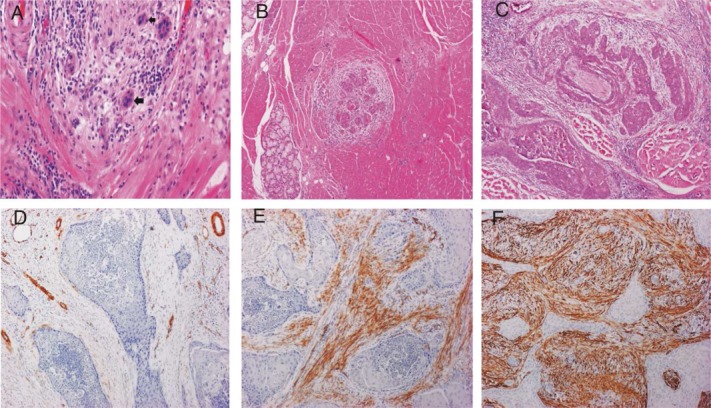
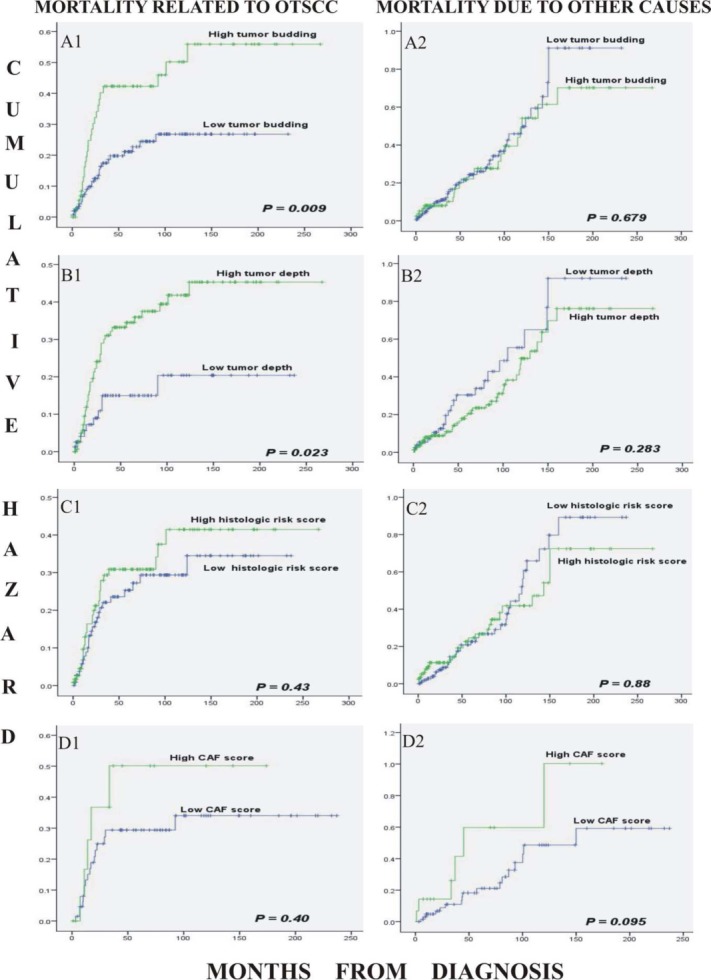
Depth of invasion, tumor budding, histologic risk-assessment score (HRS), and cancer-associated fibroblast (CAF) density were studied in 233 cases of T1/T2 N0M0 oral tongue SCC managed in 5 university hospitals in Finland.
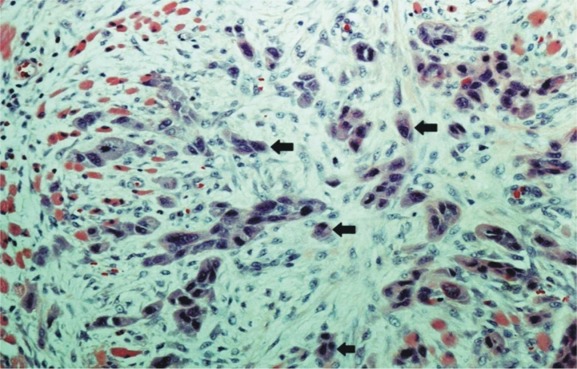
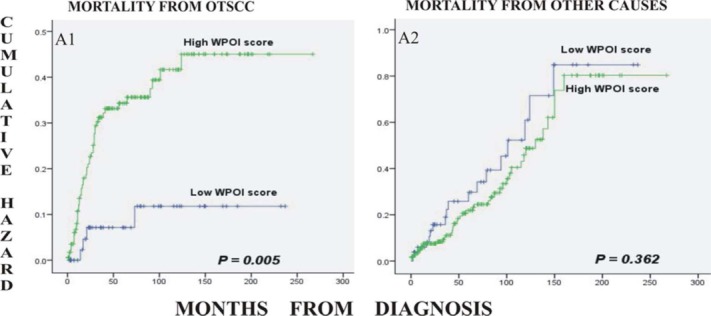
Tumor budding (≥5 clusters at the invasive front of the tumor) and depth of invasion (≥4 mm) were associated with poor prognosis in patients with early oral tongue SCC (hazard ratio [HR], 2.04; 95% confidence interval [CI], 1.17-3.55; HR, 2.55; 95% CI, 1.25-5.20, respectively) after multivariate analysis. The HRS and CAF density did not predict survival. However, high-risk worst pattern of invasion (WPOI), a component of HRS, was also an independent prognostic factor (HR, 4.47; 95% CI, 1.59-12.51).
Analyzing the depth of invasion, tumor budding, and/or WPOI in prognostication and treatment planning of T1/T2 N0M0 oral tongue SCC is recommended.
口腔(活动期)舌鳞状细胞癌(SCC)在疾病早期(T1/T2 N0M0)预后差异很大。将早期口腔舌SCC分为低风险和高风险类别,这在其治疗方面将是一项重大进展。
对芬兰5所大学医院收治的233例T1/T2 N0M0口腔舌SCC病例,研究其浸润深度、肿瘤芽生、组织学风险评估评分(HRS)和癌症相关成纤维细胞(CAF)密度。
多因素分析后,肿瘤芽生(肿瘤浸润前沿≥5个簇)和浸润深度(≥4mm)与早期口腔舌SCC患者预后不良相关(风险比[HR]分别为2.04;95%置信区间[CI]为1.17 - 3.55;HR为2.55;95%CI为1.25 - 5.20)。HRS和CAF密度不能预测生存。然而,HRS的一个组成部分——高风险最差浸润模式(WPOI)也是一个独立的预后因素(HR为4.47;95%CI为1.59 - 12.51)。
建议在T1/T2 N0M0口腔舌SCC的预后评估和治疗计划中分析浸润深度、肿瘤芽生和/或WPOI。