• 文献检索
  • 文档翻译
  • 深度研究
  • 学术资讯
  • Suppr Zotero 插件Zotero 插件
  • 邀请有礼
  • 套餐&价格
  • 历史记录
应用&插件
Suppr Zotero 插件Zotero 插件浏览器插件Mac 客户端Windows 客户端微信小程序
定价
高级版会员购买积分包购买API积分包
服务
文献检索文档翻译深度研究API 文档MCP 服务
关于我们
关于 Suppr公司介绍联系我们用户协议隐私条款
关注我们

Suppr 超能文献

核心技术专利:CN118964589B侵权必究
粤ICP备2023148730 号-1Suppr @ 2026

文献检索

告别复杂PubMed语法,用中文像聊天一样搜索,搜遍4000万医学文献。AI智能推荐,让科研检索更轻松。

立即免费搜索

文件翻译

保留排版,准确专业,支持PDF/Word/PPT等文件格式,支持 12+语言互译。

免费翻译文档

深度研究

AI帮你快速写综述,25分钟生成高质量综述,智能提取关键信息,辅助科研写作。

立即免费体验

利用全球定位系统数据开发时间-地点加权空间测量方法

Development of Time-location Weighted Spatial Measures Using Global Positioning System Data.

作者信息

Han Daikwon, Lee Kiyoung, Kim Jongyun, Bennett Deborah H, Cassady Diana, Hertz-Picciotto Irva

机构信息

Department of Epidemiology and Biostatistics, Texas A&M School of Rural Public Health, College Station, TX, USA.

出版信息

Environ Health Toxicol. 2013 May 7;28:e2013005. doi: 10.5620/eht.2013.28.e2013005. Print 2013.

DOI:10.5620/eht.2013.28.e2013005
PMID:23700565
原文链接:https://pmc.ncbi.nlm.nih.gov/articles/PMC3657713/
Abstract

OBJECTIVES

Despite increasing availability of global positioning system (GPS), no research has been conducted to analyze GPS data for exposure opportunities associated with time at indoor and outdoor microenvironments. We developed location-based and time-weighted spatial measures that incorporate indoor and outdoor time-location data collected by GPS.

METHODS

Time-location data were drawn from 38 female subjects in California who wore a GPS device for seven days. Ambient standard deviational ellipse was determined based on outdoor locations and time duration, while indoor time weighted standard deviational ellipse (SDE) was developed to incorporate indoor and outdoor times and locations data into the ellipse measure.

RESULTS

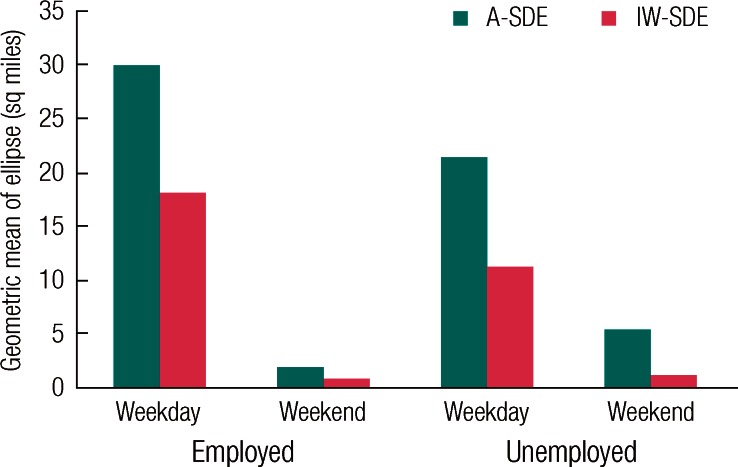
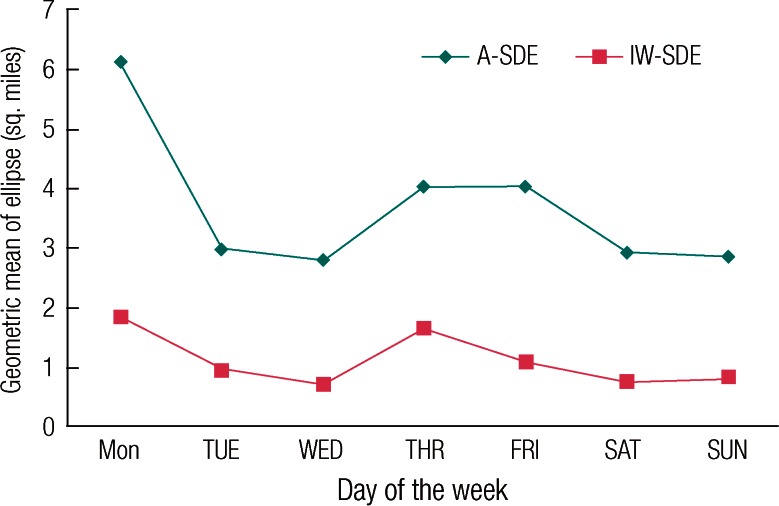
Our findings indicated that there was considerable difference in the sizes of exposure potential measures when indoor time was taken into consideration, and that they were associated with day type (weekday/weekend) and employment status.

CONCLUSIONS

This study provides evidence that time-location weighted measure may provide better accuracy in assessing exposure opportunities at different microenvironments. The use of GPS likely improves the geographical details and accuracy of time-location data, and further development of such location-time weighted spatial measure is encouraged.

摘要

目的

尽管全球定位系统(GPS)的可用性不断提高,但尚未开展研究来分析与室内和室外微环境中的时间相关的暴露机会的GPS数据。我们开发了基于位置和时间加权的空间测量方法,该方法纳入了由GPS收集的室内和室外时间-位置数据。

方法

时间-位置数据来自加利福尼亚州的38名女性受试者,她们佩戴GPS设备达7天。基于室外位置和持续时间确定环境标准偏差椭圆,同时开发了室内时间加权标准偏差椭圆(SDE),以便将室内和室外时间及位置数据纳入椭圆测量。

结果

我们的研究结果表明,考虑室内时间时,暴露潜在测量的大小存在显著差异,并且它们与日类型(工作日/周末)和就业状况相关。

结论

本研究提供了证据,表明时间-位置加权测量在评估不同微环境中的暴露机会时可能提供更高的准确性。GPS的使用可能会改善时间-位置数据的地理细节和准确性,鼓励进一步开发这种位置-时间加权空间测量方法。
https://cdn.ncbi.nlm.nih.gov/pmc/blobs/57c0/3657713/8f59828b58bd/eht-28-e2013005-g002.jpg
https://cdn.ncbi.nlm.nih.gov/pmc/blobs/57c0/3657713/70cda7bcf6cd/eht-28-e2013005-g001.jpg
https://cdn.ncbi.nlm.nih.gov/pmc/blobs/57c0/3657713/8f59828b58bd/eht-28-e2013005-g002.jpg
https://cdn.ncbi.nlm.nih.gov/pmc/blobs/57c0/3657713/70cda7bcf6cd/eht-28-e2013005-g001.jpg
https://cdn.ncbi.nlm.nih.gov/pmc/blobs/57c0/3657713/8f59828b58bd/eht-28-e2013005-g002.jpg

相似文献

1
Development of Time-location Weighted Spatial Measures Using Global Positioning System Data.利用全球定位系统数据开发时间-地点加权空间测量方法
Environ Health Toxicol. 2013 May 7;28:e2013005. doi: 10.5620/eht.2013.28.e2013005. Print 2013.
2
Classification of indoor-outdoor location using combined global positioning system (GPS) and temperature data for personal exposure assessment.利用全球定位系统 (GPS) 和温度数据进行室内外位置分类,用于个人暴露评估。
Environ Health Prev Med. 2017 Apr 4;22(1):29. doi: 10.1186/s12199-017-0637-4.
3
Performances of different global positioning system devices for time-location tracking in air pollution epidemiological studies.不同全球定位系统设备在空气污染流行病学研究中进行时间-位置跟踪的性能。
Environ Health Insights. 2010 Nov 23;4:93-108. doi: 10.4137/EHI.S6246.
4
Automated time activity classification based on global positioning system (GPS) tracking data.基于全球定位系统 (GPS) 跟踪数据的自动时间活动分类。
Environ Health. 2011 Nov 14;10:101. doi: 10.1186/1476-069X-10-101.
5
Refining Time-Activity Classification of Human Subjects Using the Global Positioning System.利用全球定位系统优化人类受试者的时间-活动分类
PLoS One. 2016 Feb 26;11(2):e0148875. doi: 10.1371/journal.pone.0148875. eCollection 2016.
6
Comparing the Data Quality of Global Positioning System Devices and Mobile Phones for Assessing Relationships Between Place, Mobility, and Health: Field Study.比较全球定位系统设备和手机在评估地点、移动性与健康之间关系时的数据质量:实地研究。
JMIR Mhealth Uhealth. 2018 Aug 13;6(8):e168. doi: 10.2196/mhealth.9771.
7
Applying indoor and outdoor modeling techniques to estimate individual exposure to PM2.5 from personal GPS profiles and diaries: a pilot study.应用室内和室外建模技术,根据个人全球定位系统(GPS)数据和日记估计个体对细颗粒物(PM2.5)的暴露:一项试点研究。
Sci Total Environ. 2009 Sep 1;407(18):5184-93. doi: 10.1016/j.scitotenv.2009.06.006. Epub 2009 Jul 5.
8
Indoor versus outdoor time in preschoolers at child care.幼儿在日托中心的室内与室外时间。
Am J Prev Med. 2013 Jan;44(1):85-8. doi: 10.1016/j.amepre.2012.09.052.
9
Evaluating heterogeneity in indoor and outdoor air pollution using land-use regression and constrained factor analysis.利用土地利用回归和约束因子分析评估室内和室外空气污染的异质性。
Res Rep Health Eff Inst. 2010 Dec(152):5-80; discussion 81-91.
10
Personal and ambient exposures to air toxics in Camden, New Jersey.新泽西州卡姆登市个人及周围环境中的空气有毒物质暴露情况。
Res Rep Health Eff Inst. 2011 Aug(160):3-127; discussion 129-51.

引用本文的文献

1
Comparing the Data Quality of Global Positioning System Devices and Mobile Phones for Assessing Relationships Between Place, Mobility, and Health: Field Study.比较全球定位系统设备和手机在评估地点、移动性与健康之间关系时的数据质量:实地研究。
JMIR Mhealth Uhealth. 2018 Aug 13;6(8):e168. doi: 10.2196/mhealth.9771.

本文引用的文献

1
A new analytical method for the classification of time-location data obtained from the global positioning system (GPS).一种用于对从全球定位系统(GPS)获取的时间-位置数据进行分类的新分析方法。
J Environ Monit. 2012 Aug;14(8):2270-4. doi: 10.1039/c2em30190c. Epub 2012 Jun 27.
2
Automated time activity classification based on global positioning system (GPS) tracking data.基于全球定位系统 (GPS) 跟踪数据的自动时间活动分类。
Environ Health. 2011 Nov 14;10:101. doi: 10.1186/1476-069X-10-101.
3
Using global positioning systems in health research: a practical approach to data collection and processing.
利用全球定位系统进行健康研究:数据收集和处理的实用方法。
Am J Prev Med. 2011 Nov;41(5):532-40. doi: 10.1016/j.amepre.2011.07.017.
4
Use of global positioning systems to study physical activity and the environment: a systematic review.使用全球定位系统研究身体活动和环境:系统评价。
Am J Prev Med. 2011 Nov;41(5):508-15. doi: 10.1016/j.amepre.2011.06.046.
5
Study of Use of Products and Exposure-Related Behaviors (SUPERB): study design, methods, and demographic characteristics of cohorts.产品使用和暴露相关行为研究(SUPERB):研究设计、方法以及队列的人口统计学特征。
Environ Health. 2010 Aug 29;9:54. doi: 10.1186/1476-069X-9-54.
6
Patterns of GPS measured time outdoors after school and objective physical activity in English children: the PEACH project.英国儿童放学后使用 GPS 测量的室外时间和客观体力活动模式:PEACH 项目。
Int J Behav Nutr Phys Act. 2010 Apr 22;7:31. doi: 10.1186/1479-5868-7-31.
7
Usefulness of commercially available GPS data-loggers for tracking human movement and exposure to dengue virus.利用市售 GPS 数据记录器追踪人类活动和登革热病毒暴露的实用性。
Int J Health Geogr. 2009 Nov 30;8:68. doi: 10.1186/1476-072X-8-68.
8
Development of a wearable global positioning system for place and health research.用于场所与健康研究的可穿戴式全球定位系统的开发。
Int J Health Geogr. 2008 Nov 25;7:59. doi: 10.1186/1476-072X-7-59.
9
Using GPS-enabled cell phones to track the travel patterns of adolescents.使用具备全球定位系统功能的手机追踪青少年的出行模式。
Int J Health Geogr. 2008 May 21;7:22. doi: 10.1186/1476-072X-7-22.
10
Time-activity patterns of pregnant women and changes during the course of pregnancy.孕妇的时间-活动模式及孕期变化。
J Expo Sci Environ Epidemiol. 2009 Mar;19(3):317-24. doi: 10.1038/jes.2008.24. Epub 2008 May 14.