Wu Jun, Jiang Chengsheng, Liu Zhen, Houston Douglas, Jaimes Guillermo, McConnell Rob
Program in Public Health, College of Health Sciences, University of California, Irvine, USA.
Environ Health Insights. 2010 Nov 23;4:93-108. doi: 10.4137/EHI.S6246.
People's time-location patterns are important in air pollution exposure assessment because pollution levels may vary considerably by location. A growing number of studies are using global positioning systems (GPS) to track people's time-location patterns. Many portable GPS units that archive location are commercially available at a cost that makes their use feasible for epidemiological studies.
We evaluated the performance of five portable GPS data loggers and two GPS cell phones by examining positional accuracy in typical locations (indoor, outdoor, in-vehicle) and factors that influence satellite reception (building material, building type), acquisition time (cold and warm start), battery life, and adequacy of memory for data storage. We examined stationary locations (eg, indoor, outdoor) and mobile environments (eg, walking, traveling by vehicle or bus) and compared GPS locations to highly-resolved US Geological Survey (USGS) and Digital Orthophoto Quarter Quadrangle (DOQQ) maps.
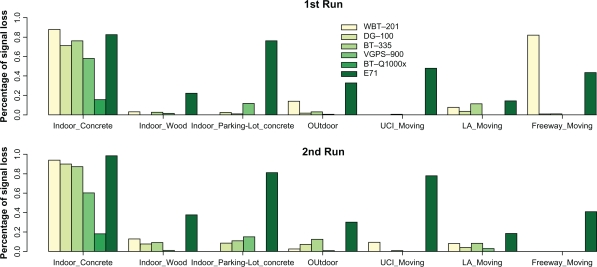
The battery life of our tested instruments ranged from <9 hours to 48 hours. The acquisition of location time after startup ranged from a few seconds to >20 minutes and varied significantly by building structure type and by cold or warm start. No GPS device was found to have consistently superior performance with regard to spatial accuracy and signal loss. At fixed outdoor locations, 65%-95% of GPS points fell within 20-m of the corresponding DOQQ locations for all the devices. At fixed indoor locations, 50%-80% of GPS points fell within 20-m of the corresponding DOQQ locations for all the devices except one. Most of the GPS devices performed well during commuting on a freeway, with >80% of points within 10-m of the DOQQ route, but the performance was significantly impacted by surrounding structures on surface streets in highly urbanized areas.
All the tested GPS devices had limitations, but we identified several devices which showed promising performance for tracking subjects' time location patterns in epidemiological studies.
人们的时间-地点模式在空气污染暴露评估中很重要,因为不同地点的污染水平可能有很大差异。越来越多的研究使用全球定位系统(GPS)来追踪人们的时间-地点模式。许多可存档位置的便携式GPS设备在市场上有售,其成本使得它们可用于流行病学研究。
我们通过检查在典型地点(室内、室外、车内)的定位精度以及影响卫星接收的因素(建筑材料、建筑类型)、获取时间(冷启动和热启动)、电池寿命和数据存储内存的充足性,评估了五款便携式GPS数据记录器和两款GPS手机的性能。我们考察了固定地点(如室内、室外)和移动环境(如步行、乘车或乘公交出行),并将GPS定位与高分辨率的美国地质调查局(USGS)地图和数字正射影像四分之一平方英里图(DOQQ)进行比较。
我们测试的仪器的电池寿命从不到9小时到48小时不等。启动后获取位置的时间从几秒到超过20分钟不等,并且因建筑结构类型以及冷启动或热启动而有显著差异。在空间精度和信号丢失方面,没有发现哪款GPS设备始终具有卓越性能。在固定的室外地点,所有设备65% - 95%的GPS定位点落在相应DOQQ位置的20米范围内。在固定的室内地点,除一款设备外,所有设备50% - 80%的GPS定位点落在相应DOQQ位置的20米范围内。大多数GPS设备在高速公路通勤期间表现良好,超过80%的定位点落在DOQQ路线的10米范围内,但在高度城市化地区的地面街道上,其性能受到周围建筑的显著影响。
所有测试的GPS设备都有局限性,但我们确定了几款在流行病学研究中追踪受试者时间-地点模式方面表现出良好前景的设备。